


Roof Ventilation 101: Why It Matters for Your Home
What Is Roof Ventilation and Why Does It Matter for Your Home?
How roof ventilation works and why it matters comes down to one simple idea: your attic needs to breathe. Here’s a quick breakdown:
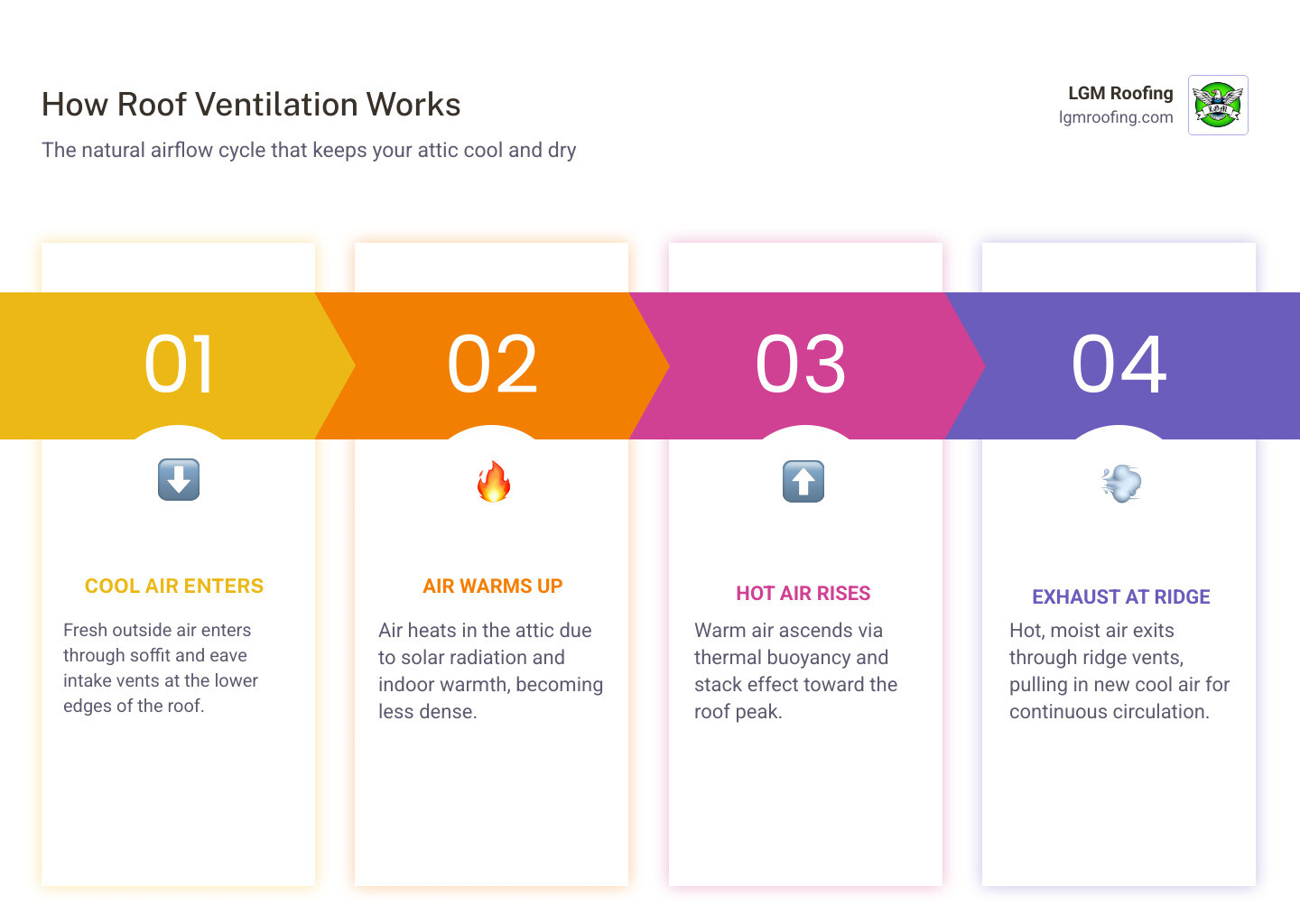
- How it works: Cool outside air enters through intake vents (usually along the soffits), warms up inside the attic, rises naturally, and exits through exhaust vents at or near the ridge — creating a continuous loop of fresh airflow.
- Why it matters: Without that airflow, heat and moisture get trapped in your attic. That leads to damaged shingles, mold growth, ice dams in winter, and higher energy bills year-round.
- The result of good ventilation: A properly ventilated attic cycles air 10 to 12 times per hour, keeping temperatures within 15°F of the outside air and protecting everything from your roof deck to your insulation.
Most homeowners don’t think about their roof ventilation until something goes wrong — a musty smell in the attic, unusually high cooling bills in July, or shingles that start to buckle and curl well before their time. By then, the damage is already underway. The good news is that understanding how ventilation works makes it much easier to catch problems early and keep your home protected through every season.
I’m Darwin Mizhirumbay, co-owner of LGM Roofing and a second-generation roofer who has seen how how roof ventilation works and why it matters plays out on real New Jersey homes — from overheated attics in summer to ice dam damage every winter. In this guide, I’ll walk you through everything you need to know to protect your roof and your home.
Understanding How Roof Ventilation Works and Why It Matters
At its core, roof ventilation is an engineered system that allows for the continuous exchange of air within your attic space. It isn’t just about having “holes in your roof”; it’s about creating a balanced environment where air moves predictably to prevent the buildup of heat and moisture. When we talk about protecting your home from damaging leaks, ventilation is often the “unsung hero” that prevents moisture from rotting your roof from the inside out.

The Science of Intake and Exhaust
To understand the mechanics, we have to look at two primary physical principles: the stack effect and the wind effect.
- The Stack Effect (Thermal Buoyancy): We all know that hot air rises. In an attic, the air is heated by the sun hitting the roof. This warm air naturally moves toward the highest point of the roof. If there are exhaust vents at the peak, the hot air escapes. This creates a vacuum that pulls cooler, denser air in through the intake vents located lower down.
- The Wind Effect: When wind blows against a roof, it creates high pressure on the windward side and low pressure on the leeward side. This pressure difference helps push air into the intake vents and pull it out through the exhaust vents, accelerating the natural circulation.
For this system to work, it must be balanced. We measure this using Net Free Vent Area (NFVA), which is the total unobstructed area available for air to move through a vent. Industry standards generally suggest a 1:1 balance between intake and exhaust. If you have plenty of exhaust but no intake, the system will struggle, potentially pulling conditioned air from your living room into the attic—which is definitely not what you want for your energy bill.
Why Roof Ventilation Works and Why It Matters in New Jersey
In New Jersey, our climate is particularly demanding. From the humid summers in Paterson to the freezing, snowy winters in Wayne, our roofs take a beating. Proper ventilation is essential for managing these extremes.
In the summer, an unventilated attic can easily soar past 130°F—sometimes hitting 150°F or 160°F. This heat radiates downward, forcing your AC to work overtime. In the winter, the challenge shifts to moisture. Everyday activities like showering, cooking, and laundry release 4 to 6 pints of water vapor daily. Without an escape route, this moisture migrates to the attic, where it hits cold surfaces and condenses into water droplets, leading to mold and wood rot. Understanding these local challenges is key to identifying the top 7 roofing problems in New Jersey homes and how to spot them.
The Critical Benefits of Proper Attic Airflow
Why should you care about the air moving over your head? Because it directly impacts your wallet and your home’s structural integrity.
| Season | Primary Goal | Major Benefit |
|---|---|---|
| Summer | Heat Removal | Lowers cooling costs and prevents shingle “baking” |
| Winter | Moisture Control | Prevents ice dams and internal wood rot/mold |
| Year-Round | Structural Health | Extends the lifespan of the roof deck and shingles |
Extending Your Roof’s Lifespan
Think of your shingles like a loaf of bread in an oven. If the attic is too hot, the shingles are essentially baked from both sides—the sun from above and the trapped attic heat from below. This leads to premature aging, curling, and “blistering.”
Excessive heat can also warp the roof sheathing (the wooden boards the shingles are nailed to). When the wood warps, the shingles no longer sit flat, making them vulnerable to wind damage. By keeping the attic temperature within 15°F of the outside air, you protect the flexibility and durability of your roofing materials. When homeowners ask can my roof be repaired or does it need to be replaced 7 ways to tell, the state of the ventilation is often a deciding factor in how much life the roof has left.
Preventing Winter Ice Dams and Moisture
Ice dams are a major headache for New Jersey residents. They form when heat escaping from a poorly ventilated attic melts the snow on the upper part of the roof. That melted snow runs down to the eaves (which are colder because they overhang the house) and refreezes into a thick ridge of ice.
This ice ridge acts as a dam, trapping water behind it. This water eventually finds its way under your shingles and into your walls or ceilings. Proper ventilation keeps the entire roof surface at a uniform temperature, ensuring snow melts evenly and doesn’t refreeze at the edges. This is a critical step when considering is your roof ready for summer storms how to prevent wind water damage in NJ, as winter prep is just as important as storm prep.
Furthermore, ventilation prevents condensation. If your insulation gets wet from attic moisture, its R-value (insulating power) drops significantly. Wet insulation is essentially useless, making your home harder to heat and create a breeding ground for mold. You might notice 5 signs the summer heat is damaging your roof and what to do about it, but winter moisture damage is often more insidious and harder to spot until it’s too late.
Common Types of Roof Vents and Their Functions
Not all vents are created equal. The best system for your home depends on your roof’s architecture and the local climate.
Intake Vents (The Foundation)
- Soffit Vents: These are located under the eaves. They can be continuous strips or individual perforated panels. They are the most common and effective way to bring cool air into the system.
- Fascia/Over-Fascia Vents: Used in homes without eaves or soffits, these allow air to enter at the very edge of the roofline.
Exhaust Vents (The Escape Route)
- Ridge Vents: These are installed along the entire peak of the roof. They are aesthetically pleasing because they blend into the shingle line and provide the most uniform air distribution.
- Gable Vents: These are the louvered vents found on the side walls of the attic. While they work well when the wind is blowing directly into them, they are less consistent than ridge vents.
- Box Vents (Static Vents): These are the square-shaped vents you see scattered across a roof. They rely entirely on natural convection (heat rising).
- Turbine Vents (Whirlybirds): These use the wind to spin a fan that pulls air out of the attic. They are very effective but depend on wind speed to function optimally.
Passive vs. Active Ventilation Systems
Most residential homes use passive systems, which rely on the natural laws of physics (stack and wind effects) to move air. These are great because they have no moving parts to break and cost nothing to operate.
Active systems, like Power Attic Ventilators (PAVs) or solar-powered fans, use a motor to force air out. These can be helpful in specific situations where natural airflow is restricted. However, a word of caution: if your attic floor isn’t perfectly air-sealed, a powerful fan can actually pull air-conditioned air from your house into the attic, increasing your energy costs!
We often use baffles (also called rafter vents or vent chutes) in conjunction with these systems. Baffles are channels installed between the rafters that ensure insulation doesn’t block the airflow from the soffit vents to the rest of the attic.
Signs Your Home Has Inadequate Ventilation
How do you know if your roof is struggling? You don’t always have to climb a ladder to find out.
Keep an eye out for these red flags:
- High Energy Bills: If your AC is running non-stop but the upstairs rooms are still stiflingly hot, your attic is likely acting like a giant radiator.
- Ice Dams and Icicles: Frequent icicles along the gutters are a classic sign of heat escaping into the attic.
- Musty Odors or Mold: If you smell mildew or see dark spots on your attic rafters, moisture is being trapped.
- Peeling Exterior Paint: Excessive attic moisture can actually push through the wood and cause paint on the outside of your house to blister or peel.
- Damaged Shingles: Look for shingles that are “cupping” (edges turning up) or “curling” (edges turning down). These are signs of roof damage often caused by extreme heat.
How Roof Ventilation Works and Why It Matters for Energy Costs
Properly ventilated roofs can cut your summer cooling costs by up to 25%. When an attic reaches 150°F, that heat doesn’t just stay in the attic; it transfers through the ceiling and into your living space. By keeping that attic temperature closer to the outside air, your HVAC system doesn’t have to work nearly as hard. This efficiency is a major factor when weighing roof repair vs replacement in NJ how to decide. A new roof with an upgraded ventilation system can pay for itself over time through energy savings alone.
Frequently Asked Questions about Roof Ventilation
How much ventilation does my attic actually need?
The general industry standard is the 1/150 rule: you need 1 square foot of net free vent area for every 150 square feet of attic floor space. However, if your home has a balanced system (equal intake and exhaust) and a vapor barrier, building codes often allow you to use the 1/300 rule (1 sq. ft. per 300 sq. ft. of attic).
For example, if you have a 1,200-square-foot attic, you would typically need 4 square feet of total ventilation—ideally 2 square feet of intake and 2 square feet of exhaust.
Can I have too much ventilation in my roof?
In short: Yes. While it’s hard to have “too much” intake, having too much exhaust—or mixing different types of exhaust—can cause problems. For example, if you have a ridge vent and a gable vent, the ridge vent might pull air from the gable vent instead of the soffit vents. This creates a “short-circuit” where only the top of the attic gets ventilated, leaving the rest of the space stagnant. This pressure imbalance can also lead to weather intrusion, where rain or snow is actually sucked into the vents during a storm.
How often should I inspect my roof vents?
We recommend a quick check at least once a year, preferably in the spring or fall. You want to make sure that:
- Soffit vents aren’t blocked by bird nests, debris, or shifted insulation.
- Screens on gable or box vents are intact to keep out pests.
- There are no visible blockages or damage to the ridge vent.
Regular maintenance helps you decide roof repair vs replacement how to know what your NJ home really needs before a small ventilation issue turns into a full roof failure.
Ensure Your Roof's Longevity with LGM Roofing Expertise
At LGM Roofing, we’ve spent over 25 years serving homeowners in Wayne, Paterson, Bloomfield, and Piscataway. We know that a roof is more than just shingles—it’s a complex system that requires precise balance to function correctly. How roof ventilation works and why it matters is a fundamental part of that system.
Whether you’re dealing with high energy bills, worrying about ice dams, or planning a full roof replacement, getting your ventilation right is the best investment you can make for the long-term health of your home. If you’re unsure if your attic is breathing the way it should, don’t leave it to guesswork.
More info about roofing services is just a click away. Reach out to us today for a professional assessment, and let’s ensure your New Jersey home is protected for 2026 and beyond!
