



Common Roof Insurance Claim Mistakes to Avoid
Why So Many New Jersey Homeowners Lose Money on Roof Insurance Claims
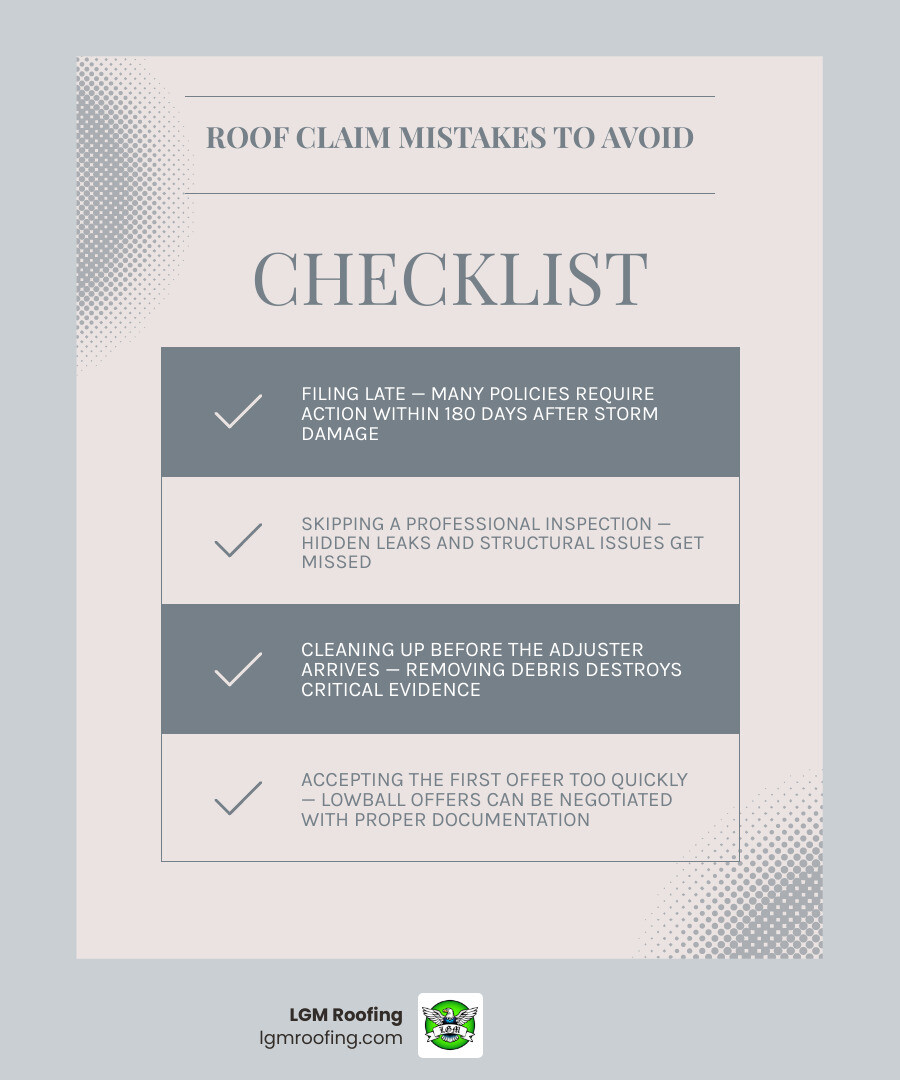
The common roof insurance claim mistakes to avoid can mean the difference between a full payout and thousands of dollars out of your own pocket. Here is a quick look at the most frequent ones:
- Filing the claim too late — many policies require action within a set window after the storm
- Skipping a professional inspection — hidden damage gets missed, weakening your case
- Cleaning up before the adjuster arrives — removing debris destroys critical evidence
- Demanding a full replacement when only repairs are needed — this can raise red flags with your insurer
- Poor photo documentation — blurry or incomplete images give insurers reason to deny or reduce your claim
- Not understanding your policy — confusing ACV and RCV coverage, or missing key exclusions, leads to surprise gaps
- Accepting the first settlement offer too quickly — initial offers are often underpaid by a significant margin
A roof takes a beating in New Jersey. Between nor’easters, heavy snow loads, summer hailstorms, and high winds, it is not unusual to find yourself dealing with storm damage and an insurance claim at the same time. That pressure makes it easy to move fast and make costly errors. In fact, research suggests that 85% of denied claims are entirely avoidable with the right preparation and documentation. Yet homeowners consistently run into the same traps — late filings, missing photos, policy misreads, and lowball settlements they accept without a second look.
I’m Darwin Mizhirumbay, co-owner of LGM Roofing and a second-generation roofer who has seen how the common roof insurance claim mistakes to avoid can quietly cost New Jersey homeowners thousands of dollars. In the guide below, I’ll walk you through exactly what to watch out for so you can protect your home and your claim.
The Most Common Roof Insurance Claim Mistakes to Avoid

Filing a roof damage claim after a major storm is stressful enough without accidentally sabotaging yourself. Many homeowners treat the insurance claims process as a simple administrative task: a storm hits, you call your agent, an adjuster visits, and you get a check.
Unfortunately, insurance claims are highly technical transactions. Because insurance adjusters represent the financial interests of the insurance company, they look for specific, objective evidence before approving a payout. If you do not provide that evidence in the format they expect, or if you make a misstep early in the process, your claim could easily be denied or severely underpaid.
To protect your property and secure the coverage you pay for every month, you must understand the exact pitfalls that frequently derail claims for homeowners in Wayne, Paterson, Bloomfield, and Piscataway.
How Delaying the Claim is One of the Most Common Roof Insurance Claim Mistakes to Avoid
One of the single most common reasons roof insurance claims are denied in New Jersey is late reporting. Many homeowners notice a few missing shingles after a winter nor’easter or a spring thunderstorm but decide to wait until the weather warms up—or until they spot an active ceiling leak—before contacting their insurance company.
This delay is a critical mistake. Most insurance policies have strict deadlines for reporting storm damage, often requiring notification within a specific window (such as 180 days from the date of the loss). In some policies, the reporting window for wind or hail damage can be even shorter.
When you wait months to file a claim, several issues arise:
- The “Wear and Tear” Trap: Over time, exposed underlayment degrades due to UV exposure, and minor shingle damage worsens. If an adjuster inspects your roof six months after a storm, they may argue that the current damage is the result of neglect, normal wear and tear, or subsequent weather events, rather than the original insured storm.
- Lack of Meteorological Evidence: Insurers cross-reference claims with local weather reports. If you file a claim months after the fact, it becomes much harder to tie the specific damage to a verified weather event on a precise date.
- Secondary Damage Exclusions: If a delayed claim leads to a slow water leak that causes structural rot or mold, your insurer may deny coverage for the interior repairs, citing your failure to mitigate the damage promptly.
To avoid this, you should act immediately after any major weather event. For a complete breakdown of the timeline and requirements, check out The Ultimate Guide to Filing a Roof Damage Insurance Claim.
Why Skipping a Professional Inspection is Among the Common Roof Insurance Claim Mistakes to Avoid
Many homeowners make the mistake of calling their insurance company before having a professional, factory-certified roofing contractor inspect the roof. They rely on “driveway inspections”—looking up at the roof from the ground and assuming everything is fine because they do not see massive holes or missing shingles.
This is a dangerous form of optimism. Hail damage, for example, is rarely visible from the ground. When hail strikes an asphalt shingle, it fractures the underlying fiberglass mat and knocks loose the protective mineral granules. While the roof may look perfectly intact from your driveway, these bruised areas will fail prematurely over the next two to three years, leading to sudden, widespread leaks long after your storm-filing window has closed.
When you call your insurance company first, they will send out an adjuster who may spend less than 15 minutes on your roof. Without an independent, professional damage report in hand, you have no way of knowing if the adjuster’s assessment is thorough or accurate.
By securing a professional roof inspection from a GAF Master Elite contractor first, you receive:
- A comprehensive, photo-documented damage report.
- Clear evidence distinguishing storm-related damage from normal aging.
- An expert partner who can be present on-site when the insurance adjuster arrives, ensuring that all damaged areas—including subtle hail bruises, damaged flashing, and wind-creased shingles—are pointed out and documented.
Before you make any assumptions about the state of your roof, read Can My Roof Be Repaired or Does It Need to Be Replaced? 7 Ways to Tell to understand what professional inspectors look for.
Cleaning Up the Evidence Before the Adjuster Arrives
It is natural to want to clean up your property immediately after a storm. Homeowners often rake up fallen branches, sweep away broken roof granules, and discard blown-off shingles before the insurance adjuster can inspect the property.
While you are legally obligated to mitigate further damage to your home (such as putting a temporary tarp over an active leak to protect your ceiling), completely cleaning up the physical evidence of storm damage before it is documented is a major mistake.
Adjusters look for “collateral damage” to confirm the severity of a storm. Physical evidence like dented gutters, damaged window screens, broken siding, and the actual shingles that blew off your roof serve as vital proof of high winds or large hail. If you throw these items away, you make it much easier for the insurer to claim that the damage was pre-existing or caused by something other than the recent storm.
What to do instead:
- Take Photos First: Before moving a single branch or cleaning up any debris, take clear, timestamped photos of the entire yard, the fallen shingles, and any dented exterior fixtures.
- Save the Shingles: If shingles have blown off, collect them and set them aside in your garage or yard to show the adjuster.
- Mitigate Safely: Install temporary tarps or plastic sheeting only where water is actively entering the home. Keep the receipts for any materials you buy for temporary repairs, as these are typically reimbursable.
Demanding a Full Replacement When Only Repairs Are Needed
Another common error is demanding a complete roof replacement when the physical damage only warrants a localized repair. If a storm damages a small, isolated section of an otherwise young, healthy roof, a targeted repair is often the most appropriate and cost-effective solution.
If you file a claim demanding a full replacement for minor shingle loss, your insurance company may view the claim with suspicion. This can lead to prolonged disputes, unnecessary delays, and a strained relationship with your adjuster.
However, New Jersey homeowners must also be aware of local building codes. Many municipalities enforce rules regarding partial roof repairs. If the damage to your roof is extensive, or if the existing roof system is too old to undergo repairs without causing further damage (known as a “brittle test” failure), a full replacement may be legally or structurally required.
To help you navigate this decision and understand what is truly necessary for your New Jersey home, consult our guide on Roof Repair vs Replacement in NJ: How to Decide as well as our detailed analysis of Roof Repair vs Replacement: How to Know What Your NJ Home Really Needs.
Why Policy Misunderstandings and Poor Documentation Lead to Denials
Many roof claim denials stem directly from a misunderstanding of policy language or a lack of clear, objective documentation. Homeowners often assume that property insurance is an all-inclusive warranty that covers any and all roof issues. In reality, insurance is designed to cover sudden, accidental physical losses—not gradual deterioration or maintenance failures.
One critical policy clause to watch out for is the 14-day seepage rule. Most homeowners’ policies explicitly exclude coverage for water damage caused by constant or repeated seepage or leakage occurring over a period of 14 days or more. If you neglect a minor roof leak and it slowly rots your decking over several weeks, your insurer will classify this as a maintenance issue and deny the entire claim.
Additionally, you must understand the fundamental difference between how your policy calculates payouts. This is determined by whether you have an Actual Cash Value (ACV) or a Replacement Cost Value (RCV) policy.
| Policy Type | How Payout is Calculated | Out-of-Pocket Impact for Homeowners |
|---|---|---|
| Actual Cash Value (ACV) | Pays the cost to repair or replace the damaged property minus depreciation based on the roof’s age. | High. If a 15-year-old roof is damaged, the payout will be significantly reduced, leaving you to cover the remaining balance. |
| Replacement Cost Value (RCV) | Pays the actual cost to repair or replace the damaged property with materials of like kind and quality, without deducting for depreciation. | Low. Once the work is completed and proof is submitted, the insurer reimburses the full cost (minus your deductible). |
Failing to Document Damage Properly
Incomplete or poor-quality documentation is a leading cause of claim denials. A few blurry smartphone photos taken from the ground are simply not enough to satisfy an insurance carrier.
To build an undeniable claim, you need structured, high-definition visual evidence. Professional documentation should include:
- Multiple Angles: Both wide-angle shots to establish context and extreme close-ups of the specific damage.
- Collateral Evidence: Photos of dented gutters, damaged flashing, torn window screens, and bruised soft metals on the roof (like ridge vents and exhaust caps).
- Interior Evidence: Clear photos of water stains on ceilings, damp insulation in the attic, or peeling paint near rooflines.
- Metadata: Photos should ideally be timestamped and geolocated to prove they were taken at your property immediately following the storm event.
Without this level of detail, insurance companies may claim there is insufficient evidence to prove the damage occurred during the covered policy period. For more details on compliance and local building requirements during a replacement, see The Definitive Guide to Roof Replacement Permits in NJ.
Accepting the First Settlement Offer Too Quickly
It is incredibly common for homeowners to accept the first settlement check their insurance company offers just to get the process over with. However, initial insurance estimates are underpaid by an average of 20%.
These initial “lowball” offers often omit critical components of a proper roof restoration, such as:
- Local building code upgrades (e.g., modern ice and water shield requirements in New Jersey).
- Realistic local labor rates for Wayne, Paterson, Bloomfield, or Piscataway.
- Essential materials like starter shingles, ridge caps, and proper ventilation components.
Never assume that the adjuster’s first estimate is the final word. If the initial offer is insufficient to cover the actual cost of a quality repair or replacement, your roofing contractor can submit a supplement. A supplement is a detailed, line-item request sent to the insurer—backed by photos and code citations—requesting additional funds to cover the necessary steps of the project.
Frequently Asked Questions About Roof Insurance Claims
Navigating the insurance world can feel like learning a foreign language. Here are some of the questions we hear most frequently from New Jersey homeowners.
What should I do if my roof insurance claim is denied?
If your claim is denied, do not panic. Many successful roofing projects begin as initial denials. Take the following steps to appeal the decision:
- Read the Denial Letter Carefully: The insurer must provide a written explanation citing the specific policy exclusion or reason for the denial (e.g., claiming the damage is due to wear and tear rather than a storm).
- Request a Re-Inspection: You have the right to ask for a second inspection, ideally with a different adjuster. Make sure your local, certified roofing contractor is present during this second visit to point out the documented storm damage.
- Provide Additional Proof of Loss: Submit a detailed engineering report, weather reports confirming the storm date, or additional high-resolution photos.
- Consult a Public Adjuster or Appraiser: If you still cannot reach an agreement, you can hire a licensed public adjuster to negotiate on your behalf, or invoke your policy’s appraisal clause to resolve the dispute.
Can my insurance company drop me for filing a storm damage claim?
In New Jersey, insurance companies are generally prohibited from dropping you or refusing to renew your policy solely because you filed a single, legitimate claim for storm damage (which is legally classified as an “Act of God”).
However, there are a few nuances to keep in mind:
- Regional Premium Adjustments: While an insurer cannot raise your individual rates based on a storm claim, they can raise rates for an entire zip code or region after a major natural disaster to offset their collective losses.
- Multiple Claims: If you file multiple claims within a short window (e.g., three claims in three years), the insurer may view your property as high-risk and choose not to renew your policy at the end of its term.
- Neglect Non-Renewal: If an inspection reveals that your roof is severely deteriorated due to old age and lack of maintenance, the insurer can issue a non-renewal notice requiring you to replace the roof out of pocket to maintain coverage.
Why is it a mistake to hire an unlicensed contractor for insurance repairs?
After a major storm, out-of-state “storm chasers” often flood New Jersey neighborhoods, knocking on doors and promising free roofs or offering to “waive” your insurance deductible.
Hiring these unlicensed, uninsured contractors is a recipe for disaster for several reasons:
- Insurance Fraud: It is illegal in New Jersey for a contractor to waive or absorb your insurance deductible. Doing so constitutes insurance fraud and can void your entire claim.
- Poor Workmanship: Storm chasers rely on fast, sub-par labor. They often skip town as soon as they collect their check, leaving you with no recourse and no active warranty when the roof begins to leak a few months later.
- No Manufacturer Warranties: Leading manufacturers like GAF will only honor their premium, extended warranties if the roof is installed by a certified, licensed contractor who adheres to strict installation standards.
To protect your home and your financial investment, you must work with an established, licensed local company. For a deeper look at these risks, read Why Hiring an Unlicensed NJ Roofer Is a Recipe for Disaster.
Securing Your Roof Insurance Claim Success
Avoiding the common roof insurance claim mistakes to avoid is the single best way to ensure your home is protected and your claim is fully funded. By acting quickly, securing a professional inspection before filing, documenting every detail, and refusing to accept the first lowball offer, you can navigate this complex process with confidence.
At LGM Roofing, we have spent over 25 years helping homeowners in Wayne, Paterson, Bloomfield, and Piscataway navigate the aftermath of New Jersey’s toughest storms. As a family-owned general contractor with GAF Master Elite certification, we don’t just install high-quality, warrantied roofs—we also provide the professional, photo-documented support you need to satisfy your insurance carrier.
If you suspect your roof has suffered storm damage, don’t leave your claim to chance. Contact our team today for expert guidance and dedicated Insurance Support.
