



How to Get Rid of Condensation Between Window Panes
Why Condensation Between Window Panes Causes Foggy Glass You Can’t Wipe Away
The condensation between window panes causes a frustrating problem that no amount of scrubbing will fix — because the moisture is trapped inside the glass unit itself, completely out of reach. If you’ve ever noticed a hazy, milky, or foggy film on your windows that won’t wipe off from either side, you’re looking at a failed window seal.
Here’s a quick breakdown of the most common causes:
- Failed IGU seal — The insulated glass unit’s inner or outer seal breaks down, allowing humid air to sneak into the space between panes
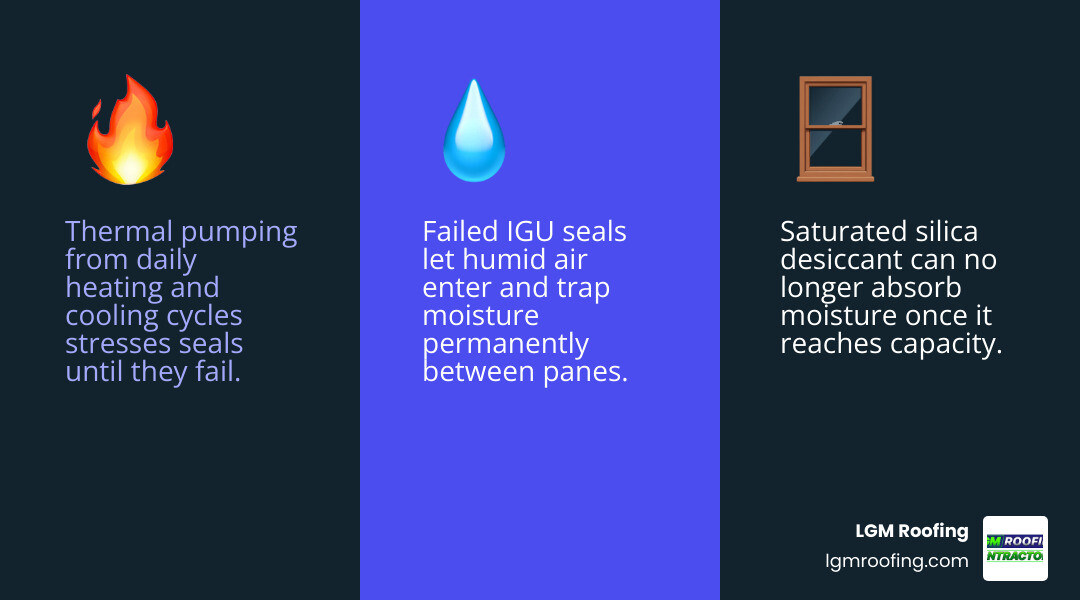
- Thermal pumping — Daily heating and cooling cycles cause the glass and frame to expand and contract, slowly stressing the seal until it gives out
- Saturated desiccant — A moisture-absorbing material inside the spacer bar called silica gel eventually fills to capacity and can no longer keep the air between the panes dry
- Window age — Most double-pane windows last 10 to 20 years; after that, seal failure becomes increasingly common
- Frame material — Vinyl frames expand and contract more than other frame types, placing extra stress on seals over time
- Installation issues — Improper installation can put uneven pressure on the glass assembly, accelerating seal wear
- Manufacturing defects — Some windows fail early due to defects in a production batch, sometimes called batch failure
The bottom line: once the seal fails, moisture gets in and stays in — and it will get worse over time, not better.
That fogged-up window you’re staring at isn’t just an eyesore. It’s a sign that your window’s insulating performance has already started to decline. Left unaddressed, trapped moisture can permanently etch the glass surface through a process called riverbedding, or leave behind a chalky white residue known as silica haze — both of which cause irreversible damage. Understanding exactly what went wrong is the first step toward fixing it the right way.
I’m Darwin Mizhirumbay, founder of LGM Roofing, and through years of hands-on experience with home exterior systems — including window installation and replacement — I’ve seen how often condensation between window panes causes homeowners to spend money on the wrong fix. In this guide, I’ll walk you through exactly what’s happening inside your glass, how to confirm it, and what your real options are.
Understanding Condensation Between Window Panes Causes
To understand why moisture gets trapped between your window panes, we first have to look at how modern double-pane and triple-pane windows are built. These are not just two independent sheets of glass slotted into a frame. They are highly engineered, sealed systems known as Insulated Glass Units (IGUs).
An IGU consists of two or more panes of glass separated by a spacer bar. The air or gas trapped inside this space acts as a barrier that slows down heat transfer, keeping your home warm in the winter and cool in the summer. To provide maximum thermal performance, manufacturers often fill this gap with dense, inert gases like argon or krypton, which are much better insulators than standard atmospheric air.
To keep this insulating gas in and keep outdoor humidity out, the unit relies on a robust double-seal system:
- The Inner Seal: Usually made of polyisobutylene (PIB), this primary seal acts as the main moisture barrier, preventing water vapor from sneaking into the gas-filled chamber.
- The Outer Seal: Typically made of silicone, polyurethane, or polysulfide, this secondary seal provides the structural strength needed to hold the entire assembly together.
When these seals are intact, the IGU functions perfectly. However, windows are constantly exposed to the elements. Over a standard lifespan of 10 to 20 years, these seals naturally degrade. Once a tiny pathway opens up in the sealant, the heavy insulating gas escapes, and moist, outdoor air moves in. This is when the visual fogging begins. If you are noticing drafts, rising utility bills, or visual haze, you should read about The Window Warning Signs You Should Not Ignore to see if your home’s exterior needs immediate attention.
How Thermal Pumping and Seal Failure Act as Condensation Between Window Panes Causes
One of the most powerful, invisible forces working against your windows every single day is a physical phenomenon known as thermal pumping.
During the day, direct solar heat beats down on your windows. This intense sunlight warms the air or gas trapped between the glass panes, causing it to expand. This expansion creates significant outward pressure, forcing the glass panes to bow slightly outward and stretching the perimeter seals. At night, the temperature drops, the gas cools down, and the entire unit contracts. This contraction creates a vacuum effect, pulling the glass inward and drawing outside air—along with whatever humidity is in it—into the unit.

This daily cycle of expanding and contracting acts like a slow, continuous pump that stresses the structural seals of your windows. Over thousands of cycles, the sealant loses its elasticity, develops micro-cracks, and eventually fails.
The rate of this degradation is heavily influenced by the materials used in your window frames:
- Vinyl Frames: Vinyl is a highly popular and cost-effective material, but it has a high coefficient of thermal expansion. This means vinyl frames expand and contract significantly more than wood, fiberglass, or aluminum when exposed to temperature swings. This dramatic movement puts extra physical stress on the IGU’s edge seals, making vinyl windows statistically more prone to premature seal failure.
- Fiberglass and Wood Frames: These materials expand and contract at rates much closer to glass itself, meaning there is less differential movement and less stress on the perimeter seals over time.
In regions like New Jersey, where we experience hot, humid summers and freezing winter temperatures, these freeze-thaw and expansion-contraction cycles are particularly harsh on window assemblies.
Saturated Desiccants and Other Secondary Condensation Between Window Panes Causes
You might wonder why a window doesn’t fog up the very second a micro-crack develops in the seal. The reason is a clever component hidden inside the window’s spacer bar: the desiccant.
The spacer bar that separates the glass panes is filled with thousands of tiny, highly porous silica gel beads. This desiccant is designed to absorb any trace amounts of moisture that enter the unit during manufacturing or seep through microscopic seal imperfections over time. Silica gel has an incredible surface area—approximately 7,200 square feet per gram—allowing it to hold a substantial amount of water vapor.
However, the desiccant has a finite saturation point. Over years of thermal pumping, as more and more humid air is drawn into the IGU, the silica beads eventually absorb all the moisture they can hold. Once the desiccant becomes fully saturated, it can no longer protect the airspace. At this point, any additional moisture that enters the unit remains free-floating in the air gap. When the temperature of the glass drops below the dew point, this moisture condenses into visible water droplets on the inside surfaces of the glass.
If left untreated, this saturated environment causes secondary, irreversible damage:
- Silica Haze: As the desiccant degrades and reacts with water, it can shed tiny white, powdery particles. These particles deposit onto the glass, creating a permanent, snowflake-like white film that cannot be cleaned off.
- Riverbedding: Over time, water droplets run down the inside of the glass in the same paths. The minerals in the water, combined with the chemical breakdown of the glass surface from constant moisture exposure, carve permanent microscopic grooves (known as riverbedding) into the glass.
How to Diagnose Trapped Moisture in Your Home’s Glass
Before you assume your window needs to be replaced, it is essential to correctly identify where the condensation is actually forming. Moisture can accumulate on three different surfaces of a window, and only one of them indicates a failed seal.
To help you distinguish between normal humidity issues and actual window failure, let’s look at the three types of condensation:
- Interior Condensation: This occurs on the room-facing side of the glass. It happens when warm, humid indoor air (from cooking, showering, or heating) meets cold winter glass. This is a ventilation or indoor humidity issue, not a window defect.
- Exterior Condensation: This forms on the outside-facing side of the glass, usually on humid summer mornings. It occurs when the outdoor air is warm and moist, but the glass surface is cold from your indoor air conditioning. This actually indicates that your window is working perfectly and has excellent thermal insulation!
- Inter-Pane Condensation (Trapped Moisture): This is moisture, fog, or water droplets trapped between the two panes of glass. It cannot be wiped away from either the inside or the outside of your home. This is the definitive sign of a failed IGU seal.
If you live in northern New Jersey and are trying to decide if your home’s windows are reaching the end of their useful life, reading about 5 Ways to Know if Window Remodeling in Montclair NJ is Right for You can help you assess the condition of your home’s exterior glass.
The Finger Test and Visual Inspections
Confirming that your window seals have failed is a straightforward process that you can perform yourself in just a couple of minutes.
First, perform the Finger Test:
- Walk up to the foggy window and run your finger through the moisture on the inside of the glass. If the fog clears and leaves a clean streak, you are dealing with normal interior condensation.
- If the inside is dry, walk outside (if accessible) and wipe the exterior glass. If the fog clears there, it is normal exterior condensation.
- If you have thoroughly wiped both the inside and outside surfaces of the glass and the foggy, dirty-looking haze remains completely unchanged, the moisture is trapped inside the sealed chamber. Your window seal has failed.
Next, conduct a Visual Inspection of the spacer bar and frame:
- Look closely at the spacer bar (the metal or foam strip separating the panes). If you see water droplets pooled along the bottom edge, or if the spacer bar looks warped, corroded, or discolored, the desiccant is completely saturated.
- Check the glass for “silica haze”—a white, cloudy, or dusty film that looks like dried soap scum. If this is present, the glass is already permanently etched and will need to be replaced.
- Inspect the external window frame for signs of poor drainage. If the frame’s weep holes (small drainage slots) are clogged with dirt or debris, water can pool around the bottom of the glass unit, accelerating seal breakdown.
For homeowners looking for reliable local experts to evaluate window performance, you can read our guide on how to Keep It Local Find Window Remodeling Near Me in Jersey City to connect with skilled professionals who understand New Jersey’s unique climate demands.
Effective Solutions for Foggy Double-Pane Windows
Once you have confirmed that your window seals have failed, it is time to look at your options for resolving the problem. Many homeowners worry that a foggy window automatically means they have to tear out their entire window frame, ruin their interior drywall, and pay for an expensive full-frame replacement. Fortunately, that is rarely the case.
Depending on the age and condition of your window frames, there are three primary approaches to handling failed seals:
- Insulated Glass Unit (IGU) Replacement (The Best Balance): This involves removing only the failed glass pack from the existing sash and installing a brand-new, factory-sealed glass unit. Your existing frame and trim remain completely untouched. This is highly cost-effective and restores 100% of the window’s original energy efficiency.
- Full Window Replacement (The Long-Term Upgrade): This involves removing the entire window structure—including the frame, sashes, and trim—and installing a completely new window. This is the best choice if your frames are rotted, warped, drafty, or if you want to upgrade your home’s architectural style.
- Defogging Services (The Temporary Cosmetic Fix): This process involves drilling tiny holes in the glass, spraying cleaning solutions inside to wash away the haze, vacuuming out the moisture, and installing one-way vents. While this can temporarily improve visibility, defogging does not repair the broken seal. The insulating argon gas is gone forever, and because the unit is no longer sealed, its thermal performance remains permanently compromised.
If you want to understand the full scope of window replacement options in our area, take a look at our comprehensive Window Remodeling New Jersey Guide for expert tips on keeping your home weather-tight.
Replacing the Glass Unit vs. Full Window Replacement
To help you decide which path is right for your home, we have put together a comparison table outlining the key differences between replacing just the glass unit (IGU) and opting for a full window replacement.
| Feature | IGU (Glass-Only) Replacement | Full Window Replacement |
|---|---|---|
| What is Replaced? | Only the sealed double-pane glass assembly. | The entire window, including frame, sash, and trim. |
| Frame Condition Required | Frame must be structurally sound, square, and in good cosmetic shape. | Works for any frame condition, especially rotted, warped, or damaged frames. |
| Energy Efficiency | Restores the window’s original thermal performance (includes fresh argon gas & Low-E coatings). | Maximizes energy efficiency by adding modern frame insulation and eliminating frame drafts. |
| Cosmetic Impact | Restores clear views; does not change the look of your window frames. | Allows you to completely change the color, material, or style of your windows. |
| Installation Time | Very fast; usually takes 20 to 30 minutes per window with minimal mess. | Takes longer; requires removing interior/exterior trim and flashing. |
According to industry statistics, the glass assembly can be replaced in approximately 75% of cases when condensation occurs between the panes. Only about 5% of cases actually require replacing the entire window due to structural frame failure. The remaining cases are typically homeowners choosing to upgrade their entire window system for aesthetic or advanced energy-efficiency reasons.
If you are located in Essex County and want to explore your options for upgrading your home’s exterior, you can learn more about local specialists by reading Which Companies Specialize in Window Remodeling in Montclair NJ.
Frequently Asked Questions About Window Moisture
Will the fog inside my double-pane windows dry out on its own?
No, the fog will not dry out on its own. Once a window seal fails and the desiccant beads inside the spacer bar become fully saturated, moisture is permanently trapped within the unit.
While you might notice the fog disappearing on hot, dry afternoons, this is simply because the rising temperature has turned the liquid water droplets back into invisible water vapor. As soon as the sun goes down and the glass cools, that vapor will condense back into visible liquid. Over time, this constant moisture cycle will permanently etch the glass surface (riverbedding) and leave behind a stubborn, white mineral film (silica haze) that ruins the glass forever.
Does condensation between window panes mean I am losing heat?
Yes, absolutely. When a window seal fails, the heavy insulating gas (like argon) escapes and is replaced by humid, outdoor air.
Dry air and argon gas are excellent insulators because they do not conduct heat easily. Damp, humid air, on the other hand, is an excellent thermal conductor. When moisture gets trapped between your panes, your window transfers heat much faster. In the winter, valuable heat escapes from your home; in the summer, outdoor heat radiates inside. This places an extra load on your heating and cooling systems, often leading to a noticeable increase in your monthly energy bills.
To learn more about how replacing failed, drafty windows can improve your home’s comfort and lower your utility bills, check out our Window Remodeling Bloomfield NJ Complete Guide.
How can I prevent window seal failure in the future?
While all insulated glass units will eventually reach the end of their natural lifespan, you can dramatically extend the life of your window seals by following these best practices:
- Choose High-Quality Windows: Look for windows built with warm-edge spacers and heavy-duty, multi-chambered frames (like high-quality vinyl or fiberglass) that resist extreme temperature expansion.
- Ensure Professional Installation: Proper flashing and square, level installation prevent uneven physical stress on the window frame, protecting the delicate glass seals from twisting or warping.
- Maintain Proper Drainage: Regularly inspect your window frames and clean out the built-in weep holes. If these holes get clogged, water can pool in the frame channel, soaking the bottom seal of the IGU and causing it to break down prematurely.
- Manage Indoor Humidity: Keep your home’s relative humidity within the ideal winter range of 30% to 35% by using exhaust fans in bathrooms and kitchens, and running a dehumidifier if necessary.
Conclusion
At LGM Roofing, we have spent over 25 years helping homeowners across New Jersey—including Wayne, Paterson, Bloomfield, and Piscataway—protect and beautify their homes. While we are widely known for our premier roofing services and our status as a GAF Master Elite contractor, our commitment to craftsmanship and structural integrity extends to all areas of your home’s exterior, including professional siding, door, and window installations.
We believe in doing things right the first time. If you are dealing with foggy, drafty, or failed double-pane windows, you don’t have to settle for temporary cosmetic fixes or jump straight to expensive, unnecessary construction. Our expert team can evaluate your window frames, determine if an IGU glass replacement is possible, and provide you with a durable, high-quality solution backed by our solid warranty.
Ready to restore your home’s comfort, clear views, and energy efficiency? Explore our specialized services by visiting our Window Remodeling page today, and let us help you find the perfect solution for your home.
