


The Most Effective Solution for Peeling Paint on Siding
Why Peeling Paint on Siding Happens — and What You Can Do About It
Peeling paint on siding causes and solutions come down to a short list of root problems that most homeowners in New Jersey deal with at some point:
Most Common Causes:
- Moisture getting behind the paint film (from interior vapor, leaks, or ground contact)
- Poor surface preparation before painting
- Incompatible paint layers or wrong paint type
- Painting in the wrong temperature or humidity conditions
- UV degradation and freeze-thaw cycles over time
Most Effective Solutions:
- Identify and fix the moisture source first
- Scrape, sand, clean, and prime properly before any repainting
- Use a high-quality 100% acrylic latex exterior paint
- Maintain gutters, caulking, and ventilation regularly
- Consider siding replacement if rot or structural damage is present
If you’ve noticed your home’s exterior paint curling, bubbling, or flaking off in strips, you’re not alone — and the good news is that most cases are preventable. The frustrating part is that the paint itself is rarely the problem. As every major paint manufacturer acknowledges, the vast majority of coating failures trace back to what happened — or didn’t happen — before a single drop of paint was applied.
New Jersey’s climate makes this especially challenging. High summer humidity, driving rain, and repeated freeze-thaw cycles from fall through spring put constant pressure on exterior finishes. A paint job that might hold up for a decade in a drier climate can start failing in just a few years here if the underlying issues aren’t addressed correctly.
Whether you’re a homeowner staring at bubbling paint near your gutters or you’ve just bought an older home and noticed widespread flaking on the wood siding, this guide walks you through exactly why it happens, how to diagnose the specific cause, and what to do about it — including when repainting is the right call and when replacing the siding altogether makes more sense.
I’m Darwin Mizhirumbay, co-owner of LGM Roofing and a New Jersey-based contractor with hands-on experience addressing exterior failures — including peeling paint on siding causes and solutions — across homes throughout the region. Growing up in a family roofing business and now leading LGM Roofing as a GAF Master Elite Contractor, I’ve seen how moisture intrusion and skipped prep work silently destroy a home’s exterior, and I’m here to help you get ahead of it.
Understanding Peeling Paint on Siding Causes and Solutions
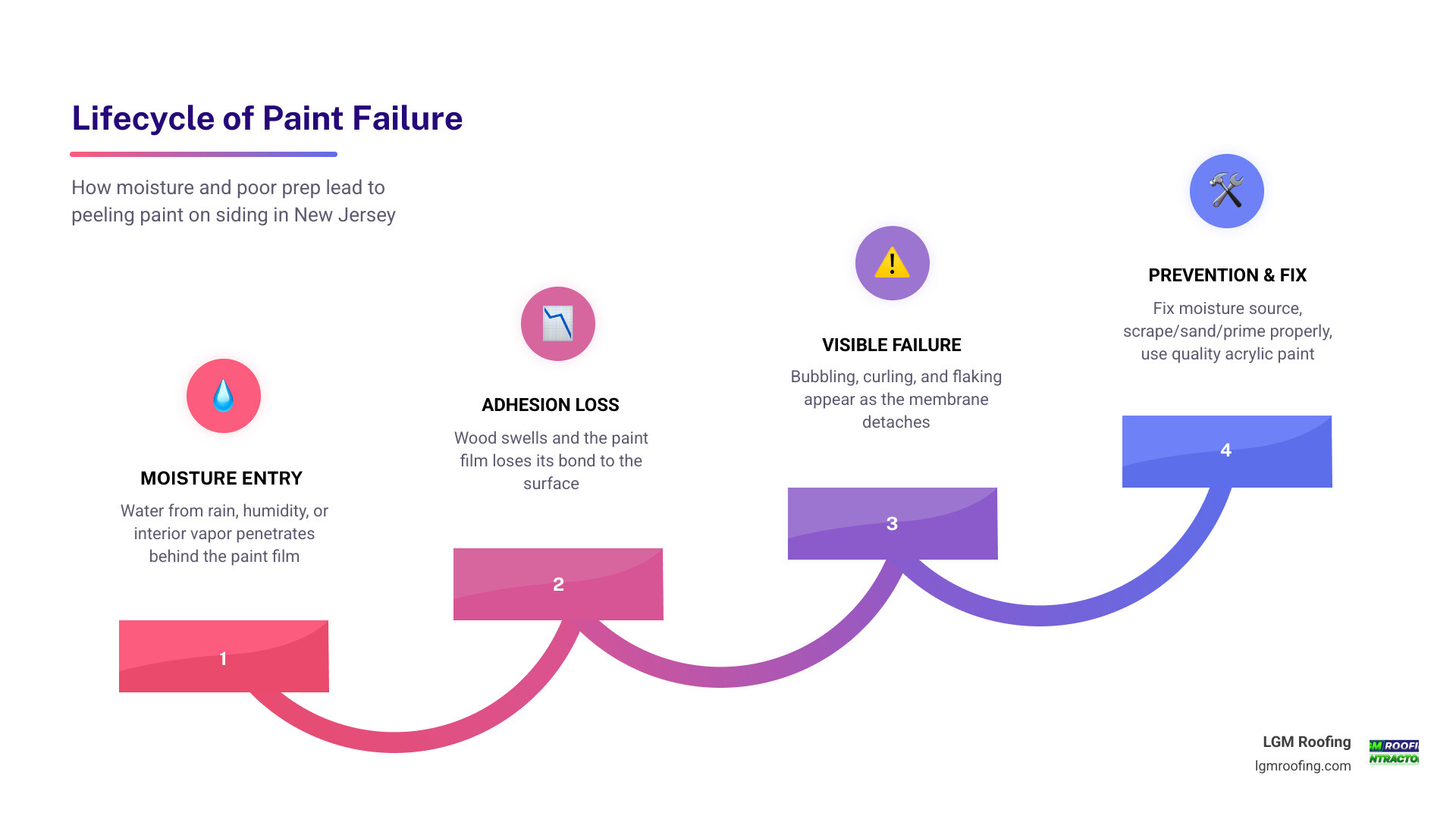
To understand why paint fails on your siding, we must look at the physical relationship between the wood, the paint film, and the environment. Exterior paint is not just a decorative layer; it is a highly engineered, breathable membrane designed to protect your home’s structural envelope from the elements. However, when moisture gets trapped beneath this membrane, or when the membrane fails to adhere to the substrate, paint failure is inevitable.

When moisture penetrates wood siding, it causes the organic fibers to swell. As the wood expands, it stretches the paint film beyond its elastic limit. When the wood eventually dries and shrinks back to its original size, the stretched paint film cannot shrink with it. This leads to micro-cracking, which allows even more water to enter, accelerating the cycle until the paint loses adhesion entirely and peels away.
Often, this structural moisture cycle leads to wood rot, which cannot be fixed with a simple coat of paint. In these scenarios, professional Siding Repair in Bloomfield NJ is required to replace damaged boards and restore the structural integrity of your home’s exterior before any coating can be successfully reapplied.
Identifying Peeling Paint on Siding Causes and Solutions Related to Moisture
Moisture is the primary enemy of exterior paint, and it can attack your siding from three distinct directions: from the inside out, from the outside in, and from the ground up.
- Vapor Drive (Inside Out): During New Jersey’s cold winters, the air inside your home is warm and humid, while the outdoor air is cold and dry. This temperature and humidity gradient creates a force known as vapor drive. Moisture vapor from showers, cooking, and humidifiers naturally migrates outward through your walls. In older homes built without a proper vapor barrier, this moisture passes directly through the wood siding and condenses immediately behind the exterior paint film. The resulting hydrostatic pressure literally pushes the paint off the wood, leaving clean, dry wood beneath the peeled strips.
- Capillary Action (Outside In): Wood siding boards are made of cellulose fibers that run lengthwise, acting like microscopic straws. The lower edges and end joints of siding boards are highly vulnerable. If these edges are not thoroughly primed and sealed, they draw rainwater upward into the board through capillary action. This is why you will frequently see paint peeling first along the bottom edges of lap siding.
- Ground Contact and Splashback (Ground Up): Siding installed too close to the ground is subjected to constant dampness. Industry standards dictate that wood siding should maintain at least a six-inch clearance from the bare ground. Without this clearance, the wood remains perpetually damp, preventing the paint from ever maintaining a secure bond.
Understanding these moisture dynamics is critical to determining whether Will Your Siding Survive a Northeast Winter? or if seasonal moisture cycles will continue to destroy your exterior finishes year after year.
Other Environmental and Application Factors
While moisture is the leading cause of paint failure, other environmental and application factors play significant roles in how long your exterior finish lasts in New Jersey:
- UV Degradation: The sun’s ultraviolet rays systematically break down the chemical binders in paint. Over time, this causes the paint to chalk, fade, and lose its flexibility. Once a paint film becomes brittle from UV exposure, it can no longer expand and contract with seasonal temperature changes, leading to hairline cracks and eventual peeling.
- Freeze-Thaw Cycles: From late autumn through early spring, New Jersey experiences rapid temperature fluctuations. Water trapped in micro-cracks behind the paint freezes and expands, then thaws. This physical expansion mechanically tears the paint film away from the wood substrate.
- Incorrect Application Conditions: Applying paint when it is too cold, too hot, or too humid prevents the film from coalescing correctly. Most high-quality exterior latex paints require a minimum curing temperature of 50°F that must hold for at least 48 hours. Painting on a damp morning or right before a temperature drop guarantees premature failure.
- Incompatible Paint Layers: Applying a modern water-based latex paint directly over an older, high-gloss oil-based paint without proper preparation is a recipe for intercoat adhesion failure. The latex paint cannot bond to the slick oil surface, causing it to peel off in large sheets.
These environmental stressors often work in tandem with weather events. To understand the broader impact of seasonal weather on your home’s exterior, read about How Storms Affect Your Roof and Siding Without You Knowing.
The Critical Role of Professional Surface Preparation
When it comes to peeling paint on siding causes and solutions, the quality of the paint itself is secondary to the quality of the preparation. Industry statistics show that 75 to 85 percent of coating failures come from improper surface preparation, not from the paint itself.
A professional repainting project requires a systematic, multi-step preparation protocol executed by experienced Siding Contractors to ensure the new coating bonds permanently:
- Thorough Cleaning: Before any scraping begins, the siding must be washed to remove dirt, pollen, atmospheric soot, and chalking paint. If mold or mildew is present, it must be treated with a dedicated fungicidal wash, as painting over active organic growth will quickly ruin the new finish.
- Scraping and Sanding: All loose, cracking, and failing paint must be meticulously removed using sharp scrapers. Once the loose paint is removed, the remaining paint edges must be “feathered” using sandpaper (typically transitioning from 80-grit to 120-grit). This smooths out the sharp ridges between the bare wood and the remaining paint, preventing water from pooling against the edges of the old paint.
- Wood Preservative and Conditioning: Bare, weathered wood fibers lose their ability to bond with paint. Sanding back to fresh, sound wood fibers is essential. Applying a paintable water-repellent preservative to exposed wood helps protect the substrate from future moisture absorption.
- Strategic Priming: Bare wood must be primed before topcoating. For wood species rich in water-soluble tannins (such as cedar and redwood), an oil-based, tannin-blocking primer is required. Without it, unsightly brown stains will bleed through water-based latex topcoats.
- High-Quality Caulking: Once primed, all joints around windows, doors, and trim should be sealed with a premium, siliconized acrylic latex sealant to prevent water from entering the wall cavity.
Diagnostic Clues for Peeling Paint on Siding Causes and Solutions
Before attempting a repair, professional contractors examine the specific failure patterns to diagnose the root cause of the issue:
- Large, Curling Strips (Clean Wood Beneath): This pattern typically points to vapor drive or interior moisture migration. The moisture has pushed the paint off from the inside, leaving the wood beneath dry and clean.
- Alligatoring (Cracked, Scale-Like Patterns): This classic failure occurs when a hard, fast-drying coating (like an oil-based paint) is applied over a softer, flexible layer (like a latex paint), or when multiple thick layers of paint have built up over decades and lost their elasticity.
- Blistering and Bubbling: Small bubbles that appear shortly after painting often indicate that the siding was painted in direct, hot sunlight, causing the solvent to vaporize and trap gas beneath the dry surface skin. If the blisters contain water when popped, it indicates an active, ongoing moisture leak behind the siding.
- Intercoat Adhesion Failure (Peeling Between Paint Layers): This happens when a new coat of paint peels cleanly away from the older coat beneath it, usually because the previous layer was dirty, chalky, or glossy and was not properly cleaned, sanded, or primed.
To verify whether the remaining paint is truly sound, professionals perform a simple adhesion test: a small section of the paint is scored with a utility knife in a cross-hatch pattern, premium painter’s tape is pressed firmly over the area, and then pulled back quickly. If any paint squares pull away with the tape, the underlying paint film is unstable and must be completely stripped before repainting.
Siding Material Comparison: Wood vs. Low-Maintenance Alternatives
The material of your siding directly dictates its maintenance schedule and susceptibility to paint failure. While traditional wood siding offers unmatched historic charm, it requires constant vigilance to protect it from moisture and UV damage. Modern alternative materials offer varying degrees of paint retention and durability.
For a comprehensive breakdown of your options, consult our Siding Selection 101: A Homeowner’s Comparison Guide. Below is a direct comparison of how different materials perform under New Jersey weather conditions:
| Siding Material | Average Paint/Finish Lifespan | Primary Vulnerability | Maintenance Requirements | Moisture Resistance |
|---|---|---|---|---|
| Traditional Wood | 3 to 7 Years | Moisture absorption, rot, UV degradation, insect damage | Frequent scraping, priming, painting, and caulking | Low (highly porous, prone to swelling) |
| Fiber Cement | 10 to 15 Years | Absorbs moisture if edges are left unsealed or unpainted | Periodic caulking and repainting every decade | Moderate-High (dimensionally stable but porous) |
| Polymer / Vinyl | Lifetime (Factory Color) | Brittle in extreme cold, color fading over decades | Annual washing with mild soap and water | Excellent (completely impervious to water) |
| PVC Siding | Lifetime (Factory Color) | High thermal expansion/contraction | Occasional washing; never requires painting | Outstanding (ideal for coastal and humid areas) |
When to Choose Siding Replacement Over Repainting
There comes a point in the lifecycle of any home exterior where continuing to scrape and repaint failing siding is no longer a viable or cost-effective solution.
If your siding has suffered structural damage, extensive wood rot, or widespread warping, applying another coat of paint is simply masking a deeper problem that will reappear within 12 to 18 months.
Furthermore, when moisture is trapped behind siding for extended periods, mold and mildew can begin developing within 24 to 48 hours. If left unaddressed, this organic growth can spread into your home’s wall cavities, compromising indoor air quality and structural sheathing.
If you are noticing soft spots in the wood, warped panels, rising energy bills due to drafty exterior walls, or paint peeling on your interior plaster or drywall, it is time to look at replacement options.
To help you evaluate your home’s current state, review Don’t Let Your House Shed Its Skin: Signs You Need New Siding. For local homeowners planning their next steps, our Siding Replacement Bloomfield NJ Guide provides a comprehensive look at the process, permits, and material choices best suited for our regional climate.
Frequently Asked Questions About Siding Paint Failure
Why is my exterior paint peeling so soon after painting?
Premature paint failure—occurring within a year or two of application—is almost always caused by poor surface preparation, painting over damp wood, or applying paint during incompatible weather conditions. If the surface was dirty, chalky, or wet when painted, the new film cannot form a mechanical bond with the substrate. Additionally, applying a water-based latex paint directly over an unsanded, unprimed oil-based paint will cause the topcoat to peel away quickly.
Can mold and mildew cause paint to peel?
Yes. Mold, mildew, and algae are living organisms that thrive in damp, shaded areas. They secrete enzymes that can physically break down the binders in paint films, weakening their structure. More importantly, mold and mildew can develop within 24 to 48 hours of moisture exposure. This organic growth retains moisture against the siding, preventing the wood from drying out and leading to localized paint failure and rot.
How does New Jersey’s climate affect painted siding?
New Jersey’s climate is exceptionally harsh on painted siding due to our high relative humidity in the summer and freezing winter temperatures. This combination creates severe freeze-thaw cycles that force wood siding to expand and contract rapidly. Additionally, coastal humidity and driving rains expose siding to constant moisture, making proper moisture management and material selection critical. To explore the most resilient options for our region, read about how to Don’t Let Winter Win with These Top Northeast Siding Choices.
Conclusion
Addressing peeling paint on siding causes and solutions requires looking beyond the surface. Paint failure is rarely just an aesthetic issue; it is almost always a symptom of underlying moisture infiltration, environmental wear, or rushed preparation work. By identifying the root cause—whether it is clogged gutters, lack of ventilation, or aged siding—you can implement a permanent solution that protects your home for years to come.
At LGM Roofing, we bring over 25 years of general contracting and exterior expertise to homeowners across New Jersey, including Wayne NJ, Paterson NJ, Bloomfield NJ, and Piscataway NJ. As a GAF Master Elite Contractor, our commitment to structural excellence, unmatched service, and industry-leading warranties ensures that your home’s exterior envelope is built to withstand the toughest Northeast winters.
Whether you need targeted siding repairs or a complete, low-maintenance siding upgrade, our team is ready to deliver lasting protection and beautiful curb appeal. Contact us today to schedule a professional exterior consultation and learn more about our high-quality Siding Installation services.
