


The Definitive Guide to Roof Replacement Permits in NJ
NJ Roof Replacement Permits: Homeowner Requirements Explained
Do you need a permit for roof replacement in NJ? The short answer depends on your home type, the scope of work, and your specific municipality — but here’s the quick breakdown most homeowners need:
Quick Answer: NJ Roofing Permit Requirements at a Glance
| Situation | Permit Required? |
|---|---|
| Like-for-like shingle replacement on a 1- or 2-family home | Generally No (since March 2018) |
| Full tear-off and re-roof on a 1- or 2-family home | Varies by municipality — check locally |
| Structural changes (rafters, decking, sheathing) | Yes |
| Roofline changes, dormers, skylights | Yes |
| Townhouse, condo, or multi-family property | Yes |
| Commercial property | Yes |
| Adding solar panels during re-roof | Yes |
| Minor repairs (patching, a few shingles) | Generally No |
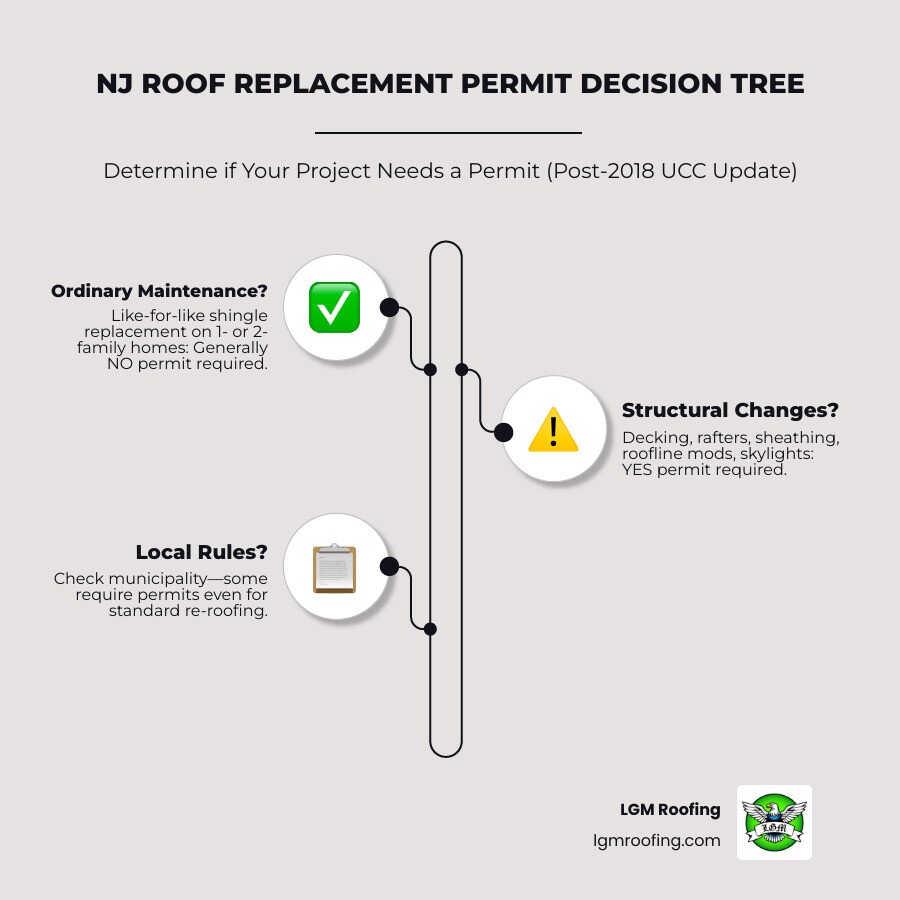
The rules got significantly simpler for most New Jersey homeowners back in 2018, when a state-level update to the NJ Uniform Construction Code reclassified standard re-roofing on detached one- and two-family homes as “ordinary maintenance.” That change removed the permit requirement for many common roof replacements — saving time, reducing paperwork, and getting projects done faster.
But here’s where it gets complicated: not every municipality in New Jersey follows the state exemption to the letter. Some towns still require permits regardless of the 2018 update, and certain project types — anything touching the structure beneath your shingles — trigger permit requirements no matter what. Getting this wrong can mean fines, insurance headaches, and real problems when you try to sell your home.
Understanding exactly where your project falls is critical before the first shingle comes off your roof.
I’m Darwin Mizhirumbay, co-owner of LGM Roofing and a second-generation roofing professional who has navigated NJ’s permitting landscape across dozens of municipalities — understanding do you need a permit for roof replacement in NJ is one of the most important things we help homeowners get right before any project begins. In the sections below, I’ll walk you through everything you need to know to stay compliant, protected, and confident in your roofing project.
The 2018 NJ UCC Update and Ordinary Maintenance
To understand the current landscape in May 2026, we have to look back at the landmark change that occurred on March 5, 2018. The New Jersey Department of Community Affairs (DCA) updated the Uniform Construction Code (UCC), specifically N.J.A.C. 5:23, to streamline home improvements.
Under this update, roofing and siding work on detached one- and two-family dwellings was reclassified as “ordinary maintenance.” This was a massive win for homeowners in places like Bloomfield and Piscataway, as it theoretically eliminated the need for a construction permit for a standard shingle swap. The state’s goal was to reduce the administrative burden on both residents and local building departments.
However, this exemption comes with strict boundaries. It only applies to residential “like-for-like” replacements that do not involve structural modifications. Furthermore, it is essential to remember that even if a permit isn’t required, you are still legally bound to follow the building code. For instance, you cannot simply add a third layer of shingles just because you don’t need a permit. Knowing how many shingle layers are actually allowed by code is vital, as NJ law limits asphalt roofs to a maximum of two layers.
Understanding the “Like-for-Like” Rule
A “like-for-like” replacement means you are replacing existing shingles with similar materials without changing the roof’s pitch or footprint. If your project is purely cosmetic—meaning you are removing old shingles and installing new ones—it often falls under the permit exemption.
This is standard for most roof repair vs replacement in NJ decisions. If the underlying structure is sound and you are simply refreshing the protective layer, you are likely in the clear regarding state-level permit requirements.
Why the 2018 Change Matters in May 2026
Eight years after this policy change, the benefits are still felt in our local communities. In May 2026, homeowners can enjoy much faster project timelines. Without the 1–2 week wait for permit approval in many townships, a roofing crew can often begin work as soon as the weather permits.
This administrative relief allows us to focus on the technical quality of the install rather than chasing paperwork. However, we always caution our clients: “ordinary maintenance” does not mean “unregulated.” You still need to ensure your contractor is following the latest safety and material standards. To help you decide if your project fits this category, check out our guide on roof repair vs replacement how to know what your NJ home really needs.
When do you need a permit for roof replacement in nj?

While the 2018 update cleared the way for many, there are several “triggers” that make a permit mandatory. If you are asking do you need a permit for roof replacement in nj, the answer is a resounding “Yes” if your project involves any of the following:
- Structural Modifications: This includes replacing rafters, trusses, or a significant amount of roof decking (sheathing).
- Roofline Changes: Adding a dormer, changing the pitch, or altering the height of the roof.
- Multi-Family and Commercial: The 2018 exemption only applies to detached one- and two-family homes. If you live in a townhouse, condo, or own a commercial building in Paterson, you must obtain a permit.
- Material Changes: Switching from light asphalt shingles to a heavy slate or tile roof may require a structural load calculation and a permit to ensure the house can support the weight.
Structural triggers: When do you need a permit for roof replacement in nj?
The moment your project moves past the shingles and into the “bones” of the house, the township wants to be involved. If we find that more than 25% of your roof sheathing is rotted and needs replacement, many NJ municipalities will require a permit and a subsequent decking inspection.
This is for your safety. A roof is only as strong as the deck it sits on. If you’re considering a shortcut, read our analysis on whether can you install a new roof over an old one. Often, a full tear-off is the only way to inspect the structure and ensure it meets code.
Beyond shingles: When do you need a permit for roof replacement in nj?
Modern roof replacement projects often involve more than just shingles. If you are adding skylights where none existed before, or if you are integrating solar panels, you are changing the structural load and the building’s envelope. These additions almost always require a permit to verify that the framing is reinforced correctly and that the solar mounts meet wind-uplift requirements.
Local Township Variations and Compliance Risks
New Jersey is famous for its “home rule,” which means local municipalities often have the final say on how state laws are interpreted. While the state says permits aren’t required for residential roofing, some towns in Essex County or Mercer County may still insist on them or require a “no-fee” registration.
For example, if you are planning a roof replacement in Bloomfield, the local building official might have specific requirements for debris containers or attic ventilation that differ from a neighbor in Wayne. We always recommend a quick call to your local construction office to verify their current stance on the 2018 UCC update.
The Consequences of Unpermitted Work
Skipping a required permit is a gamble that rarely pays off. If a building inspector sees a dumpster in your driveway without a permit on the window, they can issue a “Stop Work Order.” This halts your project mid-stream, often leaving your roof exposed to the elements while you scramble to file paperwork.
Beyond the immediate delay, the consequences include:
- Fines: Municipal fines can range from $500 to over $2,000.
- Insurance Issues: If a leak occurs later and the insurance company discovers the work was unpermitted, they may deny your claim.
- Resale Problems: During a home sale, the buyer’s inspector or the town’s C.O. (Certificate of Occupancy) inspector will check for open permits. If they find unpermitted work, you may be forced to strip the roof and have it re-inspected—or pay massive penalties to “regularize” the project. This is why hiring an unlicensed NJ roofer is a recipe for disaster.
Protecting Your Investment and Resale Value
A permit isn’t just a tax; it’s a layer of protection. When a permit is closed, the town issues a Certificate of Approval. This document is proof to future buyers and insurance companies that your roof was installed to code. It is an essential piece of paper to keep in your home’s permanent file, especially if you ever need to navigate the ultimate guide to filing a roof damage insurance claim.
The Application and Inspection Process for NJ Homeowners
If it turns out you do need a permit, don’t panic. The process is straightforward when handled correctly. Usually, the application requires a “Technical Folder” which includes:
- Construction Permit Application: Basic details about the property.
- Building Subcode Technical Section: Details on the roofing materials and methods.
- Proof of Ownership: Often a copy of your tax bill or deed.
- Contractor Information: A copy of our NJ Home Improvement Contractor (HIC) license and proof of insurance.
Documentation: What is required when do you need a permit for roof replacement in nj?
When we handle the permit for you, we provide the municipality with a detailed scope of work. This includes the brand and type of shingles, the type of underlayment, and our plan for debris disposal. Townships are increasingly strict about where old shingles end up, so having a documented disposal plan is a must.
Required Inspections and Final Sign-off
For a permitted roof, there are usually two key inspections:
- The Decking Inspection: Performed after the old shingles are removed but before the new ones go on. The inspector checks for rotted wood and ensures the nailing pattern of the plywood meets code.
- The Final Inspection: Performed once the job is complete. The inspector looks at the flashing around chimneys, the ridge vents, and the overall installation to ensure it matches the approved plans.
Once the final inspection passes, the permit is “closed.” Always ensure you receive a copy of the final sign-off from your contractor.
Frequently Asked Questions about NJ Roofing Permits
Do minor roof repairs require a permit in New Jersey?
Generally, no. Replacing a few missing shingles, patching a small leak, or resealing flashing around a pipe boot is considered “ordinary maintenance.” As long as you aren’t replacing more than 25% of the total roof area within a 12-month period, you typically do not need to involve the building department.
Should the homeowner or the contractor apply for the permit?
While a homeowner can apply for a permit as an “owner-builder,” we strongly recommend that the contractor pulls the permit. When the contractor’s name is on the permit, they are legally responsible for the work meeting code. If a contractor asks you to pull the permit, it’s often a red flag that they aren’t properly licensed or insured in the state of New Jersey.
Are there exemptions for shingle overlays in NJ?
A shingle overlay (installing new shingles over old ones) follows the same permit rules as a replacement, but with one major catch: the “Two-Layer Limit.” Per the International Residential Code (IRC) R908.3.1.1, you cannot have more than two layers of roofing. If you already have two layers, a full tear-off is mandatory, and no permit exemption will save you from a violation if you try to add a third.
Conclusion
Navigating the question of do you need a permit for roof replacement in nj doesn’t have to be a headache. While the 2018 laws made things easier for many single-family homeowners, the local variations and structural requirements mean you still need an expert in your corner.
At LGM Roofing, we bring over 25 years of experience to every doorstep in Wayne, Paterson, Bloomfield, and Piscataway. As a GAF Master Elite certified contractor, we don’t just understand the building codes—we exceed them. We handle the paperwork, coordinate with local building officials, and ensure your new roof comes with the superior warranties and quality assurance you deserve.
Ready to start your project with a team that knows NJ regulations inside and out? More info about our services is just a click away. Let us protect your home with a roof that’s built to last and fully compliant.
