


The Complete Guide to Vinyl Siding vs Fiber Cement Siding Comparison
Vinyl Siding vs Fiber Cement Siding: Which Is Right for Your Home?
A vinyl siding vs fiber cement siding comparison is one of the most common decisions New Jersey homeowners face when it’s time to replace or upgrade their exterior. Here’s a quick side-by-side breakdown to help you decide at a glance:
| Feature | Vinyl Siding | Fiber Cement Siding |
|---|---|---|
| Durability | Good | Excellent |
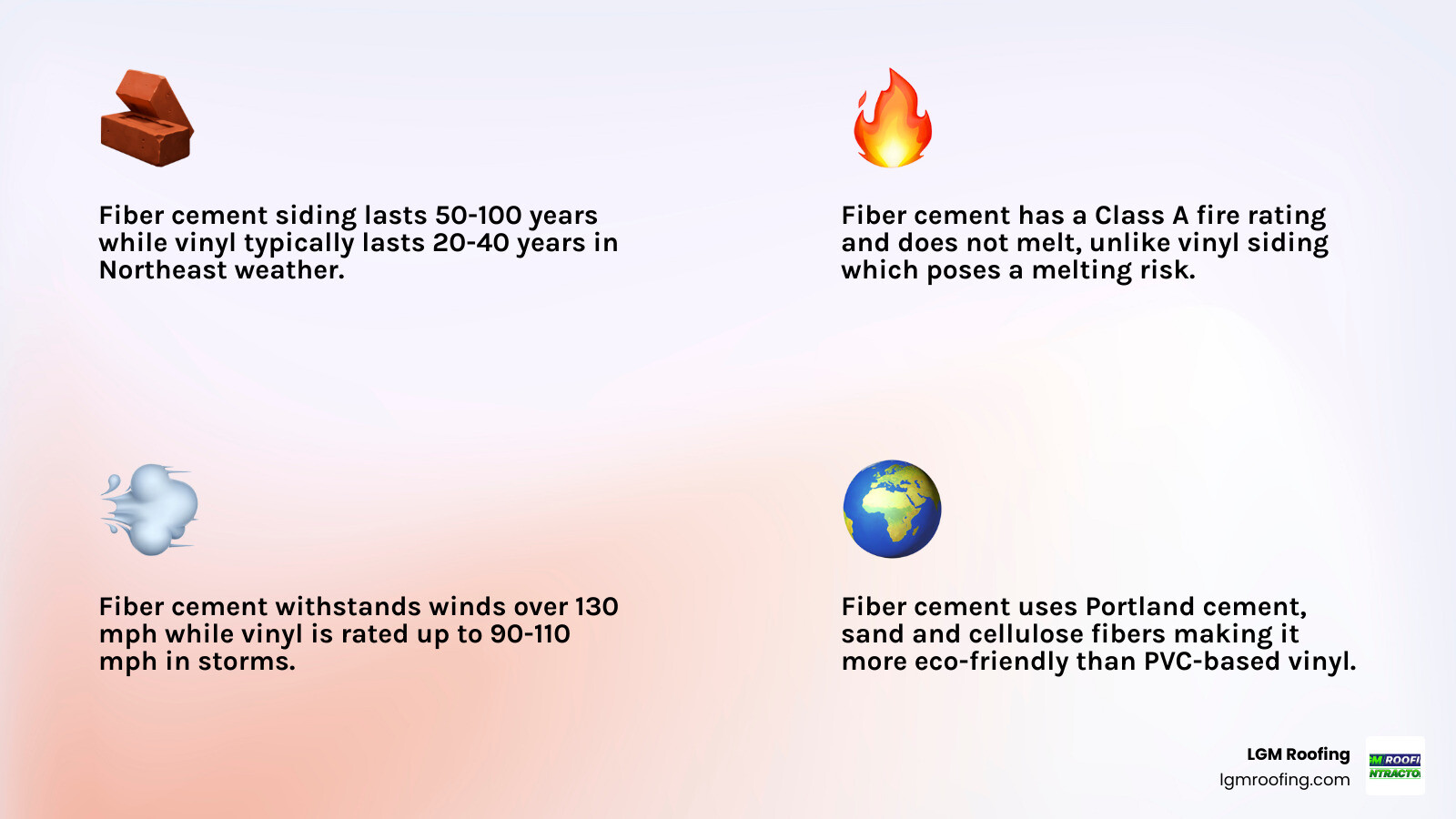
| Lifespan | 20-40 years | 50-100 years |
| Fire Resistance | Low (melts) | High (Class A rating) |
| Wind Resistance | Up to 90-110 mph | 130+ mph |
| Maintenance | Low (occasional washing) | Moderate (repainting every 10-15 years) |
| Upfront Cost | Lower | Higher |
| Resale Value | Good | Better |
| Eco-Friendliness | Lower (PVC-based) | Higher (cement, sand, cellulose) |
| Installation Complexity | Easier | Requires skilled crew |
Both materials protect your home, improve curb appeal, and outperform traditional wood siding on maintenance. But they serve different homeowner priorities. Vinyl wins on affordability and ease of upkeep. Fiber cement wins on longevity, fire safety, and long-term value — especially in a climate like New Jersey’s, where freeze-thaw cycles, humidity, and storm exposure put siding through its paces year after year.
The right choice depends on your budget, how long you plan to stay in your home, your neighborhood’s price range, and how much maintenance you’re willing to take on. This guide walks you through every major factor so you can make a confident, informed decision.
I’m Darwin Mizhirumbay, founder of LGM Roofing and a second-generation contractor with hands-on experience helping New Jersey homeowners navigate exactly this kind of vinyl siding vs fiber cement siding comparison. Having worked on hundreds of exterior projects across the state, I’ve seen how the right siding choice can protect a home for decades — and how the wrong one can cost far more in the long run.
Core Differences in a Vinyl Siding vs Fiber Cement Siding Comparison
To truly understand how these two heavyweights stack up, we have to look beneath the surface at their core material compositions. The physical makeup of each material dictates how it handles physical impacts, structural shifting, and decades of exposure to New Jersey weather.
Vinyl siding is primarily manufactured from polyvinyl chloride (PVC) resin, a petroleum-derived plastic. To make it suitable for home exteriors, manufacturers mix in stabilizers, pigments, and modifiers that help the material resist ultraviolet (UV) radiation and minor impacts. Because it is a form of plastic, vinyl is lightweight, flexible, and completely impervious to water. However, it is relatively thin—typically measuring between 0.040 and 0.048 inches. This thin profile means it relies heavily on the structural integrity of your home’s sheathing and can feel somewhat hollow to the touch unless paired with a fused foam backing.
On the other side of our vinyl siding vs fiber cement siding comparison, fiber cement is a heavy, dense composite material. It is manufactured from a precise blend of Portland cement, ground sand, water, and cellulose fibers. The cellulose fibers act as a reinforcing agent, giving the rigid cement base the tensile strength and flexibility it needs to resist cracking. Fiber cement is substantially thicker than vinyl, usually averaging around 0.25 to 5/16 of an inch. This thickness—up to five times that of standard vinyl—allows manufacturers to press deep, realistic textures into the face of the boards, mimicking the heavy shadow lines and grain patterns of natural cedar wood.
| Property | Vinyl Siding | Fiber Cement Siding |
|---|---|---|
| Primary Ingredient | Polyvinyl Chloride (PVC) | Portland Cement, Sand, Cellulose |
| Material Thickness | 0.040″ – 0.048″ | 0.25″ – 0.3125″ (5x thicker) |
| Weight per 100 Sq. Ft. | ~45 to 70 lbs | ~300 lbs |
| Structural Feel | Flexible, can feel hollow | Rigid, solid, mimics masonry |
| Expansion & Contraction | High (requires loose nailing) | Minimal (highly stable) |
When we look at how these materials behave on a wall, their structural differences become highly practical. Because vinyl is plastic, it expands and contracts significantly as temperatures change. An installer must hang vinyl siding loosely on the nails so it can slide back and forth; nailing it too tight will cause the panels to buckle, warp, or crack as the seasons change. Fiber cement, being cement-based, is incredibly stable. It barely moves with temperature swings, allowing for tight, clean joints that stay sealed over time.
For a deeper look into selecting the perfect material for your home’s unique shape and exposure, check out our comprehensive resource, Siding Selection 101: A Homeowner’s Comparison Guide. If your current exterior is already showing its age, it might be time to read up on the warning signs in Don’t Let Your House Shed Its Skin: Signs You Need New Siding.
Durability and Lifespan in the Northeast Climate

New Jersey weather does not go easy on home exteriors. From the humid, coastal salt air near the shore to the freezing winter winds blowing through Paterson NJ and Wayne NJ, our homes experience a brutal cycle of seasonal extremes. Choosing a siding material that can withstand these rapid transitions is key to protecting your structural framing.
The freeze-thaw cycle is particularly tough on home siding. During late winter and early spring, moisture can seep behind or into exterior claddings. When night temperatures drop below freezing, this water expands.
For vinyl siding, the threat during winter isn’t water absorption—since plastic cannot absorb water—but rather temperature-induced brittleness. When the thermometer plunges, PVC plastic becomes highly rigid and fragile. If a stray winter storm hurls hail, or if a rogue tree branch strikes cold vinyl, the material is prone to cracking, chipping, or puncturing.
Fiber cement handles freeze-thaw cycles differently. Because it is a dense composite, it is highly rigid and retains its impact resistance regardless of how cold it gets. It won’t become brittle in a Piscataway winter. However, because it contains cellulose fibers, proper installation is absolutely critical. All cut edges of fiber cement must be sealed and painted during installation to prevent liquid water from penetrating the core of the board, which could lead to delamination over decades of freezing and thawing.
Wind resistance is another area where the physical properties of these materials play a massive role:
- Vinyl Siding: Standard vinyl is rated to withstand winds between 90 and 110 mph. Because it is lightweight and hung loosely on nail hems to allow for thermal expansion, extreme winds can occasionally catch the edges of the panels, causing them to rattle or, in severe storms, pull completely off the wall.
- Fiber Cement Siding: Weighing roughly 300 pounds per square (100 square feet), fiber cement is incredibly heavy and is nailed tightly directly into the wall studs. When installed correctly by experienced professionals, it is rated to withstand winds upwards of 130 mph, making it a highly reliable choice for storm-prone regions in the Northeast.
To understand how your home’s exterior will fare during our toughest season, explore our detailed analysis in Will Your Siding Survive a Northeast Winter?.
Lifespan Expectations in a Vinyl Siding vs Fiber Cement Siding Comparison
When planning a long-term investment in your home, understanding the true lifespan of these materials is crucial. While both options outlast traditional untreated wood, their long-term performance curves look very different.
Standard vinyl siding typically has a functional lifespan of 20 to 30 years. However, in climates with strong seasonal sun exposure, vinyl can begin to show visible signs of aging after just 10 to 15 years. The combination of UV radiation and thermal expansion causes the chemical bonds in the PVC to degrade over time. This leads to:
- Fading and Chalking: The vibrant color you chose gradually loses its luster, often developing a powdery white residue on the surface.
- Brittleness: As the plasticizers in the vinyl dry out, the panels lose their flexibility, making them increasingly susceptible to cracking from minor impacts like lawnmowers or basketballs.
- Warping: Extreme heat, sometimes magnified by reflections from modern low-E windows on neighboring homes, can actually melt or warp vinyl panels from yards away.
Fiber cement siding, by contrast, is engineered for extreme longevity, frequently lasting between 50 and 100 years. Because it is made of mineral-based materials, it is completely immune to UV degradation, meaning it will never warp, melt, or become brittle from sun exposure. While the finish or paint applied to fiber cement will need to be refreshed over the decades, the structural board itself remains completely stable.
To explore the best long-term exterior options for our region, take a look at Don’t Let Winter Win with These Top Northeast Siding Choices. If you are a homeowner in the Essex County area planning a project, our Siding Replacement Bloomfield NJ Guide offers excellent localized insights.
Maintenance, Aesthetics, and Environmental Impact
Beyond raw durability, your daily relationship with your home’s exterior comes down to maintenance, visual appeal, and how you feel about its ecological footprint.
Let’s start with maintenance. Vinyl siding is famously low-maintenance. Because the color is baked directly throughout the PVC material, it never needs to be painted, scraped, or stained. If you want to change the color of your home down the road, painting vinyl is highly impractical and rarely lasts, but for homeowners who want a “set-it-and-forget-it” exterior, vinyl is tough to beat. Your only real maintenance task is an annual rinse with a garden hose and a soft-bristle brush to remove accumulated dirt, pollen, or mildew from shaded areas of the house.
Fiber cement siding requires a bit more active stewardship, though it is still incredibly manageable compared to natural wood. While the boards themselves can last a century, the paint finish on top does not. If you purchase pre-finished fiber cement utilizing advanced factory-baked color technologies, you can expect the finish to last 15 years or more without fading. Eventually, however, fiber cement will require repainting—typically every 10 to 15 years. Additionally, because fiber cement installations rely on high-grade caulking at the joints and trim transitions to keep moisture out, you will need to inspect and occasionally refresh these caulk joints every 5 to 7 years.
From an environmental standpoint, the two materials represent very different philosophies:
- Vinyl Siding: Made from PVC, vinyl is a petroleum-based plastic. Its manufacturing process is energy-intensive and releases greenhouse gases. Because it does not biodegrade, old vinyl siding removed during renovations usually ends up in landfills, where it remains indefinitely, though some specialized recycling programs are beginning to emerge.
- Fiber Cement Siding: Composed of natural materials like sustainable wood pulp (cellulose), sand, and cement, fiber cement has a much lower chemical footprint. It is non-toxic and highly sustainable, though the production of Portland cement does carry a notable carbon footprint. Because of its extreme longevity, it needs to be replaced far less frequently than vinyl, reducing landfill waste over the life of the structure.
Aesthetic Versatility in a Vinyl Siding vs Fiber Cement Siding Comparison
Your siding choice is the single most important factor in your home’s curb appeal and, ultimately, its resale value.
Because vinyl siding is thin and molded, its wood-grain textures can sometimes look shallow or repetitive up close. The seams where vinyl panels overlap are also visible, which some homeowners find less appealing on premium or historic homes. However, high-quality, thicker vinyl options and insulated vinyl lines have made massive strides, offering cleaner lines and richer color palettes than the pastels of decades past.
Fiber cement, being five times thicker than vinyl, provides a truly premium aesthetic. It features deep, realistic wood-grain textures that are virtually indistinguishable from natural wood from the sidewalk. Because of its rigidity, it creates deep shadow lines where the planks overlap, giving your home a heavy, high-end architectural look. It can be installed in a wide variety of styles, including traditional horizontal lap boards, vertical board-and-batten, and rustic shake shingles.
This premium look translates directly into financial value. National real estate reports consistently show that fiber cement siding maintains a higher resale value than vinyl, recouping a substantial portion of its installation cost at the time of resale. In mid-to-upper-tier neighborhoods in towns like Wayne NJ or Bloomfield NJ, home buyers often expect premium cladding materials, and having fiber cement can make a home sell significantly faster.
For a detailed look at planning a high-impact exterior upgrade, read our Siding Installation Bloomfield Guide. To learn more about working with local experts who understand these aesthetic nuances, check out The A-Team of Siding Expert Contractors in Bloomfield NJ.
Fire Resistance and Home Safety
When evaluating siding materials, home safety—specifically fire resistance—is a critical factor that is often overlooked until it is too late. The material wrapping your home acts as either a shield or fuel when exposed to extreme heat or open flames.
Fiber cement siding is an industry standout for fire safety. Because its primary ingredients are Portland cement and sand, it is entirely non-combustible. It carries a Class A (or Class 1) flame spread rating, which is the highest safety rating available for building materials. If a fire starts nearby—whether it’s a wildfire, a neighbor’s house fire, or a misplaced backyard grill—fiber cement siding will not ignite, feed the flames, or contribute to the spread of the fire. This exceptional performance is why many insurance companies offer masonry-rate discounts for homes clad in fiber cement.
Vinyl siding behaves very differently under thermal stress. Because PVC is a plastic product derived from petroleum, it has a relatively low melting point. When exposed to high heat—even from a house fire several yards away or a grill pushed too close to the deck—vinyl siding will quickly warp, buckle, and melt off the wall. Once the vinyl melts away, the flammable wood sheathing underneath is exposed directly to the source of the fire, allowing flames to penetrate the home’s framing much faster. Furthermore, when vinyl does burn, it releases thick, toxic black smoke and volatile organic compounds (VOCs).
For homeowners in densely populated areas of northern New Jersey, where homes in cities like Paterson NJ are built with tight setbacks, non-combustible siding can prevent a localized fire on a neighbor’s property from jumping across the property line to your home.
Frequently Asked Questions about Siding Selection
Which siding material is more durable against severe storms?
Fiber cement siding is significantly more durable against severe storms, including high winds and heavy hail. Because of its weight and rigid fastening system, it is rated to withstand winds over 130 mph when installed correctly, whereas vinyl can fail or rattle loose at wind speeds between 90 and 110 mph.
When it comes to hail impact, the materials react differently:
- Vinyl Siding: In cold temperatures, vinyl becomes brittle. Hail can easily puncture or crack the panels, requiring whole-section replacements to maintain water tightness.
- Fiber Cement Siding: Its dense, masonry-like composition easily deflects hail impacts. While a severe storm might chip the paint finish, the structural integrity of the board remains unharmed.
If your home has recently been through a severe storm and you suspect damage, our guide on Siding Repair in Bloomfield NJ provides step-by-step advice on what to look for and how to handle repairs.
How does humidity affect vinyl and fiber cement?
New Jersey summers are notoriously humid, which can create a breeding ground for mold, mildew, and rot.
Vinyl siding is completely waterproof, meaning the plastic panels themselves will never absorb moisture, rot, or support mold growth. However, because vinyl is hung loosely, moisture can sometimes get trapped behind the panels if the house wrap (water-resistive barrier) underneath was poorly installed.
Fiber cement is highly resistant to rot and wood-boring pests because of its cementitious makeup. However, because it contains cellulose (wood) fibers, it can absorb water if it is continuously exposed to standing water or if cut edges are left unpainted. Proper flashing, correct clearances from roofs and ground level, and high-quality paint are vital to keeping fiber cement dry and performing beautifully in humid climates.
Is professional installation required for both materials?
Yes, professional installation is highly recommended for both, but it is absolutely non-negotiable for fiber cement.
Vinyl siding is lightweight and relatively forgiving, but improper DIY installation often leads to warped panels because the installer nailed them too tightly, preventing natural thermal movement.
Fiber cement is incredibly heavy (around 300 lbs per square) and requires specialized tools, including dust-collecting shears or carbide-tipped blades, to cut safely. Because it is a rigid material, improper handling can lead to cracked edges, and incorrect fastening will void the manufacturer’s warranty. To protect your investment and ensure your home remains completely watertight, always work with certified Siding Contractors who have specific training in handling heavy composite materials.
Conclusion
Choosing between vinyl and fiber cement isn’t about finding a single “best” material—it’s about matching the right product to your home’s architectural style, your personal budget, and your long-term goals.
Vinyl remains an exceptional, highly popular choice for homeowners seeking a beautiful, low-maintenance upgrade that fits comfortably within a standard remodeling budget. Fiber cement, on the other hand, represents a premium investment in your home’s structural longevity, fire safety, and curb appeal, offering an unmatched wood-like aesthetic that stands up to the harshest Northeast winters.
At LGM Roofing, we bring more than 25 years of general contracting experience to every home exterior project across New Jersey—from Wayne NJ and Paterson NJ to Piscataway NJ and Bloomfield NJ. Our commitment to excellence, unmatched local service, and robust warranties ensure your home is protected for decades to come, no matter which material you choose.
Are you ready to transform your home’s exterior and boost your curb appeal? Contact us today to explore our professional Siding Installation services and schedule your personalized consultation.
