
Fiberglass vs. Wood: A Homeowner’s Guide to Comparing Exterior Doors
Choosing the right entry door for your home? Compare fiberglass, wood, and steel for NJ’s climate, curb appeal, energy, and security.

Fiberglass vs. Wood: A Homeowner’s Guide to Comparing Exterior Doors
Why Choosing the Right Entry Door for Your Home Matters More Than You Think
Choosing the right entry door for your home comes down to five key factors:
- Material – Fiberglass, wood, or steel each offer different levels of durability, maintenance, and insulation
- Architectural style – Your door should complement your home’s design, trim, and exterior accents
- Energy efficiency – Look for Energy Star ratings, thermal breaks, and proper weatherstripping
- Security – Multi-point locks, reinforced strike plates, and quality hardware protect your home
- Correct sizing and installation – A weather-tight fit depends on accurate measurements and professional installation
Your front door is one of the first things anyone notices about your home. It sets the tone before a single word is spoken. But beyond looks, it’s doing a lot of heavy lifting — keeping out drafts, deterring intruders, and standing up to whatever New Jersey’s four seasons throw at it. Whether you’re replacing a worn-out slab or upgrading for better insulation and curb appeal, the decision involves more trade-offs than most homeowners expect. Material, style, security, and fit all have to work together — and getting one wrong can cost you in comfort, energy bills, or resale value.
I’m Darwin Mizhirumbay, founder of LGM Roofing, and my background in home construction and exterior systems across New Jersey has given me a front-row seat to how much a well-chosen entry door can transform a home — and how much a poor choice can undermine everything else. In this guide, I’ll walk you through everything you need to know about choosing the right entry door for your home so you can make a confident, informed decision.
Comparing Materials: Fiberglass, Wood, and Steel Performance
When we sit down with homeowners in Wayne or Paterson, the first question is almost always about the “best” material. The truth is, the right choice depends on your priorities. Steel doors currently account for about half of the market share because they are incredibly tough and economical, but fiberglass is rapidly gaining ground for its “set it and forget it” nature.
To help you visualize the trade-offs, we’ve put together a quick comparison of how these materials perform in a typical New Jersey environment:
| Feature | Fiberglass | Wood | Steel |
|---|---|---|---|
| Durability | High (Dent/Rust resistant) | Moderate (Prone to rot/warp) | High (Strong, but can dent) |
| Maintenance | Very Low | High (Periodic refinishing) | Low (Needs paint every 3-5 yrs) |
| Energy Efficiency | Excellent (Up to R-8) | Fair (R-2 to R-5) | Good (with insulated core) |
| Average Lifespan | 30+ Years | 20-30+ Years (with care) | 30+ Years |
| Best For | Extreme NJ weather | Historic/Luxury aesthetics | Maximum security & value |
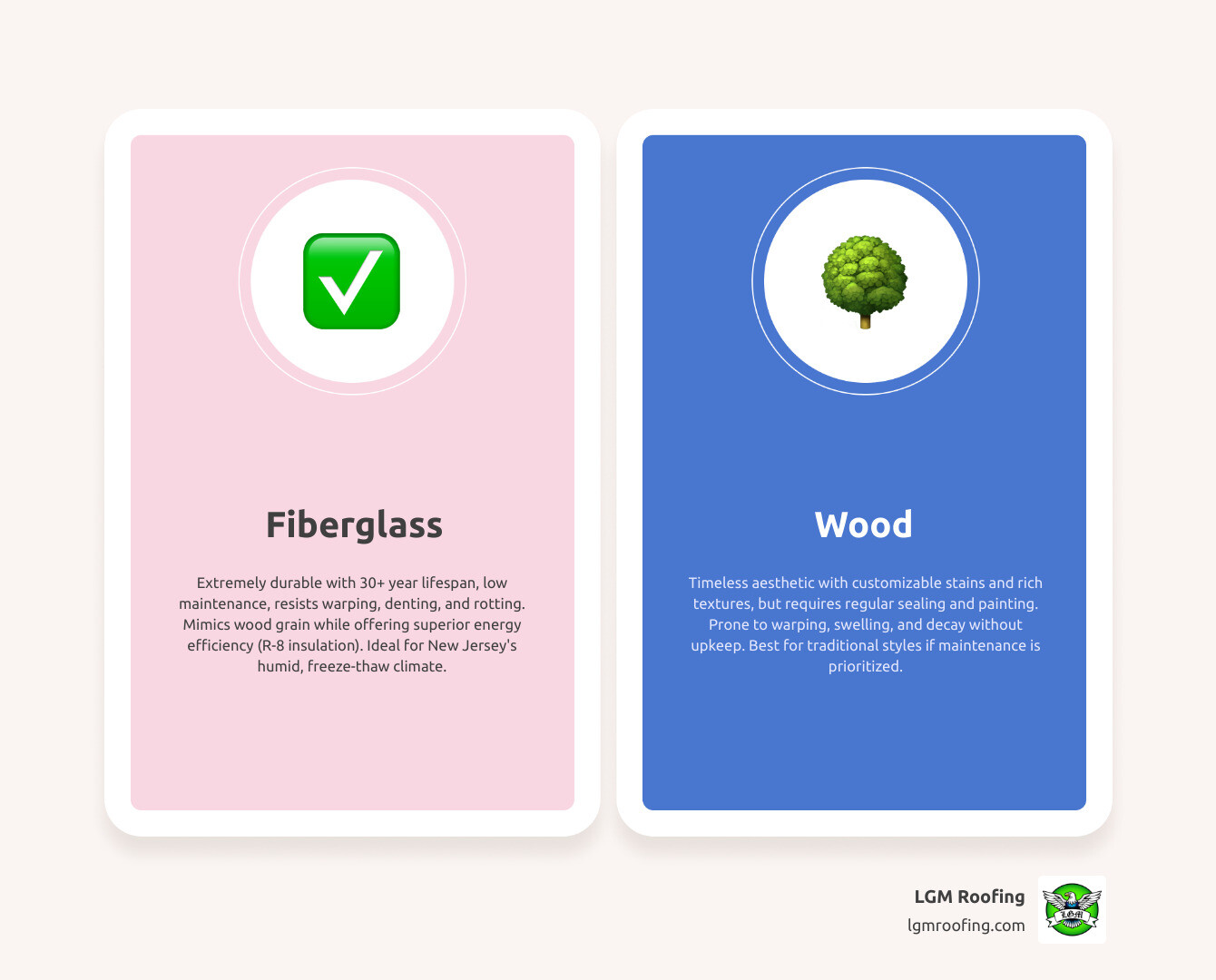
Fiberglass is often the “goldilocks” material for our climate. It can be molded to look exactly like real mahogany or oak, but unlike wood, it won’t swell when the humidity hits 90% in July. Steel doors, usually made with 24-gauge steel skins, offer an impressive return on investment — historically as high as 188% — because they are nearly impossible to kick in when paired with a quality frame. If you are ready to upgrade, our Door Installation services ensure that whichever material you choose is fitted perfectly to your home’s structure.
Material maintenance and lifespan
We like to tell our clients that an entry door is a 30-year investment. However, that lifespan is entirely dependent on how much work you want to do. Wood doors are the “high-maintenance cousins” of the door world. They are stunning, but they require sanding and repainting or revarnishing every few years to prevent moisture from seeping into the grain. Without this, New Jersey’s rain will eventually cause warping or rot.
Steel doors are much easier to manage but aren’t invincible. If a stray rock from the lawnmower chips the paint, you need to touch it up quickly to prevent rust. Most steel doors require a fresh coat of paint every three to five years to stay looking sharp. Fiberglass is the champion of longevity; it’s impervious to salt air and moisture, making it a favorite for our Door Installation in Bloomfield NJ projects where homeowners want beauty without the weekend chores.
Environmental resistance in New Jersey
Living in the Garden State means your door has to be a shapeshifter. In the winter, it deals with sub-zero temperatures and freeze-thaw cycles that can crack inferior materials. In the summer, the heat and humidity can make a wooden door stick in its frame so tightly you’d think it was glued shut.
For those living closer to the coast or in high-humidity areas, salt spray and moisture are constant threats. Fiberglass doors excel here because they have the same expansion and contraction rate as glass, meaning the seals around your decorative windows stay tight for decades. If you’re looking for a local expert who understands these regional quirks, we provide specialized Door Installation Jersey City NJ services tailored to urban and coastal environments.
Matching Your Entryway to New Jersey Architectural Styles
A door can be technically perfect, but if it looks like a spaceship landed on a Colonial home, it’s going to hurt your curb appeal. New Jersey is home to a massive variety of architectural styles, from the historic Victorians in Montclair to the sleek modern builds in Piscataway.
- Colonial & Georgian: These homes thrive on symmetry. A classic six-panel door in bold colors like navy, black, or deep red is the gold standard.
- Craftsman & Bungalow: Look for doors with three panels and small, square glass inserts at the top. Natural wood stains or earth tones like sage green work best here.
- Modern/Contemporary: Go bold with minimalistic designs, horizontal glass lites, and vibrant colors like lime green or bright orange.
- Tudor: Arched doorways and heavy wrought iron hardware are the hallmarks of this style.
For more specific regional advice, check out our Door Installation Guide Belleville NJ to see what styles are trending in your neighborhood.
Choosing the right entry door for your home based on curb appeal
When choosing the right entry door for your home, think of the door as the “jewelry” of the house. The hardware finish you choose — whether it’s oil-rubbed bronze for a rustic look or brushed nickel for a modern vibe — should coordinate with your exterior lighting.
Glass inserts, sidelights, and transoms (the windows above the door) are fantastic for letting in natural light, but they do require a trade-off. More glass generally means slightly lower insulation, though modern double- or triple-pane glass with Low-E coatings has narrowed that gap significantly. If you’re in a historic area, our Montclair NJ Door Installation Tips can help you navigate the balance between vintage aesthetics and modern performance.
Coordinating with home accents
Don’t ignore the “supporting cast.” Your new door should play nice with your window trim, shutters, and molding. A common mistake we see is homeowners picking a beautiful wood-grain fiberglass door but leaving the surrounding trim in a clashing white vinyl. We recommend matching the door’s material feel to the home’s existing accents. For instance, avoid a shiny metal door if your home features rustic cedar shingles. For more on making these elements work together, read our Door Installation Bloomfield NJ Tips.
Technical Essentials: Energy Efficiency and Proper Measurement
You could buy the most expensive door in the world, but if it’s measured incorrectly, you’ll be heating the entire neighborhood this winter. The standard exterior door size is 36 inches wide by 80 inches tall, but “standard” is a loose term in older New Jersey homes. We often find “nominal” sizes like 30×80 or 32×80 in older construction.
When we measure, we look at three things:
- Rough Opening: The hole in the wall. This should be about 2.5 inches wider and 2 inches taller than the door itself to allow for the frame and shimming.
- Jamb Depth: The thickness of your wall.
- Net Frame Dimension: The actual outer width and height of the door unit.
Getting these numbers right is the difference between a door that glides open and one that requires a shoulder-shove to close. For a deeper dive into the technical side, our Door Installation Montclair NJ Guide covers the specifics of measuring for older, settled homes.
Choosing the right entry door for your home for maximum insulation
In 2026, energy efficiency isn’t just a “nice to have” — it’s a financial necessity. Choosing the right entry door for your home can actually save you money on your taxes. Through 2032, homeowners can deduct up to 30% of the cost of a qualifying energy-efficient door.
Look for doors with high R-values (a measure of thermal resistance). While a standard wood door might sit at an R-2, a high-quality fiberglass door can reach R-8 or higher. This is achieved through a polyurethane foam core that acts like a cooler for your home. If you’re looking to maximize your budget, our guide on Smart Savings How to Get Economical Door Installation in Montclair explains how to choose high-efficiency models that pay for themselves over time.
Weatherproofing and sealing
Air leaks are the silent killers of energy efficiency. Most heat loss occurs around the door rather than through the door material itself. We always recommend:
- Silicone or Rubber Weatherstripping: These stay flexible in NJ winters, unlike cheap foam that flattens and cracks.
- Adjustable Thresholds: As your house settles over the years, you can move the threshold up or down to maintain a tight seal.
- Bottom Sweeps: These act as the final barrier against drafts and insects.
If you notice a draft but aren’t ready for a full replacement, our Door Repair Bloomfield NJ Guide offers DIY tips for refreshing your seals.
Choosing the Right Entry Door for Your Home: Security and Installation
Security is the primary job of any entry door. Most forced entries happen when a doorjamb splits near the strike plate. To prevent this, we use 3-inch-long screws that go through the strike plate and deep into the actual wall studs of the house, not just the decorative trim.
Beyond the screws, choosing the right entry door for your home means looking at the locking mechanism. A deadbolt with at least a 1-inch throw bolt is the minimum requirement. For the ultimate in protection, we recommend multi-point locking systems, which secure the door to the frame at the top, middle, and bottom with a single turn of the key. You can find more about high-security options in our review of the Best Door Installation Jersey City NJ.
Professional installation vs. DIY
We get it — the DIY spirit is strong in New Jersey. But installing an entry door is significantly harder than it looks on YouTube. A “prehung” door comes already attached to its frame, which makes it easier, but you still have to ensure the entire unit is perfectly “square, level, and plumb.” If it’s off by even an eighth of an inch, the weatherstripping won’t seal, and the lock might not line up.
Professional installation is especially recommended if you are changing the size of the opening or if your home has settled significantly. We ensure a weather-tight seal that protects your interior flooring from water damage. For a stress-free experience, see why homeowners trust our Welcome Home Expert Door Installation for Montclair Residences.
Enhancing entryway protection
Sometimes, the main door needs a partner. Storm doors are a great addition for New Jersey homes, providing an extra layer of insulation and protecting your expensive primary door from rain and snow. They also allow you to leave the main door open for ventilation while keeping bugs out. For those in high-traffic or urban areas, a dedicated security door made of steel or wrought iron can provide peace of mind without sacrificing style. If you’re facing an emergency or a broken entry, our Emergency Door Install Jersey City Guide is a great resource for quick solutions.
Frequently Asked Questions about Entry Doors
How do I measure for a new entry door replacement?
To get the most accurate measurement, measure the width and height of the existing door slab itself, then round up to the nearest inch. You should also measure the “rough opening” by removing the interior trim to see the space between the wall studs. For older homes in Bloomfield, we often find custom sizes, so it’s best to consult our guide on Door Replacement in Bloomfield NJ before ordering.
What are the main differences between prehung and slab doors?
A slab door is just the door itself — no hinges, no holes for the handle, and no frame. This is a good choice if your existing frame is in perfect condition and you just want a new look. A prehung door comes with the frame, hinges, and weatherstripping already assembled. It’s the best choice for ensuring a weather-tight seal. Learn more about which is right for you in our article on Entryway Excellence Mastering Residential Door Replacement in Bloomfield.
Which door material is best for New Jersey’s climate?
Fiberglass is generally the best all-around performer for New Jersey because it doesn’t rot like wood or rust like steel, and it offers the highest insulation values for our cold winters. However, steel is a fantastic economical alternative that offers superior security. We break down the best options for every budget in our guide to Experienced Residential Door Installation in Belleville NJ for Every Home.
Conclusion
At LGM Roofing, we know that choosing the right entry door for your home is about more than just picking a color from a catalog. It’s about protecting your family, reducing your energy bills, and making sure your home looks its absolute best for years to come. With over 25 years of experience serving New Jersey — from the suburban streets of Wayne to the bustling neighborhoods of Paterson and Bloomfield — we bring a level of expertise and commitment to excellence that is exceptional.
We don’t just “install doors”; we provide peace of mind through quality craftsmanship and a solid warranty that stands the test of time. Whether you’re looking for a high-security steel entry or a stunning wood-grain fiberglass masterpiece, we’re here to help you every step of the way.
Ready to transform your home’s entrance? Contact us today to learn more about our Door Installation services and let’s build an entryway you’ll be proud to come home to.
Ready for a roof you can trust?
Get a free, no-pressure estimate. Family-owned since 2006, GAF Master Elite, and rated 4.9 by 130 homeowners on Google.