
Pick Your Shingle and Mingle with the Best Roofing Options
Discover how to choose the right roofing material for NJ weather, durability, style & 2026 trends. Compare asphalt, metal, slate & more!

Pick Your Shingle and Mingle with the Best Roofing Options
Why Knowing How to Choose the Right Roofing Material Can Save You Years of Headaches
Knowing how to choose the right roofing material starts with answering six key questions:
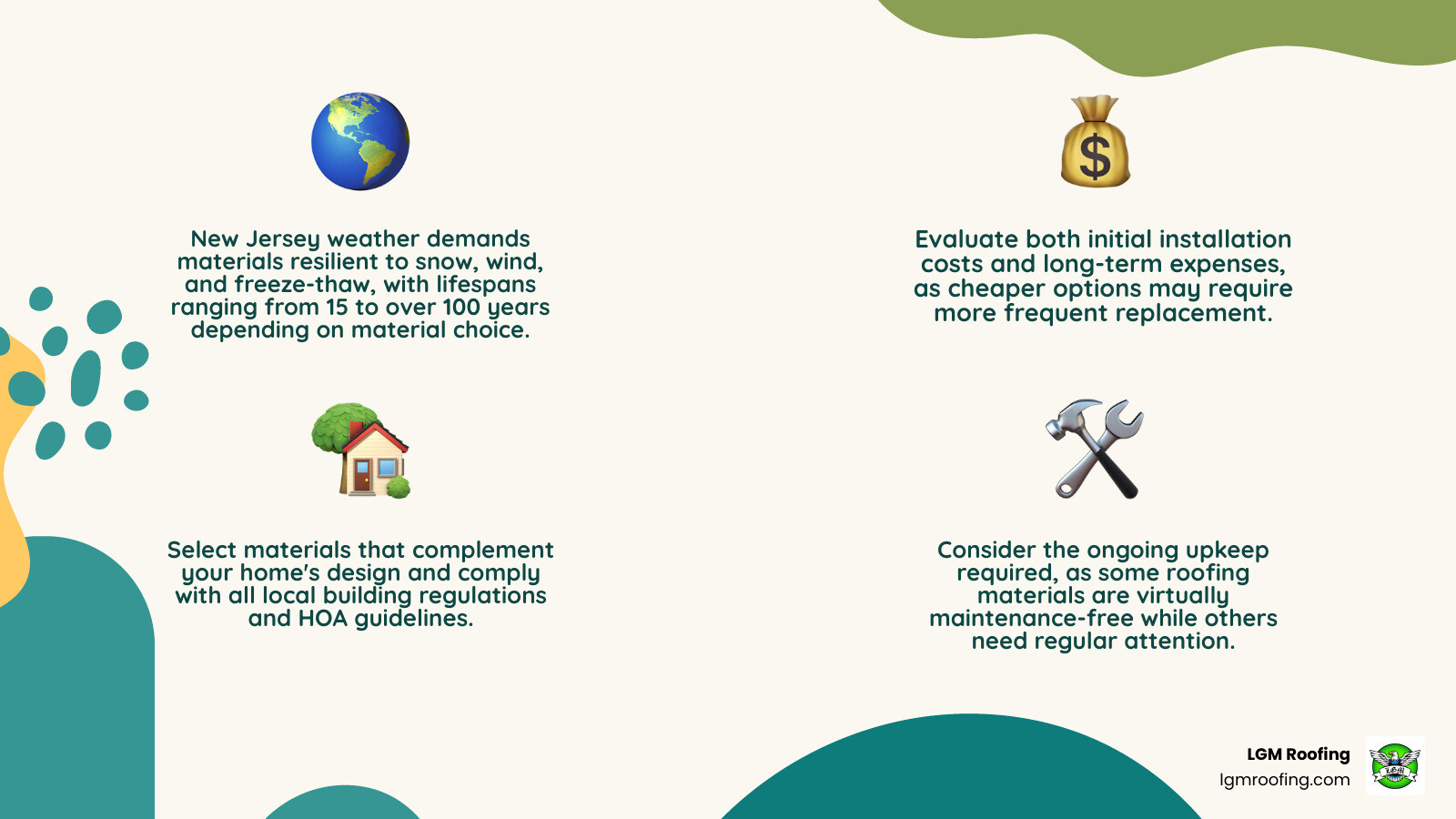
- What’s your climate like? New Jersey homes face snow, humidity, freeze-thaw cycles, and coastal winds — not every material holds up equally.
- How long do you plan to stay? Asphalt shingles last 15–30 years. Metal can last 40–70. Slate and tile can exceed 100 years.
- What’s your budget — upfront and long-term? A cheaper shingle today can cost more over time if it needs replacing twice before a metal roof would.
- What does your home look like? Colonial, Mediterranean, farmhouse, and modern styles each pair naturally with different materials.
- How much maintenance are you willing to do? Some materials are nearly set-and-forget. Others need regular treatment to stay healthy.
- What do local codes and your HOA allow? This can immediately narrow your options before you even compare materials.
Your roof is one of the most important — and expensive — decisions you’ll make as a homeowner. It protects everything underneath it, shapes your home’s curb appeal, and affects your energy bills every single month. Yet for most homeowners, a roof replacement only comes around once or twice in a lifetime, which means most people are making a major decision with almost no experience doing it.
That’s a stressful place to be. You’re comparing materials you’ve never bought before, weighing contractor bids you’re not sure how to read, and trying to figure out what will actually hold up through New Jersey winters, humid summers, and the occasional severe storm — all while managing a budget that doesn’t have much room for mistakes.
The good news? Once you understand the key factors that drive roofing performance, the decision gets a lot clearer. And that’s exactly what this guide is designed to help you do.
I’m Darwin Mizhirumbay, co-owner of LGM Roofing and a second-generation roofing professional who grew up watching my father build this company from the ground up since 2006 — learning what materials perform in New Jersey’s demanding climate and what separates a roof that lasts from one that disappoints. Helping homeowners understand how to choose the right roofing material is something I’m genuinely passionate about, and I’ll walk you through everything you need to make a confident, informed decision.
Key Factors in How to Choose the Right Roofing Material
When we sit down with homeowners in Wayne or Paterson, the conversation usually starts with aesthetics, but it quickly moves to the “boring” stuff that actually matters: durability and engineering. A roof isn’t just a lid on a box; it’s a complex system designed to shed water, resist wind, and breathe.
The first major factor in Roof Replacement is the structural integrity of your home. Some materials, like natural slate or concrete tiles, are incredibly heavy. If your home wasn’t originally designed for that weight, you might need a structural engineer to sign off on reinforcements before we can even talk about shingle colors.
Secondly, you have to look at local building codes. In New Jersey, regulations can be extensive. For example, some municipalities allow you to install a new layer of shingles over an old one, while others strictly forbid it. Knowing these rules upfront prevents a “surprise” work-stop order from a building inspector halfway through the job.
How to Choose the Right Roofing Material for New Jersey Weather
If you’ve lived in Piscataway or Bloomfield for a full year, you know our weather has a bit of an identity crisis. We get “Nor’easters” with heavy, wet snow, humid summers that feel like a sauna, and fall windstorms that love to peel back loose shingles.
When considering How Often Should You Replace Your Roof? A Breakdown by Material & Climate, you have to account for the freeze-thaw cycle. In NJ, water can seep into tiny cracks in your roofing material during a rainy afternoon, freeze solid that night, and expand. Over time, this “ice wedging” can crack lower-quality materials.
In our humid climate, algae resistance is also a must. Have you ever seen those ugly black streaks on a neighbor’s roof? That’s Gloeocapsa magma, a type of algae that feeds on the limestone filler in asphalt shingles. Choosing a material with copper or zinc granules can keep your roof looking clean for decades.
Matching Architectural Style and Curb Appeal
We always say that the roof is the “hat” of the house—it needs to fit the outfit.
- Colonial-style homes: These are staples in the Northeast. They look best with traditional asphalt shingles or rustic wood shakes (or their synthetic equivalents).
- Modern Farmhouses: This style has exploded in popularity in 2026. These homes look stunning with standing seam metal roofing, often in dark charcoal or black.
- Mediterranean or Spanish Colonial: While less common in NJ, if you have one, clay tiles are the traditional choice. However, because of our freeze-thaw cycles, we often recommend concrete tiles or stone-coated steel that mimics the look but handles the ice better.
Comparing Performance Across Popular Roofing Materials
To help you visualize the long game, we’ve put together a quick comparison of how these materials stack up in terms of longevity and resilience.
| Material | Typical Lifespan | NJ Weather Rating | Maintenance Needs |
|---|---|---|---|
| Architectural Asphalt | 20–30 Years | Good | Low |
| Metal (Standing Seam) | 40–70 Years | Excellent | Very Low |
| Natural Slate | 75–150 Years | Excellent | Moderate (Specialized) |
| Composite/Synthetic | 30–50 Years | Excellent | Low |
| Clay/Concrete Tile | 50–100 Years | Good (Weight-dependent) | Moderate |
If you are looking for something unique, our specialty roofing section dives deeper into materials that move beyond the standard shingle.
Asphalt Shingles and Metal Roofing Growth
As of April 2026, asphalt shingles remain the most common choice in the U.S. because they are versatile and reliable. However, we are seeing a massive shift toward Architectural (Dimensional) Shingles. Unlike the flat “three-tab” shingles of the past, architectural shingles are layered, providing a thicker, more textured look that hides imperfections and offers better wind resistance.
On the other hand, metal roofing now holds nearly 20% of the market share. Why the sudden surge? Homeowners are realizing that metal isn’t just for barns anymore. Modern stone-coated steel can look exactly like wood shakes or clay tiles but comes with a 50-year lifespan and incredible energy efficiency. In fact, metal roofing can reduce your cooling costs by up to 25% by reflecting solar heat rather than absorbing it into your attic.
Slate, Clay, and Concrete Tile Durability
If you want the “forever roof,” natural slate is the gold standard. It’s essentially a rock on your roof. It’s fireproof, impervious to rot, and can last for a century. However, it is the most expensive and heaviest option.
Clay and concrete tiles are also incredibly durable. Concrete tiles are particularly popular in 2026 because they can be manufactured to look like almost anything—wood, slate, or traditional terra cotta—while offering superior fire resistance. The main caveat for NJ homeowners is ensuring your roof pitch is steep enough to shed snow effectively, as the weight of the tiles combined with a heavy snow load can be a structural challenge.
Evaluating Long-Term Performance and Maintenance
A common mistake is choosing a roof based only on what it looks like on day one. You have to think about day 3,000.
Wood shakes, for instance, are undeniably beautiful. But in a humid NJ environment, they require regular treatment to prevent rot, moss, and insect infestations. If you aren’t the type to schedule a roof cleaning every few years, wood might not be for you.
When you’re stuck between a Roof Repair vs Replacement in NJ: How to Decide, we look at the “remaining life” of the material. If your shingles are curling or losing their protective granules, a repair is often just a temporary Band-Aid on a larger problem.
Final Steps in How to Choose the Right Roofing Material
Once you’ve narrowed down the material, the final step is choosing the right partner to install it. We recommend getting at least three bids, but don’t just look at the number at the bottom. A “cheap” bid often leaves out critical components like:
- Underlayment: The secondary barrier that protects your deck if a shingle blows off.
- Ice and Water Shield: Mandatory in NJ for eaves and valleys to prevent leaks from ice dams.
- Ventilation: If your roof can’t “breathe,” it will cook your shingles from the inside out, voiding your warranty.
Understanding Warranties and Impact Resistance
In 2026, many manufacturers offer “lifetime” warranties, but you have to read the fine print. Usually, “lifetime” means 10 years of full protection, after which the value depreciates.
We always suggest looking for Class 4 Impact Resistance. This is a rating given to materials that can withstand a 2-inch steel ball dropped from 20 feet without cracking. In a world with increasingly unpredictable storms, a Class 4 roof can often get you a significant discount on your homeowners insurance. Also, check if the warranty is transferable. If you sell your home in five years, being able to tell a buyer the roof warranty carries over to them is a massive selling point.
Emerging Trends in 2026 Roofing Technology
Roofing technology has moved fast over the last two years. We are no longer just looking at “shingles”—we are looking at “energy systems.”
Solar-integrated roofing (like solar shingles) has become a top-tier choice for homeowners in Wayne and Piscataway. Unlike the bulky blue panels of the past, these shingles look almost identical to standard asphalt but generate electricity. They are more subtle, enhance curb appeal, and take advantage of federal tax credits that remain strong through 2026.
Energy Efficiency and Environmental Impact
Sustainability is a huge factor in how to choose the right roofing material today. Cool Roof Technology uses specialized pigments in shingles to reflect more sunlight and absorb less heat. This keeps your attic cooler and reduces the strain on your AC.
Additionally, we’re seeing a rise in synthetic composites. These are often made from recycled rubbers and plastics. They are incredibly tough—often carrying Class 4 impact ratings—and they prevent thousands of pounds of waste from hitting NJ landfills. Metal is also a champion here, as it is 100% recyclable at the end of its long life.
Insurance Benefits and Fire Resistance
Insurance companies are becoming much stricter about roof age and material. In some cases, installing a fire-resistant (Class A rated) or impact-resistant roof can lower your premiums by 5% to 35%.
Metal and tile are naturally fire-resistant, which is a major safety benefit. If you live in a wooded area in New Jersey where brush fires could be a concern, moving away from wood shakes to a Class A rated synthetic or metal roof is a smart move for both safety and your wallet.
Frequently Asked Questions about Roofing Selection
What is the most durable roofing material for cold climates?
For New Jersey’s cold, snowy winters, metal roofing and slate are the champions. Metal is particularly good because it allows snow to slide off easily, preventing the weight buildup that can cause structural stress. Synthetic composites are also excellent because they don’t become brittle in freezing temperatures.
How does roof ventilation affect material lifespan?
Proper ventilation is the “secret sauce” of a long-lasting roof. Without it, heat and moisture get trapped in your attic. In the summer, this heat bakes your shingles. In the winter, the moisture can cause your roof deck to rot and lead to ice dams. A well-ventilated roof can last 25% longer than a poorly ventilated one.
Can I install a new roof over my existing shingles?
While it is sometimes legal in New Jersey to do a “re-roof” (adding a second layer), we generally advise against it. Laying new shingles over old ones hides potential rot in the wood deck, adds double the weight to your home, and usually shortens the lifespan of the new shingles because they trap more heat. Plus, most manufacturers will not offer their full “lifetime” warranty on a second-layer installation.
Conclusion
At LGM Roofing, we believe that a roof is more than just a home improvement project—it’s a legacy. With over 25 years of experience serving New Jersey, we’ve seen every type of weather and every type of material. Our tradition is built on quality, and our heritage is rooted in the hard work Darwin’s father started decades ago.
Whether you are in Wayne, Paterson, Bloomfield, or Piscataway, choosing the right roof doesn’t have to be a gamble. By weighing your home’s architectural style against the realities of NJ weather and long-term maintenance, you can find a solution that protects your family for decades to come.
If you’re ready to stop guessing and start planning, explore our full range of Services or give us a call. We’d love to help you pick your shingle and mingle with the best options available in 2026!
Ready for a roof you can trust?
Get a free, no-pressure estimate. Family-owned since 2006, GAF Master Elite, and rated 4.9 by 130 homeowners on Google.