
Will a Second Layer of Shingles Kill Your Warranty?
Discover if does reroofing affect warranty coverage. Learn overlay risks, NJ codes & steps to protect your roof investment.

Will a Second Layer of Shingles Kill Your Warranty?
Introduction
Does Reroofing Affect Warranty Coverage? Here’s What NJ Homeowners Need to Know
Does reroofing affect warranty coverage — and the short answer is yes, in most cases it does. Here’s a quick breakdown before we dig deeper:
- Manufacturer warranties are typically voided when new shingles are installed over old ones, because the new materials can’t adhere or perform properly on an uneven surface
- Contractor workmanship warranties are often invalidated if a third party performs the overlay or if the installation deviates from the original contractor’s scope
- Extended system warranties almost always require a complete tear-off and certified installation to remain valid
- Spot repairs or partial reroofing can be classified as unauthorized modifications, putting your entire coverage at risk
- Moisture trapped between layers accelerates damage and gives manufacturers grounds to deny future claims
In short: if protecting your warranty is a priority, a full roof replacement is almost always the safer choice over an overlay.
Think about this scenario: you decide to save some money by having new shingles installed right over your existing roof. The job looks fine from the street. Then, two years later, you notice a leak. You pull out your warranty paperwork — and discover your coverage was voided the moment that second layer went down. It’s a frustrating situation that many New Jersey homeowners find themselves in, often without realizing the risk until it’s too late.
Understanding how reroofing decisions interact with warranty coverage isn’t just a technical detail — it’s the difference between having a financial safety net and paying entirely out of pocket when something goes wrong.
I’m Darwin Mizhirumbay, co-owner of LGM Roofing and a GAF Master Elite Contractor, and I’ve seen how the question of does reroofing affect warranty coverage catches homeowners off guard during what should be a straightforward roofing project. In this guide, I’ll walk you through exactly what’s at stake so you can make a confident, informed decision.
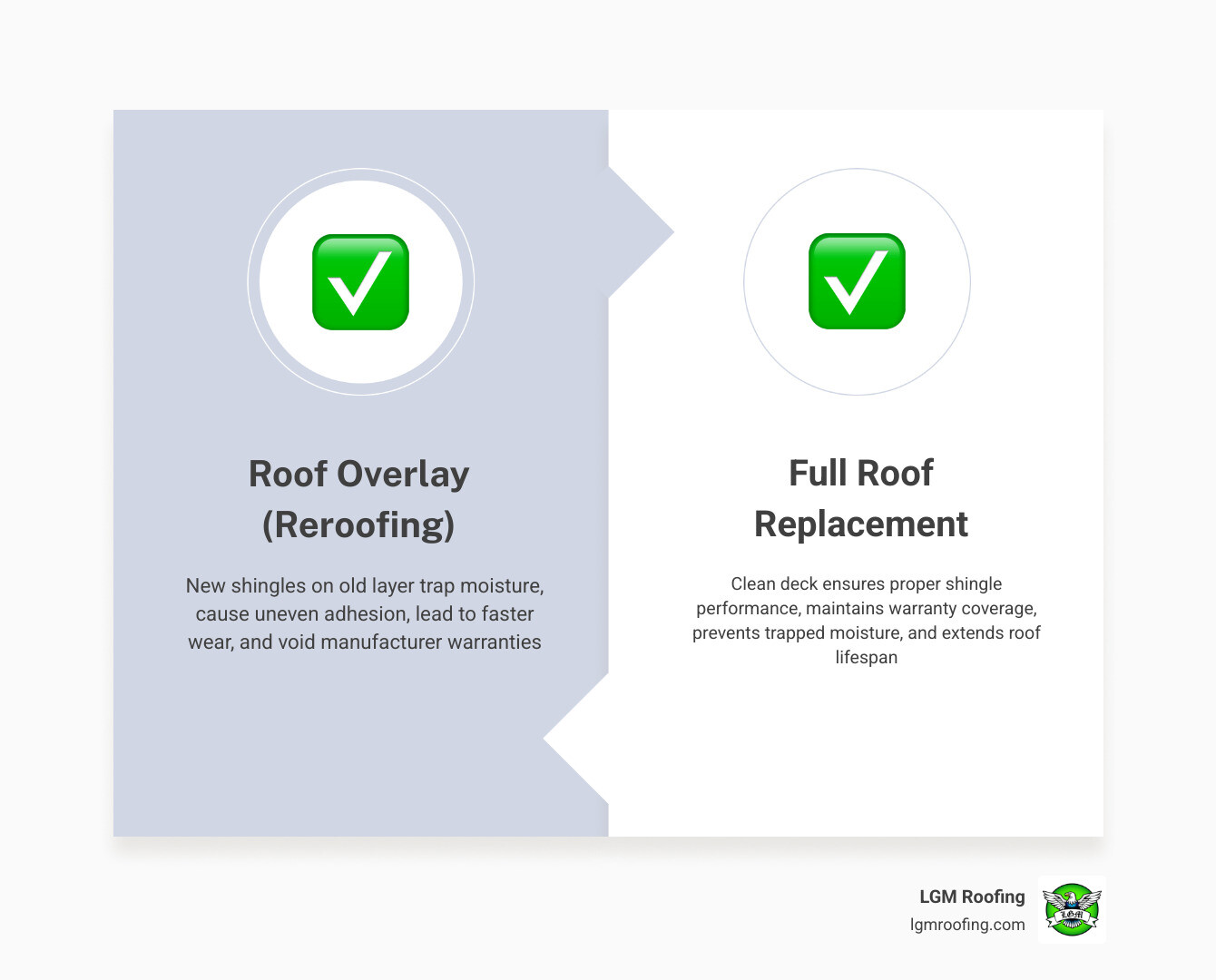
Understanding How Reroofing Affects Warranty Coverage
When we talk about “reroofing” in the industry, we are usually referring to an overlay—the process of nailing a second layer of shingles directly over the existing ones. While this might seem like a cost-effective shortcut, it fundamentally changes the environment in which your roofing materials must perform. Manufacturers design their products to be installed on a clean, flat, and well-ventilated deck.
When you add a second layer, you are essentially asking those shingles to perform on an uneven “moving target.” This leads to several technical failures that manufacturers use as grounds to deny claims. First, there is the issue of heat retention. A double layer of shingles traps significantly more heat than a single layer. In the humid New Jersey summers we experience in places like Paterson and Bloomfield, this excess heat can literally “bake” the shingles from the bottom up, leading to premature curling, granule loss, and cracking.
Furthermore, reroofing creates moisture traps. If there is any dampness in the old shingles or the wood underneath, it becomes sealed between the two layers. This lack of “breathability” leads to wood rot that remains hidden until the structural integrity of your home is compromised. If you are debating between these two paths, our guide on Roof Replacement explains why starting fresh is often the only way to make sure a long-term result.
| Feature | Roof Overlay (Reroofing) | Full Roof Replacement |
|---|---|---|
| Manufacturer Warranty | Often voided or severely limited | Fully intact (25–50 years) |
| Structural Weight | Doubles the load on rafters | Standard design load |
| Heat Dissipation | Poor (traps heat between layers) | Excellent (properly ventilated) |
| Expected Lifespan | Reduced by 20-40% | Full rated lifespan |
| Deck Inspection | Impossible to see rot/mold | Full inspection and repair |
Does Reroofing Affect Warranty Coverage for Manufacturers?
The short answer is a resounding “yes.” Most major shingle manufacturers are extremely specific about their installation requirements. To honor a warranty for material defects, they typically require the shingles to be installed over an approved underlayment attached directly to a clean roof deck.
When you perform an overlay, the new shingles cannot adhere properly to the gritty, uneven surface of the old roof. This prevents the “seal strip” (the adhesive line on the shingle) from bonding correctly. If a windstorm hits Wayne or Piscataway and your shingles blow off because they never sealed, the manufacturer will likely deny the claim, citing “improper installation.” We dive deeper into the local legalities of this in our article on Can You Install a New Roof Over an Old One Pros Cons NJ Regulations.
Impact on Contractor Workmanship Warranties
Beyond the materials themselves, your labor warranty is at risk. A workmanship warranty is a promise from your contractor that they installed the roof correctly. However, if you hire a different company to perform a “spot reroof” or an overlay on a roof originally installed by someone else, you create a “finger-pointing” scenario.
If a leak develops, the original installer will claim the new layer caused the issue, while the new installer will claim the old layer was the problem. This effectively kills your protection. To understand how this fits into your overall project planning, check out our Roof Installation Cost Bloomfield Guide for a clearer picture of professional standards.
Common Reasons an Overlay Voids Your Protection
Manufacturers are “extremely finicky,” as some experts say, about the fine print. One of the most common reasons does reroofing affect warranty coverage is the violation of ventilation standards. A roof needs to “breathe” to prevent heat and moisture from destroying the shingles. When you double the thickness of the roofing material, you make it much harder for the attic to stay cool. If your ventilation doesn’t meet the strict 1-square-foot-per-150-square-feet-of-attic-floor rule, your warranty is likely dead on arrival.
Other common “warranty killers” include:
- Nail Length: Standard roofing nails are often too short to penetrate through two layers of shingles and deeply into the wood deck. If the nails don’t hit the deck, the roof isn’t “attached” according to code.
- Structural Strain: Most New Jersey homes are designed to carry the weight of one roof. Adding a second layer can cause the roof deck to sag, which creates “low spots” where water pools—another automatic warranty exclusion.
- Granule Loss: The extra heat from an overlay causes the asphalt to soften, leading to rapid granule loss. Once those protective granules are gone, the shingles have no UV protection.
For more on avoiding these pitfalls, see our Roof Replacement Bloomfield Complete Guide.
Why Partial Reroofing Affects Warranty Coverage Long-Term
Homeowners often ask us if they can just “reroof” a single slope or a damaged section. This is often classified as an “unauthorized modification.” If you have a 50-year system warranty and you allow a different contractor to perform a spot repair using different methods, you may have just voided the coverage for the entire roof, not just the repaired area.
Mechanical damage—such as someone walking on the shingles or installing a satellite dish incorrectly—is rarely covered by warranties. When you perform a partial reroof, you are essentially creating a “seam” of vulnerability. You can learn more about how to evaluate these situations in our guide: Can My Roof Be Repaired or Does It Need to Be Replaced 7 Ways to Tell.
The Risk of Using Mixed Materials and Brands
Extended manufacturer warranties (often called “System Warranties”) require that every single component—from the starter shingles and underlayment to the ridge vents and hip caps—all come from the same brand. If you reroof using Brand A shingles over Brand B underlayment, you lose the “System” protection and are downgraded to a basic material warranty, which often doesn’t cover labor for replacement. This is a critical factor when deciding between Roof Repair vs Replacement in NJ How to Decide.
Steps to Preserve Your Warranty During a Roofing Project
If you want to ensure your investment stays protected through April 2026 and beyond, you must be proactive. The most important step is choosing a manufacturer-certified contractor. Manufacturers trust these pros to follow their “finicky” rules, and in return, they offer enhanced warranties that cover both materials and labor.
To keep your warranty valid:
- Register Immediately: Most warranties must be registered with the manufacturer within 30 to 60 days of installation. If you miss this window, you may only have a “basic” warranty with no labor coverage.
- Keep a “Roof File”: Save every receipt, contract, and photo. If you ever need to file a claim, the manufacturer will ask for proof of purchase and proof of professional installation.
- Annual Inspections: Many warranties require “reasonable maintenance.” If a small leak goes ignored for a year and causes massive rot, the manufacturer can deny the claim due to owner neglect.
For New Jersey residents, navigating these requirements can be tricky. We offer Roof Repair vs Replacement How to Know What Your NJ Home Really Needs to help simplify the process.
Documentation and Transferability Requirements
Are you planning to sell your home in Paterson or Wayne eventually? A transferable warranty is a massive selling point. However, most warranties do not transfer automatically. Usually, the new owner must send a written notice and a small transfer fee to the manufacturer within 30 days of the closing. If this step is skipped, the warranty often expires the moment the deed changes hands.
Having Insurance Support can also be helpful when documenting the condition of your roof after a storm to ensure your warranty remains in good standing.
Regional Considerations and Insurance Perspectives
In New Jersey, we deal with specific climate challenges—from the salt air near the coast to the heavy snow loads in the north. Because of this, NJ building codes are strict. In many municipalities, you are legally allowed to have a maximum of two layers of roofing. However, just because it’s “legal” doesn’t mean it’s “warrantable.”
Insurance companies also look at reroofing with a skeptical eye. If your home suffers wind damage, an adjuster may find that the shingles blew off because they were nailed into an old, soft layer of shingles rather than solid wood. In that case, the insurance company might only pay for a “partial” repair or deny the claim for “improper installation,” leaving you stuck between a manufacturer who won’t pay and an insurer who won’t pay.
Frequently Asked Questions about Reroofing Warranties
Does installing a new roof over an old one automatically void the manufacturer warranty?
While it doesn’t always “automatically” void the entire thing, it almost always voids the “labor” portion and significantly reduces the “material” coverage. Most manufacturers will only cover manufacturing defects (like shingles falling apart) but will refuse to cover any issues related to seal failure, wind blow-offs, or premature aging caused by the heat of the second layer.
Can I transfer my roof warranty if I chose an overlay instead of a full replacement?
This is much more difficult. Many “enhanced” or “lifetime” warranties that are transferable are only granted for full tear-offs. If you have an overlay, you likely only have a “basic” limited warranty, which may not be transferable at all, or may have very limited value to a future buyer.
How do insurance companies view reroofing when processing a damage claim?
Insurance companies generally view reroofing as a higher risk. They know that a double-layered roof is harder to inspect and more prone to “unseen” damage. If you have a claim, they will check to see if the roof was installed to manufacturer specifications. If the overlay caused the shingles to fail prematurely, they may deny the claim based on “wear and tear” or “improper installation” rather than “storm damage.”
Conclusion
At LGM Roofing, we’ve spent over 25 years serving the New Jersey community, from the busy streets of Paterson to the quiet neighborhoods of Bloomfield and Wayne. We’ve seen the “reroofing” shortcut fail homeowners far too often. While the initial savings of an overlay might look tempting, the long-term reality is that it often kills your warranty, shortens your roof’s life, and complicates your insurance.
If you are asking does reroofing affect warranty coverage, you are already on the right track to protecting your home. Don’t leave your biggest investment to chance. Whether you need a simple repair or a full, warrantied replacement, our team is here to provide the expert guidance you deserve.
Ready to ensure your roof is protected for decades to come? Contact us today for a professional consultation and see why New Jersey homeowners trust us for their Roof Replacement needs.
Ready for a roof you can trust?
Get a free, no-pressure estimate. Family-owned since 2006, GAF Master Elite, and rated 4.9 by 130 homeowners on Google.