
How to Get Paid for Making Your NJ Home More Efficient
Unlock new jersey energy rebates for home upgrades in 2026! Stack federal & state incentives, get cash back & 0% financing for efficiency.

How to Get Paid for Making Your NJ Home More Efficient
How New Jersey Energy Rebates for Home Upgrades Can Put Real Money Back in Your Pocket
New jersey energy rebates for home upgrades are more accessible in 2026 than they have ever been — and most homeowners are leaving thousands of dollars on the table simply because they don’t know where to look.
Here is a quick look at the main programs available right now:
| Program | Who It’s For | Key Benefit |
|---|---|---|
| NJ Whole House Incentive (PSE&G) | NJ homeowners, no income requirement | Up to $7,500 cash-back + $25,000 at 0% financing |
| SAVEGREEN (NJNG) | NJNG customers | Up to $5,000 rebates + $15,000 at 0% APR |
| Comfort Partners | Income-qualified residents (≤225% federal poverty level) | Free energy-saving installations |
| Federal Energy Efficient Home Improvement Credit (IRA) | U.S. homeowners, primary residence | Up to $3,200 annually in tax credits |
| HOMES Program (IRA) | All homeowners; higher rebates for low/moderate income | Up to $8,000 based on energy savings |
| HEEHR (IRA) | Low-to-moderate income households | Up to 100% of project costs for qualifying upgrades |
| Residential Clean Energy Credit (IRA) | U.S. homeowners | 30% of costs for solar, heat pumps, battery storage through 2032 |
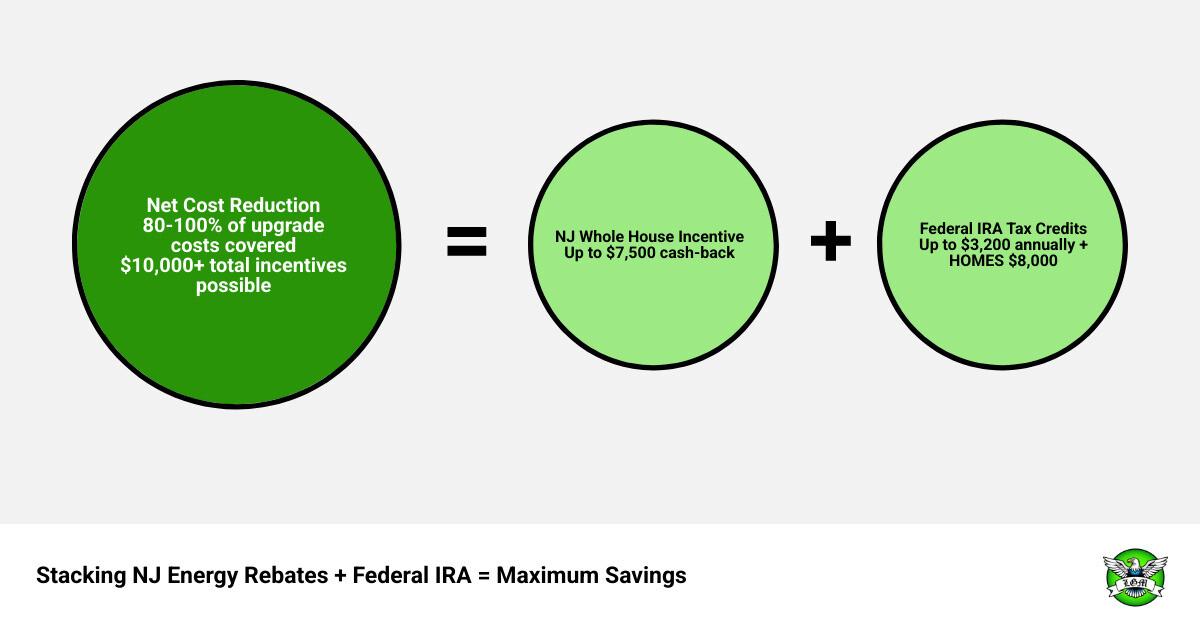
The best part? Most of these programs can be stacked together. A homeowner who combines a state utility rebate with a federal tax credit can dramatically reduce the out-of-pocket cost of upgrading insulation, windows, HVAC, or even roofing.
New Jersey has been steadily expanding its clean energy incentives through the NJ Clean Energy Program (NJCEP), while the federal Inflation Reduction Act continues to layer on additional savings opportunities. Whether you own a single-family home in the suburbs or a small multi-family property near the shore, there is likely a program designed specifically for your situation.
The catch is that these programs have funding limits, application deadlines, and eligibility requirements that change. Knowing how to navigate them — and how to time your upgrades — is what separates homeowners who capture the full benefit from those who miss out entirely.
I’m Darwin Mizhirumbay, founder of LGM Roofing and a New Jersey contractor with experience helping homeowners understand how exterior improvements like roofing, siding, and insulation connect directly to new jersey energy rebates for home upgrades. In this guide, I’ll walk you through every major program, who qualifies, and how to stack incentives to get the most out of your 2026 home improvement project.
Overview of New Jersey Energy Rebate Programs for 2026
Navigating the landscape of energy efficiency in New Jersey requires a bit of a roadmap. As we move through April 2026, the state’s commitment to reducing carbon emissions has resulted in a robust menu of incentives. These aren’t just small “thank you” checks; they are substantial financial tools designed to make high-efficiency living economical for everyone from Paterson to Piscataway.
The backbone of these efforts is the New Jersey Clean Energy Program (NJCEP), which coordinates with major utility providers like PSE&G, JCP&L, and New Jersey Natural Gas (NJNG). Whether you are dealing with signs of roof damage or just want to lower your monthly overhead, these programs provide the capital to get the job done right.
How to qualify for New Jersey energy rebates for home upgrades in 2026
To get your hands on these rebates, you need to follow a specific set of rules. First and foremost, most programs require the property to be your primary residence. Investment properties or “flips” typically do not qualify for the largest consumer-facing rebates.
The “Golden Rule” of NJ energy rebates is the Home Energy Audit. Before you swing a hammer or buy a new furnace, a BPI-certified (Building Performance Institute) auditor must assess your home. They use specialized software to model your home’s energy use and project how much you’ll save with specific upgrades. Furthermore, all work must be performed by approved, certified contractors to ensure the energy savings are actually realized.
Understanding the 2026 Whole House Incentive Program
One of the most exciting opportunities this year is the Whole House Incentive Program. Rather than just giving you a flat rebate for a single appliance, this program looks at your home as a complete system.
If your planned upgrades—such as air sealing, insulation, and high-efficiency HVAC—result in at least a 5% projected Total Energy Savings (TES), you qualify for a minimum $2,000 cash-back rebate. For every percentage point of savings you achieve beyond that 5%, you can earn an additional $200, capping out at a generous $7,500. To make the project even more feasible, many participants can access up to $25,000 in zero-interest financing to cover the upfront costs.
Maximizing New Jersey energy rebates for home upgrades through exterior improvements
As roofing and siding experts, we often see homeowners overlook the “envelope” of their home. You can install the most expensive heat pump in the world, but if your walls and roof are leaking air, you’re literally throwing money out the window. This is why programs like SAVEGREEN and the PSE&G Whole House Incentive prioritize air sealing and insulation.
Energy-efficient window and door incentives
Your windows and doors are the most common points for thermal transfer. In our window remodeling New Jersey guide, we emphasize that modern windows do more than just look good. To qualify for federal tax credits and state rebates, windows must generally be ENERGY STAR certified.
When selecting products, we look at the U-Factor (how well the window insulates) and the Solar Heat Gain Coefficient (how much heat from the sun it lets in). If you are looking for the best window installation Bloomfield NJ or a professional door installation Jersey City NJ, choosing high-performance products can net you up to $600 in federal tax credits for windows and $500 for exterior doors, often stackable with utility-specific rebates.
The role of roofing and insulation in energy efficiency
The attic is often the biggest culprit for energy loss. Heat rises, and in a poorly insulated NJ home, it escapes straight through the roof. By improving your “thermal envelope” with high R-value insulation, you can significantly boost your TES percentage, which directly increases your rebate amount.
We often help clients decide between roof repair vs replacement in NJ. If you are replacing your roof, it is the perfect time to address insulation and ventilation. While the shingles themselves might not always carry a direct rebate, “cool roofs” that reflect more sunlight can contribute to your overall home efficiency score. Also, be mindful of local codes; for instance, you should check if you can install a new roof over an old one as this can impact your ability to properly seal and insulate the deck.
Federal Inflation Reduction Act (IRA) Incentives for NJ Homeowners
The federal government has made 2026 a landmark year for “stacking” incentives. The Inflation Reduction Act (IRA) provides two primary pathways: tax credits and direct rebates. These are designed to work alongside your new jersey energy rebates for home upgrades to drive the total cost of ownership down to historic lows.
Stacking federal tax credits with New Jersey energy rebates for home upgrades
The Energy Efficient Home Improvement Credit (Section 25C) allows you to claim 30% of the cost of eligible home improvements, up to an annual cap of $3,200. This includes up to $2,000 for heat pumps and $1,200 for other upgrades like insulation and windows.
The real magic happens when you combine this with the HOMES (Home Owner Managing Energy Savings) program. This is a performance-based rebate that pays you based on how much energy you actually save. For households at or below 80% of the Area Median Income (AMI), these rebates can cover up to 80% of the project cost, capped at $8,000. If you are planning a roof replacement Bloomfield, incorporating these energy measures can turn a necessary maintenance task into a high-ROI investment.
High-Efficiency Electric Home Rebates (HEEHR)
Electrification is the buzzword for 2026. The HEEHR program focuses on moving homes away from fossil fuels. This includes point-of-sale rebates for:
- Heat Pumps: For space heating and cooling.
- Heat Pump Water Heaters: Which can be up to 70% more efficient than standard electric tanks.
- Electric Wiring and Panels: To support these new high-draw appliances.
For low-income households, these rebates can cover 100% of the project costs. For moderate-income households (80-150% AMI), the coverage is typically 50%.
Financing Options and Low-Income Assistance Programs
We understand that even with huge rebates, the initial investment can be daunting. That is why New Jersey utility companies offer some of the best financing terms in the country. Many of these utilize On-Bill Repayment (OBRP), meaning your monthly loan payment is simply added to your utility bill—often offset by the energy savings you’re now enjoying.
Comfort Partners and weatherization for income-qualified residents
For our neighbors in Wayne, Paterson, and beyond who meet the income threshold (typically at or below 225% of the federal poverty guidelines), the Comfort Partners program is a lifesaver. This program provides free energy-saving installations. This isn’t just about lightbulbs; it can include attic insulation, air sealing, and even heating system repairs or replacements—all at no cost to the homeowner.
Utility-specific financing: PSE&G vs. NJNG SAVEGREEN
If you don’t qualify for low-income programs, the utility financing is still incredibly attractive:
| Utility | Financing Limit | Term Length | Interest Rate |
|---|---|---|---|
| PSE&G | Up to $25,000 | 7-10 Years | 0% APR |
| NJNG (SAVEGREEN) | Up to $15,000 | 5-10 Years | 0% APR |
| JCP&L | Up to $15,000 | Varies | 0% APR |
Additionally, the EnergySaveNJ marketplace offers instant rebates on smart thermostats and ENERGY STAR appliances, so you don’t have to wait months for a check in the mail.
Step-by-Step Guide to Claiming Your NJ Energy Rebates
Getting paid for your upgrades requires a bit of paperwork discipline. Missing a deadline or a specific form can result in a denied claim, so we always recommend a methodical approach.
- The Preliminary Audit: Schedule your audit with a BPI-certified professional. This establishes your “baseline” energy use.
- Contractor Selection: Choose a contractor (like us!) who is familiar with the program requirements. We ensure the materials we use meet the strict ENERGY STAR or ERI standards.
- Installation: Complete the work. This usually involves a combination of “envelope” work (insulation/sealing) and equipment upgrades.
- Verification: Some programs require a “test-out” audit to prove the energy savings were achieved.
- Submission: Submit your application. Most NJ utility programs require applications to be postmarked within 120 days of the equipment purchase or installation date.
Required documentation for successful rebate claims
Don’t throw away any receipts! To successfully claim your new jersey energy rebates for home upgrades, you will typically need:
- Paid Receipts: Showing the model numbers of the installed equipment.
- Manual J/S Calculations: Professional HVAC sizing reports that prove the system is right for your home’s square footage.
- Proof of Permits: New Jersey requires permits for most major HVAC and structural work.
- Energy Modeling Reports: Provided by your auditor to show the projected TES (Total Energy Savings).
Frequently Asked Questions about NJ Energy Rebates
Can I stack federal tax credits with NJ state rebates?
Absolutely. In fact, that is the most effective way to pay for a project. You can take the 0% financing from your utility, collect the state rebate check, and then claim the 30% federal tax credit on your next tax return.
Do these rebates apply to new construction or investment properties?
Generally, no. Most of these programs are specifically for existing, primary residences. However, there is a Residential New Construction program that offers incentives to builders and homeowners who exceed standard energy codes during the build process.
How much can I save on my monthly utility bills with these upgrades?
While every home is different, the NJ Clean Energy Program suggests that a comprehensive “whole-home” approach can save you up to 30% on your monthly bills. When you factor in the long-term ROI and the increased comfort of a home without drafts, the value is undeniable.
Conclusion
At LGM Roofing, we have spent over 25 years serving communities across New Jersey, including Wayne, Paterson, Bloomfield, and Piscataway. We have seen how much the industry has changed, and we are proud to help our clients navigate these complex financial opportunities.
Whether you are looking for a siding contractors Jersey City ultimate guide to pick the right insulated materials or you need a complete roof overhaul, our team is committed to excellence and exceptional service. We don’t just provide a roof; we provide a more efficient, comfortable home backed by a solid warranty.
Ready to start your journey toward a more efficient home? Reach out to us for more info about siding and energy-efficient exterior services today, and let’s make sure you get every dollar you deserve.
Ready for a roof you can trust?
Get a free, no-pressure estimate. Family-owned since 2006, GAF Master Elite, and rated 4.9 by 130 homeowners on Google.