
The Ultimate Gutter Maintenance Checklist
Discover gutter maintenance tips for homeowners: protect your foundation, prevent leaks & flooding with seasonal cleaning, safety & pro advice.

The Ultimate Gutter Maintenance Checklist
Why Gutter Maintenance Tips for Homeowners Matter More Than You Think
Gutter maintenance tips for homeowners can be the difference between a dry, structurally sound home and thousands of dollars in preventable repairs. Here is a quick overview of the most important steps to keep your gutters working the way they should:
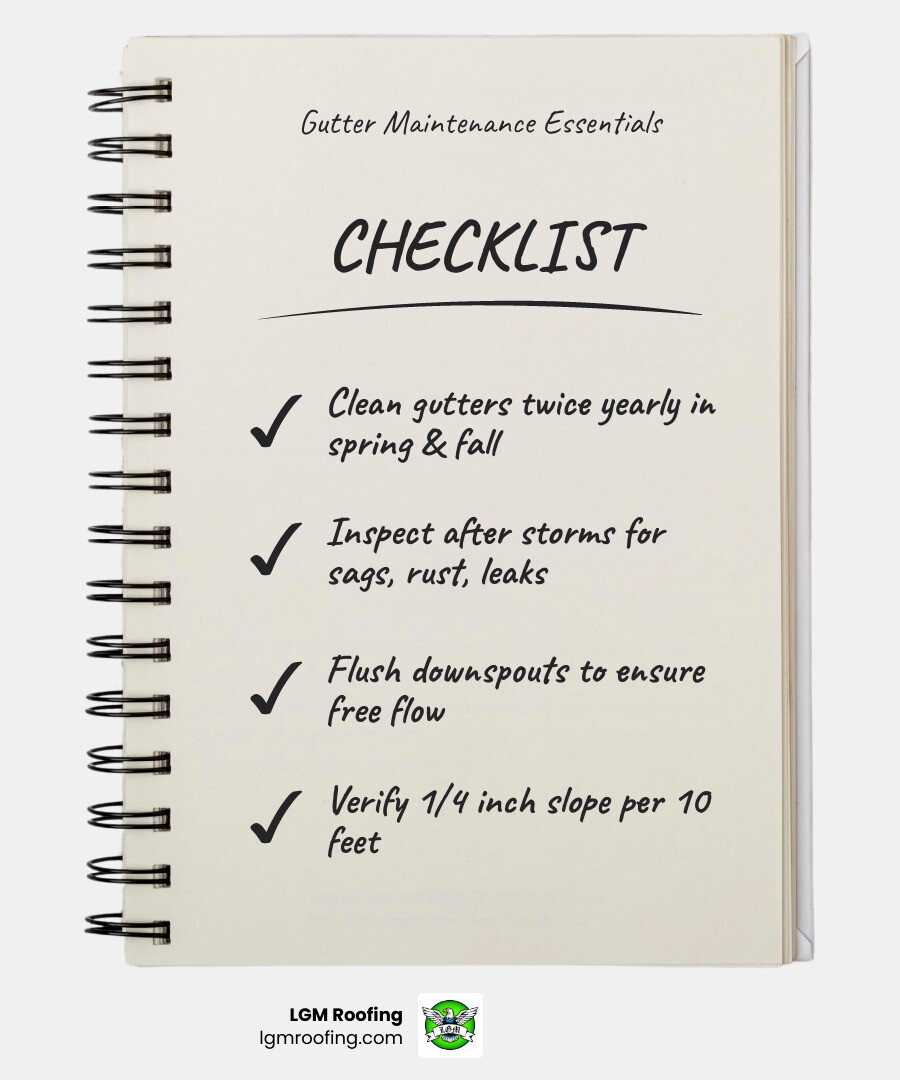
- Clean gutters at least twice a year — in spring and fall, or more often if you have heavy tree coverage nearby
- Inspect for damage after every major storm — look for sagging sections, rust, leaking seams, and loose hangers
- Flush downspouts with a garden hose to confirm water flows freely and discharges at least 4 to 6 feet from your foundation
- Check the slope — gutters should drop roughly a quarter inch for every 10 feet to drain properly
- Seal small leaks early using butyl rubber caulk before they become bigger structural problems
- Know when to call a professional — steep roofs, rotted fascia, or full gutter replacement are not DIY territory
Neglecting gutters is one of the most common — and costly — mistakes homeowners make. Clogged or damaged gutters can overflow and send water straight toward your foundation, saturate the soil around your home, rot the fascia boards behind the gutter channel, and even contribute to basement flooding. The damage compounds quietly over time, and by the time it becomes visible, the repair bill is rarely small.
Here in New Jersey, the stakes are even higher. Freeze-thaw cycles, coastal storms, and heavy seasonal leaf fall all put extra stress on residential drainage systems. A gutter system that works fine in summer can become a block of ice in January, or overflow in a single afternoon of heavy fall rain if it has not been cleaned.
My name is Darwin Mizhirumbay, and as co-owner of LGM Roofing — a GAF Master Elite certified contractor with deep roots in the New Jersey roofing and exterior trades — I have seen how following the right gutter maintenance tips for homeowners protects both the structure and the long-term value of a home. In the sections below, I will walk you through everything you need to know to keep your gutters in top shape year-round.
Why Regular Gutter Maintenance is Essential for Your Home’s Integrity
When we talk about home maintenance, gutters are often the “forgotten” system—until they fail. However, their role is foundational. Literally. The primary purpose of your gutter system is to collect the thousands of gallons of water that fall on your roof and direct it safely away from your home.
When gutters become clogged with leaves, twigs, and shingle granules, that water has nowhere to go but over the edges. This leads to soil saturation right next to your home. In New Jersey, where we have many homes with basements, this is a leading cause of basement flooding. Saturated soil puts immense hydrostatic pressure on your foundation walls, which can lead to cracks and structural failure.
Furthermore, overflowing water is the primary culprit behind fascia rot. The fascia is the vertical board that your gutters are mounted to. When water spills over the back of the gutter, it sits against that wood. Research indicates that 68 percent of fascia rot cases are directly traceable to gutters that have not been cleaned or re-sloped within the past two years. This rot can spread to the soffits (the underside of your roof overhang) and even into the rafters, creating an entry point for pests like termites, birds, and rodents.
By Protecting Your Home From Damaging Leaks, you aren’t just saving your paint job; you are preserving the structural skeleton of your house. Regular maintenance also prevents the formation of ice dams in the winter, which can rip gutters right off the house and cause water to back up under your shingles.
Essential Gutter Maintenance Tips for Homeowners to Prevent Water Damage
Effective maintenance is about consistency. As we move through April 2026, it is important to realize that your gutters are a year-round system. While most homeowners think of cleaning as a “once-a-year” chore, your local environment dictates the actual frequency.
If your home in Bloomfield NJ or Wayne NJ is surrounded by mature oaks or evergreens, you may need to clean your gutters as often as every three months. Pine needles and oak tassels are notorious for clogging downspout elbows quickly. Even without heavy tree cover, wind-blown debris and shingle grit can accumulate, slowing down the water flow and creating a “sludge” that holds moisture against your home.
We recommend following an End Of Summer Roof Maintenance Checklist For Nj Homeowners to ensure that the drainage system is clear before the heavy fall leaf drop and the subsequent winter freezes.
Seasonal Gutter Maintenance Tips for Homeowners in New Jersey
New Jersey’s climate is particularly tough on exterior drainage. We experience dramatic freeze-thaw cycles that can expand small amounts of trapped water, causing seams to split and hangers to pull away from the wood.
- Spring: This is the “reset” season. Clear out winter debris—twigs broken by snow and ice, and any “muck” that settled over the winter. This ensures you’re ready for the heavy April showers.
- Summer: While usually drier, summer is the time to check for bird nests or pest activity. It is also an ideal time for inspections. We often tell clients that End Of Summer Roof Check Why August Is The Best Time For An Inspection In Nj because the weather is predictable, allowing for easy repairs of any leaks or sagging sections before the wet seasons return.
- Fall: The most critical time. You must clear leaves after they have finished falling but before the first hard freeze. Frozen, leaf-filled gutters are nearly impossible to clean and are heavy enough to damage your roofline.
- Winter: Monitor for ice dams and icicles. If you use rain barrels, disconnect them in the winter to prevent ice from backing up into the downspouts and splitting the metal.
Safety First: Gutter Maintenance Tips for Homeowners Using Ladders
Safety is our number one priority at LGM Roofing. Working on a ladder is inherently dangerous, and gutter cleaning requires you to move and reach frequently.
Always use an extension ladder rather than a step ladder for gutter work, and ensure it is placed on firm, level ground. A ladder stabilizer or “standoff” is a great investment; it keeps the ladder from resting directly on the gutters (which can dent them) and provides more stability.
We advocate for the “three points of contact” rule: always have two hands and one foot, or two feet and one hand, on the ladder at all times. Never overreach. If you can’t reach a spot comfortably, climb down and move the ladder. Having a spotter to hold the base of the ladder is not just a suggestion—it’s a necessity for safe DIY work.
If your roof is particularly steep (a pitch greater than 6:12) or if you see Signs Of Roof Damage while you’re up there, it is time to put the ladder away and call a professional. The risk of a fall is never worth the savings of a DIY job.
The Professional Process for Inspecting and Cleaning Drainage Systems

When we perform a professional cleaning or a Roof Inspection Near Me, we follow a systematic process to ensure the entire drainage system is functional, not just the visible troughs.
- Debris Removal: We start by manually removing large debris. We typically work from the downspout end and move outward, using scoops and buckets to prevent pushing more clogs into the vertical pipes.
- The Flush Test: Once the “big stuff” is gone, we use a high-pressure garden hose to flush out the fine silt and granules. This is the moment of truth. We watch the water flow to ensure there is no “ponding” or standing water in the channels.
- Downspout Clearing: If water backs up during the flush, there is a clog in the downspout—usually at the elbow. We use a plumber’s snake or a bottom-up pressure flush to clear these stubborn blockages.
- Discharge Verification: We follow the water all the way to the end. For a foundation to remain dry, downspouts must discharge water at least 4 to 6 feet away from the home. If yours are dumping water at the base of the wall, we recommend adding extensions or splash blocks.
- Slope and Alignment: We verify the “pitch.” A properly functioning gutter should have a quarter-inch drop for every 10 feet of length. If the slope is off, water will sit in the trough, leading to rust and mosquito breeding grounds.
Identifying and Addressing Common Gutter Issues
As gutters age—they typically last about 20 years—they begin to show specific signs of wear. Identifying these early can save you from a full Gutter Installation project prematurely.
| Issue | Sign | DIY Fix |
|---|---|---|
| Leaking Seams | Dripping water at joints or end caps. | Clean, dry, and apply butyl rubber or silicone sealant. |
| Sagging | Gutter pulling away from the house or dipping in the middle. | Replace old spikes with screw-style ferrule brackets every 24-36 inches. |
| Rust | Orange staining or “pitting” in steel gutters. | Sand the area and apply rust-inhibiting paint (temporary fix). |
| Clogged Downspouts | Water overflowing near the top of the downspout. | Use a garden hose or plumber’s snake to clear the elbow joints. |
Loose spikes are a common problem in New Jersey due to our humidity and temperature swings. Traditional spikes eventually wiggle out of the wood. We recommend replacing them with heavy-duty screw-style hangers. These “bite” into the fascia board and stay secure much longer.
If you find that your gutters are constantly clogging despite regular cleaning, you might consider gutter guards.
- Micro-mesh: The gold standard. It blocks even small debris like pine needles and shingle grit.
- Screen/Mesh: Good for larger leaves but can let smaller debris through.
- Reverse Curve: Uses surface tension to direct water in while leaves fall off (requires professional installation).
- Foam/Brush: We generally advise against these as they can trap organic matter and lead to moss growth inside the gutter.
Frequently Asked Questions about Gutter Maintenance
How often should I schedule professional gutter cleaning?
For most New Jersey homeowners, we recommend a professional cleaning twice a year—once in the late spring after the trees have finished budding and once in the late fall after the leaves have dropped. However, if you are in a heavily wooded area in Piscataway NJ or Paterson NJ, quarterly cleanings may be necessary to prevent overflow.
What are the signs that my gutters need immediate replacement?
Keep an eye out for “tiger stripes” (vertical stains on the outside of the gutter), visible rust, or cracks. If you see water marks on your siding or if the gutters are sagging despite having plenty of hangers, the material may be reaching the end of its 20-year lifespan. If the fascia board behind the gutter is soft or rotting, you likely need a full replacement and fascia repair.
Do gutter guards eliminate the need for regular maintenance?
No gutter guard is 100% “maintenance-free.” While high-quality micro-mesh guards can reduce cleaning frequency by 90%, you still need to perform an annual visual inspection. Small debris can sometimes sit on top of the guards, and you’ll want to ensure that the “flow” is still optimal during heavy rain.
Conclusion
Gutter maintenance is one of the most cost-effective ways to protect your home’s foundation and roofline. By following these gutter maintenance tips for homeowners, you are actively preventing the kind of structural damage that can cost tens of thousands of dollars to remediate.
At LGM Roofing, we take pride in our 25+ years of experience serving New Jersey. As a GAF Master Elite contractor, we don’t just look at your gutters; we look at your entire roofing system to ensure everything is working in harmony to keep you dry. Whether you need a simple repair, a professional cleaning, or a high-quality seamless Gutter Installation, our team is here to provide the expertise you deserve.
Don’t wait for the next big storm to find out your gutters are failing. Take advantage of our Free Roof Estimates In Bloomfield Nj Why Summer Is The Ideal Time To Book One and let us give you the peace of mind that your home is fully protected. Contact us today to schedule your consultation!
Ready for a roof you can trust?
Get a free, no-pressure estimate. Family-owned since 2006, GAF Master Elite, and rated 4.9 by 130 homeowners on Google.