
How to Verify Roofing Contractor Credentials Fast
Learn how to verify a roofing contractors credentials fast with our 3-step guide covering licenses, insurance, and certifications.

How to Verify Roofing Contractor Credentials Fast
Why Verifying a Roofing Contractor’s Credentials Can Save You From a Costly Mistake
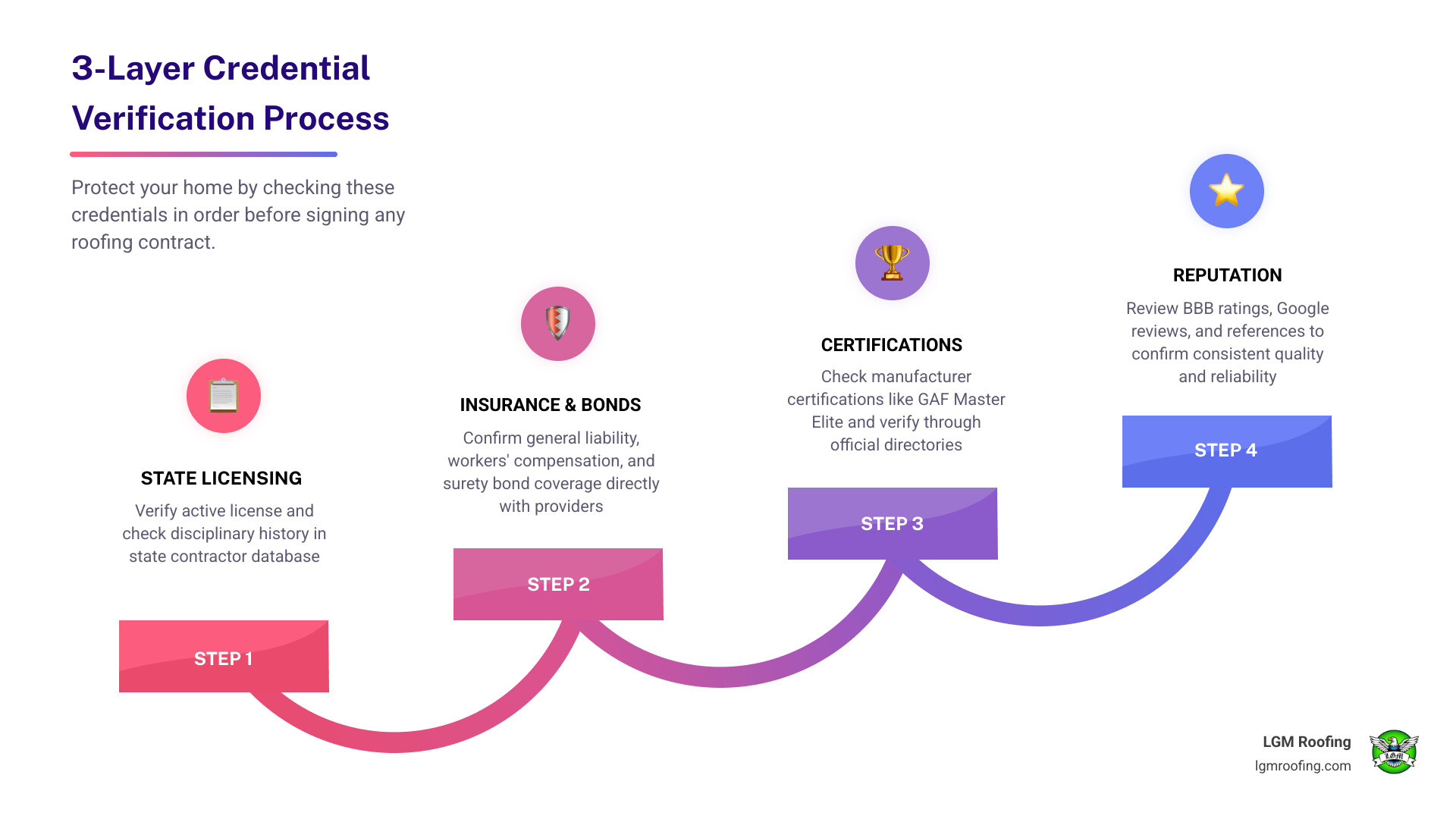
Knowing how to verify a roofing contractor’s credentials before signing anything is one of the most important steps a homeowner can take. Here’s a quick overview of what that process looks like:
- Check state licensing — Search your state’s contractor licensing database to confirm the roofer holds an active, valid license for roofing work.
- Verify insurance — Request a Certificate of Insurance and call the insurer directly to confirm general liability and workers’ compensation coverage are active.
- Confirm surety bond — Ask for bond documentation and verify it with the issuing surety company.
- Check their reputation — Look up BBB ratings, Google reviews, and any disciplinary actions on the state licensing board.
- Look for manufacturer certifications — Legitimate contractors often hold certifications from manufacturers like GAF, which require verified installation standards.
- Review the contract — Before any work begins, get a written proposal that details scope, materials, timeline, and payment terms.
Roofing scams cost American homeowners over $300 million every year, according to the Federal Trade Commission — and that number doesn’t capture the full picture. The FBI estimates that insurers pay out at least $1 billion annually on fraudulent roof claims nationwide. Meanwhile, industry data consistently shows that over 95% of roofing problems trace back to poor workmanship, not bad materials. That means who you hire matters far more than what shingles end up on your roof.
For New Jersey homeowners in particular, the stakes are real. After any major storm, unlicensed contractors — often called “storm chasers” — flood local neighborhoods, knock on doors, and offer fast, cheap fixes. They collect deposits. Then they disappear. Or worse, they do the work badly enough that your roof fails within months, leaving you with damage that your homeowner’s insurance may not cover because the job was done by someone who was never properly licensed or insured.
This guide walks you through every step of the verification process, so you can protect your home and your wallet before a single shingle gets touched.
I’m Darwin Mizhirumbay, co-owner of LGM Roofing and a second-generation roofing professional who grew up watching my father build this business from the ground up — which gave me a education in what separates trustworthy contractors from the ones you should avoid. My hands-on experience running LGM Roofing as a fully licensed, insured, and GAF Master Elite certified company shapes everything I’m sharing in this guide on how to verify a roofing contractor’s credentials. Let’s get into it.
Why You Must Know How to Verify a Roofing Contractors Credentials
When you need a new roof, it’s easy to get caught up in choosing shingle colors or scheduling the project. However, taking a step back to thoroughly vet your contractor is the single most important thing you can do for your home.
Unlicensed operators are a massive issue in the roofing industry. Because roofing has relatively low barriers to entry—anyone with a ladder and a truck can claim to be a roofer—it attracts individuals looking to make a quick buck at your expense. These operators frequently cut corners, skip safety protocols, and use substandard techniques.
This poor workmanship has real-world consequences. When an unqualified crew installs a roof, they often bypass critical steps like installing proper underlayment, sealing valleys, or nailing shingles at the correct angles. Over time, these mistakes lead to premature leaks, mold growth, and structural rot. To understand exactly why skipping these verification steps can ruin your investment, read our detailed guide on Why Hiring an Unlicensed NJ Roofer Is a Recipe for Disaster.

Beyond poor workmanship, hiring an unverified contractor exposes you to severe legal and financial liability. Roofing is statistically one of the most dangerous occupations in the country. If an uninsured worker falls from your roof or gets hurt on your property, you could be held personally liable for their medical expenses and lost wages. Your standard homeowner’s insurance policy may not fully cover injuries sustained by workers hired illegally.
Additionally, if an unlicensed contractor damages your neighbor’s property or hits an overhead utility line, you could find yourself entangled in a costly legal battle. Taking the time to verify credentials eliminates these nightmare scenarios entirely.
Step 1: Confirm State Licensing and Local Permits
In New Jersey, any contractor performing residential roofing work must be registered with the State as a Home Improvement Contractor (HIC). This registration is issued by the New Jersey Division of Consumer Affairs.
A valid HIC registration proves that the contractor has met the state’s minimum requirements, which include maintaining a physical office location and carrying active liability insurance. If a contractor cannot or will not provide you with their New Jersey registration number (which always starts with “13VH”), that is an immediate red flag.
Beyond state-level registration, roofing projects in NJ almost always require local building permits. Legitimate roofing companies will handle the entire permit application process for you. They will submit the paperwork to your local municipal building department—whether you are in Wayne, Paterson, Bloomfield, or Piscataway—and ensure the completed work is inspected by a local official.
If a contractor asks you to pull the permits yourself as the homeowner, they are likely trying to hide the fact that they are unlicensed or unregistered. To learn more about the rules, timelines, and why this step is non-negotiable, check out The Definitive Guide to Roof Replacement Permits in NJ.
How to Verify a Roofing Contractors Credentials via State Databases
You should never just take a contractor’s word that they are licensed. Instead, use official state databases to confirm their status independently.
To verify a New Jersey contractor’s credentials online:
- Visit the official New Jersey Division of Consumer Affairs verification portal.
- Select “Home Improvement Contractors” from the license type dropdown menu.
- Enter the contractor’s business name or their 13VH registration number.
- Review the search results carefully.
When you look up a contractor, verify that their status is listed as Active. An inactive, suspended, or revoked license means they cannot legally perform work on your home.
The database will also display any formal disciplinary actions, complaints, or civil penalties filed against the business by the state. This lookup tool is your first and most reliable line of defense against fraudulent operators.
Step 2: Verify Insurance and Surety Bonds
A legitimate roofing contractor must carry two primary types of insurance: General Liability Insurance and Workers’ Compensation Insurance.
General liability insurance protects your property from damage caused by the roofing crew. For example, if a heavy bundle of shingles is dropped and smashes through your skylight, or if a sudden rainstorm floods your exposed attic during the tear-off process, the contractor’s liability policy covers the repairs. We highly recommend hiring contractors who carry at least $1,000,000 in general liability coverage.
Workers’ compensation insurance is equally crucial. It covers medical bills, rehabilitation, and lost wages for any crew member who is injured while working on your property. Without it, that financial responsibility can fall squarely on your shoulders.
Additionally, you should confirm if the contractor carries a surety bond. A surety bond is a three-party agreement between the contractor, an insurance company (the surety), and the homeowner. If the contractor fails to complete the project, walks away with your deposit, or does not complete the work according to local building codes, you can file a claim against the bond to recover your losses.
| Insurance Type | What It Covers | Why It Matters to You |
|---|---|---|
| General Liability | Property damage and third-party bodily injury caused by the contractor’s operations. | Prevents you from paying out-of-pocket if your home or landscaping is damaged. |
| Workers’ Compensation | Medical expenses and lost wages for workers injured on your job site. | Protects you from devastating personal injury lawsuits if a worker falls. |
| Surety Bond | Financial compensation if the contractor fails to fulfill the contract terms. | Ensures your project gets finished or your money is refunded if the business fails. |
How to Verify a Roofing Contractors Credentials with Insurance Providers
Contractors will often hand you a paper copy of their Certificate of Insurance (COI) during your initial consultation. While this is a good start, certificates can be easily altered or may have lapsed since they were printed.
To verify that the insurance policies are actually active:
- Look at the COI for the name and contact information of the Insurance Agency or Broker who issued the policy.
- Call the insurance agency directly. Do not use a phone number provided by the contractor; look up the agency’s official number online to ensure you are speaking to a real representative.
- Provide the contractor’s name and policy number listed on the COI.
- Ask the agent to confirm that the policy is currently in force, has not lapsed, and has policy limits that match your project’s needs.
- Request that the insurance agency email or mail a copy of the COI directly to you, listing you as the “Certificate Holder.” This ensures that if the policy is canceled mid-project, the insurer is legally obligated to notify you.
Step 3: Check Manufacturer Certifications and Reputation
While state licenses and insurance establish a contractor’s legal right to operate, manufacturer certifications prove their commitment to high-quality craftsmanship.
The most prestigious credential in the residential roofing industry is the GAF Master Elite® certification. GAF is North America’s largest roofing manufacturer, and they only award this certification to the top 2% of all roofing contractors in any given region. To qualify, a contractor must maintain an active state license, carry comprehensive insurance, have a clean credit rating, and undergo ongoing professional training.
Choosing a certified installer directly impacts the long-term protection of your home. It allows the contractor to offer premium, manufacturer-backed warranties that uncertified roofers simply cannot access. To see how these credentials translate to real-world performance, explore How GAF Certification Ensures Your Roof Installation Actually Lasts.
Furthermore, these elite credentials unlock top-tier warranty options that cover both materials and installation workmanship. Read Don’t Get Nailed by Fine Print: The Master Elite Warranty Guide to learn how to secure complete peace of mind.
Beyond certifications, you should research a contractor’s reputation in your local community:
- Better Business Bureau (BBB): Check their rating (look for an A or A+ rating) and read through any resolved or unresolved complaints.
- Online Reviews: Look at Google, Yelp, and Facebook reviews. Pay attention to how the contractor responds to negative feedback. A professional, polite response to a complaint is often a sign of a highly reliable business.
- Local References: Ask the contractor for a list of recently completed projects in your immediate area (e.g., Wayne, Paterson, Bloomfield, or Piscataway) and call those homeowners to ask about their experience.
Frequently Asked Questions About Roofing Credentials
What are the red flags of an unlicensed storm chaser?
Storm chasers are out-of-state operators who travel to areas recently impacted by severe weather. They use high-pressure sales tactics to convince homeowners to sign contracts on the spot.
Common red flags include:
- Knocking on your door uninvited offering “free” roof replacements.
- Vehicles with out-of-state license plates or temporary, magnetic door signs.
- Demanding large cash deposits upfront before any materials are delivered.
- Pressuring you to sign over your homeowner’s insurance check directly to them.
- Refusing to provide a local physical address or a New Jersey HIC registration number.
If your home has suffered storm damage, it is vital to work with a trusted local contractor who understands the insurance process. For a step-by-step roadmap on navigating this situation safely, read The Ultimate Guide to Filing a Roof Damage Insurance Claim.
How do I verify a roofer’s manufacturer certification?
You can easily verify a contractor’s manufacturer certification by visiting the manufacturer’s official website. For example, GAF maintains a public “Contractor Locator” tool. By entering the contractor’s business name or your ZIP code, you can instantly confirm if they are a certified GAF Master Elite installer.
This verification is incredibly important because it is the only way to qualify for the industry’s highest-performing warranties. To learn about the ultimate level of manufacturer-backed protection, see our guide on Everything You Need to Know About the GAF Golden Pledge.
What should be included in a roofing contract?
A professional roofing contract should be highly detailed and leave no room for ambiguity. Before signing, ensure the document includes:
- The contractor’s complete business name, physical address, phone number, and NJ HIC registration number.
- A detailed scope of work, including the exact brand, style, and color of shingles to be installed.
- Clarification on whether the old roof will be completely torn off or if they are nailing over existing shingles (a complete tear-off is always recommended).
- Specific details on the underlayment, ice and water shields, drip edges, and ventilation systems to be used.
- A clear payment schedule (e.g., a small deposit, a mid-project payment, and the final payment only after successful completion and local inspection).
- Approximate start and completion dates.
- Explicit details regarding the workmanship warranty and the manufacturer’s material warranty.
Conclusion
Your roof is your home’s primary shield against the elements. Protecting that shield—and your bank account—starts with taking the time to verify your roofing contractor’s credentials. By checking state databases, confirming insurance coverage directly with providers, looking for manufacturer certifications, and insisting on a clear, written contract, you can avoid the costly mistakes that plague so many homeowners.
At LGM Roofing, we believe in total transparency. With over 25 years of hands-on experience in the construction industry, we proudly serve homeowners across New Jersey, including Wayne, Paterson, Bloomfield, and Piscataway. As a fully licensed, insured, and GAF Master Elite certified contractor, we back our workmanship with the strongest warranties in the business.
If you are trying to figure out what to look for in a roofing partner, check out our guide on What Makes a Good Roofing Company and How to Find One?.
When you are ready to work with a certified team that puts quality and integrity first, Get professional roofing services from LGM Roofing today.
Ready for a roof you can trust?
Get a free, no-pressure estimate. Family-owned since 2006, GAF Master Elite, and rated 4.9 by 130 homeowners on Google.