
To Patch or Not to Patch: Your Ultimate Roofing Decision Guide
Learn how to decide between roof repair and replacement for NJ homes. Assess damage, age, insurance & get pro tips for max value & efficiency.

To Patch or Not to Patch: Your Ultimate Roofing Decision Guide
How to Decide Between Roof Repair and Replacement: A Quick Answer for NJ Homeowners
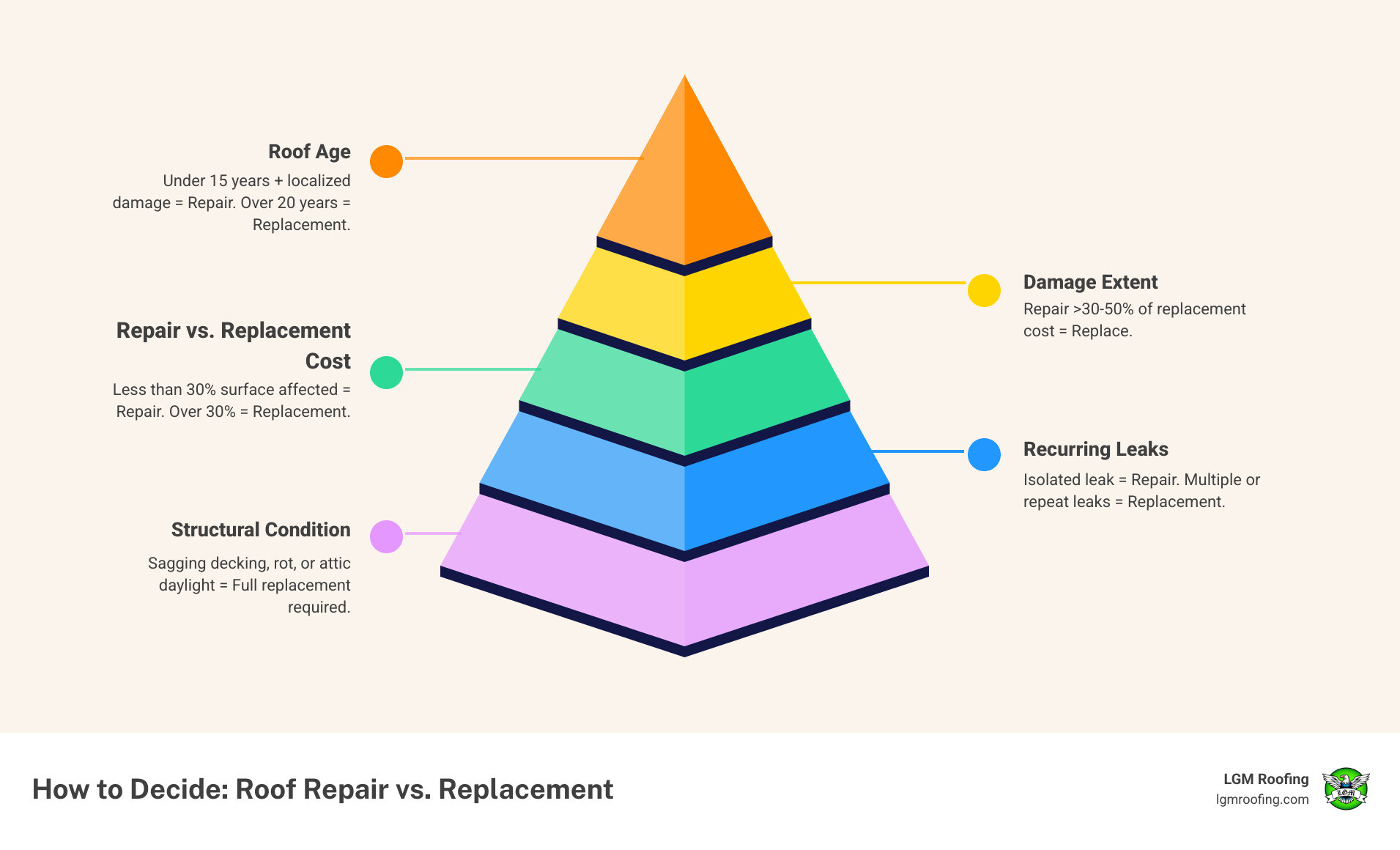
How to decide between roof repair and replacement comes down to five key factors most homeowners can evaluate before ever calling a contractor:
- Roof age: If your asphalt shingle roof is under 15 years old and the damage is localized, repair is usually the right call. Over 20 years old? Replacement is likely the smarter investment.
- Extent of damage: Damage covering less than 30% of your roof surface generally points to repair. More than that, and replacement starts making more financial sense.
- Repair cost vs. replacement cost: If a single repair estimate exceeds 30-50% of what a full replacement would cost, replace the roof.
- Recurring leaks: One isolated leak is fixable. Multiple leak points, or the same spot leaking again after a repair, often signals systemic failure.
- Structural condition: Sagging decking, rotting framing, or daylight visible from your attic are replacement red flags — not repair territory.
That said, the full picture is rarely black and white. A roof that looks fine from the street might be quietly failing from the inside. And a roof that looks rough might have years of life left with the right targeted repair. New Jersey’s climate — hot summers, harsh winters, and everything in between — adds another layer of complexity that makes the decision even more nuanced.
That’s exactly what this guide is built to help you navigate.
I’m Darwin Mizhirumbay, co-owner of LGM Roofing and a second-generation roofer who grew up watching my father build this business one job at a time since 2006. Understanding how to decide between roof repair and replacement is something I deal with every week across homes throughout New Jersey, and I’ll walk you through every factor that actually matters so you can make a confident, informed decision.
How to Decide Between Roof Repair and Replacement Based on Damage
When we arrive at a home in Paterson or Wayne, the first thing we look for is the “personality” of the damage. Is this an “event” or is it “exhaustion”? An event, like a fallen branch or a particularly nasty windstorm, usually calls for a repair. Exhaustion, where the materials are simply giving up after decades of service, demands a replacement.
Identifying signs of roof damage is the first step. You might notice aesthetic wear, such as dark streaks caused by algae or moss growth. While these look unappealing, they don’t always mean you need a new roof; often, a professional cleaning or minor shingle replacement will suffice. However, structural compromise is a different story.
Common red flags include:
- Missing Shingles: A few shingles missing after a storm can be replaced individually.
- Granule Loss: If your gutters look like they’re filled with coffee grounds, your shingles are losing their UV protection.
- Curling or Cupping Edges: This is a sign that the asphalt is drying out and shrinking, leaving your home vulnerable to leaks.
If you are looking at your roof and wondering, “Can my roof be repaired or does it need to be replaced 7 ways to tell,” remember that localized issues are often solvable, but widespread brittleness is a sign of systemic failure.
Evaluating the Extent of Roof Damage in NJ Homes
In our experience serving Bloomfield and Piscataway, the “30% Rule” is a great guideline for how to decide between roof repair and replacement. If the damage is confined to one small area—say, around a chimney or a single valley—a targeted repair is highly effective.
However, storm impact can be deceptive. A hailstorm might only leave small dents, but those dents crack the shingle’s matting, leading to leaks months later. When evaluating roof repair vs replacement in nj how to decide, we look at the density of the damage. If we have to replace more than a third of the shingles to make the roof watertight, the labor involved often makes a full replacement the more logical path.
When Recurring Leaks Signal a Full Replacement
There is nothing more frustrating for a homeowner than paying for a repair only to have the same spot leak again three months later. This is often a sign of systemic failure. When water finds its way under the shingles, it doesn’t just sit there; it travels.
If you have multiple leak points or find that water stains are appearing in different rooms, the underlayment has likely failed. At this point, roof replacement is no longer just an option; it’s a necessity to prevent:
- Decking Rot: The wooden boards beneath your shingles can soften and rot, leading to dangerous sagging.
- Mold Growth: Trapped moisture in the attic is a breeding ground for mold, which can impact your family’s health.
- Interior Ceiling Stains: Once you see brown rings on your drywall, the damage has already moved past the exterior of your home.
The Role of Roof Age and Material Lifespan
In 2026, roofing technology has advanced, but the laws of physics still apply to older materials. The age of your roof is perhaps the most important variable in the equation. A “young” roof with a leak is a candidate for surgery (repair); an “old” roof with a leak is usually a candidate for retirement (replacement).
| Roofing Material | Expected Lifespan (Years) | 2026 NJ Performance Notes |
|---|---|---|
| 3-Tab Asphalt Shingles | 15–20 | Prone to wind uplift in NJ storms |
| Architectural Shingles | 25–30 | Best balance of cost and durability |
| Metal Roofing | 40–70 | Excellent for snow shedding and UV resistance |
| Slate | 75–100+ | Requires heavy-duty structural support |
| Clay/Concrete Tile | 50–100 | Rare in NJ but highly fire-resistant |
UV degradation is a constant battle in New Jersey. Even on cold days, the sun’s rays are breaking down the chemical bonds in your shingles. For more detail on these lifespans, check out our guide on roof repair vs replacement how to know what your nj home really needs.
How to Decide Between Roof Repair and Replacement for Aging Shingles
We generally tell our clients that 15 years is the “pivot point” for asphalt shingles. If your roof is 15 years or older, any significant repair should be weighed against the cost of a full replacement. Shingles become brittle as they age, meaning that when a roofer tries to fix one area, the surrounding shingles might crack or lose granules just from being stepped on or lifted.
You might wonder, “Is shingling over your old roof a smart move?” While “reroofing” (adding a second layer) can save on initial labor, it often traps heat and moisture, shortening the life of the new shingles and making it impossible to inspect the decking for rot. In almost every case, a full tear-off is the better long-term move.
Insurance Coverage and the 15-Year Rule
Insurance plays a massive role in how to decide between roof repair and replacement. Many homeowners are surprised to learn that their coverage changes as the roof ages.
- RCV (Replacement Cost Value): These policies typically pay to replace the roof at current market prices, minus your deductible.
- ACV (Actual Cash Value): Once a roof hits the 15-to-20-year mark, many insurers switch to ACV. This means they only pay for the depreciated value of the roof. If a 20-year-old roof is destroyed, you might only receive a small fraction of the replacement cost.
This is why we emphasize documentation. If a storm hits, having photos of your roof’s condition beforehand can be the difference between a smooth claim and a denied one. Always ensure you are present (or your contractor is) when the adjuster performs their inspection to ensure no damage is overlooked.
Long-Term Benefits of Choosing Replacement Over Patchwork
While a repair stops the immediate bleeding, a full replacement resets the clock on your home’s protection. It’s like getting a brand-new engine for a car versus just replacing a spark plug.
A full replacement allows us to address the entire “roofing system.” This includes the shingles, the underlayment, the flashing, and—crucially—the ventilation. For those in the Bloomfield area, our roof replacement bloomfield complete guide covers these system components in depth.
How to Decide Between Roof Repair and Replacement for Energy Efficiency
One of the most overlooked benefits of a new roof is the impact on your utility bills. Old roofs often suffer from poor ventilation, which allows heat to build up in the attic during NJ summers. This forces your air conditioner to work overtime.
Modern “cool roof” technology and improved reflective coatings can significantly reduce thermal absorption. When we perform a replacement, we also look at your insulation levels. Upgrading your attic ventilation to meet 2026 energy standards can lead to substantial savings on your monthly bills, making the replacement pay for itself over time through thermal regulation.
Professional Inspections and Seasonal Timing in New Jersey
You wouldn’t diagnose a complex medical issue without a doctor; the same applies to your roof. A professional inspection is the only way to catch hidden issues like failing pipe boots or rusted flashing that might be invisible from the ground.
Timing also matters in the Garden State. We often recommend the fall as the ideal time for a replacement. The temperatures are moderate, which allows the shingle adhesive to seal properly without the blistering heat of summer or the brittle cold of winter.
During an inspection, we often perform the “Attic Daylight Test.” We head into your attic on a sunny day with the lights off. If we see pinpricks of light coming through the boards, you have holes that water will eventually find. We also use moisture detection tools to find damp insulation before it turns into a mold problem. If you’re just dealing with a minor leak, a quick roof repair might be all you need to get through the season.
NJ Regulations and Multi-Layer Roofing
New Jersey building codes are quite specific about how many layers of roofing a house can support. In most municipalities, you are allowed a maximum of two layers of shingles. However, just because it’s legal doesn’t mean it’s a good idea.
Adding a second layer increases the structural weight on your rafters, which can be dangerous during a heavy NJ snowload. Furthermore, most manufacturers will void or severely limit their warranty if shingles are installed over an old layer. To understand the full scope of local laws, read about can you install a new roof over an old one pros cons nj regulations.
Frequently Asked Questions about Roof Maintenance
Can a leaky roof always be repaired?
Not always. While isolated leaks caused by a single backed-out nail or a cracked pipe boot are easy fixes, leaks that stem from widespread shingle degradation cannot be “patched” effectively. If the shingles are too brittle to be lifted without breaking, a repair will likely cause more leaks than it fixes.
What temporary solutions extend a roof’s life?
If a replacement isn’t in the budget immediately, there are ways to buy time. Emergency tarping is the most common method after storm damage. Applying high-quality sealants to flashing and patching small sections of missing shingles can also help. Most importantly, keep your gutters clean! Clogged gutters back water up under the shingles, causing rot that could have been avoided.
Does a new roof increase NJ home value?
Absolutely. A new roof is one of the highest-ROI home improvements you can make. It provides “curb appeal” that makes a great first impression on buyers, but more importantly, it provides buyer confidence. Most home inspectors will flag a roof older than 15 years, which can lead to difficult negotiations or even a collapsed sale. A transferable warranty on a new roof is a massive selling point in the NJ real estate market.
Conclusion
At LGM Roofing, we believe in treating every home as if it were our own. With over 25 years of experience across Wayne, Paterson, Bloomfield, and Piscataway, we’ve seen every roofing challenge New Jersey can throw at a homeowner. We don’t believe in high-pressure sales; we believe in education and providing a solid warranty that gives you peace of mind for decades to come.
Whether you need a small patch to get through the winter or a full architectural shingle system to protect your family for the next thirty years, we are here to help. If you’re still stuck on how to decide between roof repair and replacement, let us take a look.
Ready for a roof you can trust?
Get a free, no-pressure estimate. Family-owned since 2006, GAF Master Elite, and rated 4.9 by 130 homeowners on Google.