
Understanding the NJ Building Code for Your Next Roof Replacement
Learn NJ code requirements for roofing layers and tear offs. Know the 2-layer limit, when tear-offs are mandatory, and ensure compliant replacements.

Understanding the NJ Building Code for Your Next Roof Replacement
I’m planning a roof replacement in New Jersey. What are the local code requirements for roofing layers and tear offs?
Understanding the nj code requirements for roofing layers and tear offs is one of the most important things you can do before starting a roof replacement project. Get it wrong, and you could face fines, forced removal of completed work, or worse — a structurally compromised roof over your family’s heads.
Here is a quick summary of the core rules under the New Jersey Uniform Construction Code (NJUCC) and IRC Section R908:
| Rule | What the Code Says |
|---|---|
| Maximum shingle layers allowed | 2 layers of asphalt shingles |
| Third layer permitted? | No — full tear-off is required |
| Two layers already exist? | Full tear-off is mandatory |
| Roof re-cover over slate, clay, or asbestos-cement tile? | Not permitted |
| Water-soaked or deteriorated decking? | Full tear-off required |
| Permit required for full replacement? | Yes, under the NJUCC |
| Ice barrier required? | Yes, where average January temp is 25 degrees F or below |
These rules are not suggestions. They are enforceable legal standards that apply to virtually every residential roofing project in New Jersey as of May 2026.
Many homeowners only discover these limits when a building inspector flags an issue mid-project — or worse, when a home inspector finds an illegal third layer during a real estate transaction. A roofing project that skips these steps can void your manufacturer warranty, lead to insurance claim denials, and seriously reduce your property value.
I’m Darwin Mizhirumbay, co-owner of LGM Roofing and a second-generation roofing professional with hands-on experience navigating the nj code requirements for roofing layers and tear offs across dozens of residential projects throughout New Jersey. In this guide, I’ll walk you through exactly what the code requires so your next roof replacement is safe, legal, and built to last.
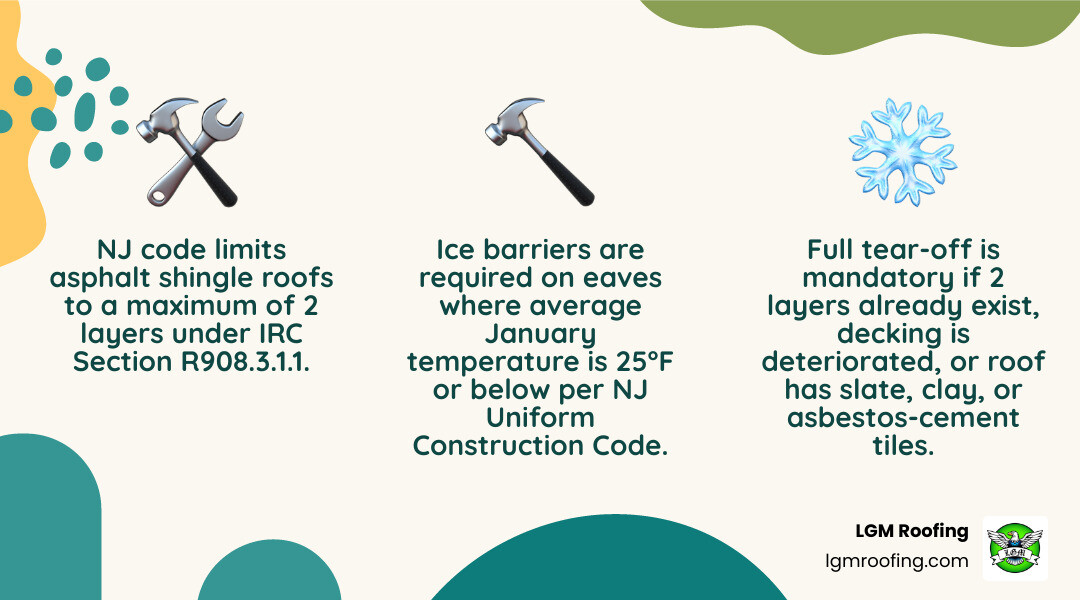
NJ Code Requirements for Roofing Layers and Tear Offs
In New Jersey, the rulebook for your roof is primarily the New Jersey Uniform Construction Code (NJUCC), which adopts the International Residential Code (IRC). Specifically, Section R908.3.1.1 is the “holy grail” of reroofing regulations. This section dictates exactly how many times we can layer shingles before the law says, “Enough is enough.”
When we talk about nj code requirements for roofing layers and tear offs, we aren’t just talking about aesthetics. These codes are designed to prevent your house from buckling under the weight of excessive materials. In cities like Paterson and Wayne, where older homes are common, we often find roofs that have been “layered” over decades. However, modern enforcement is strict. If you are planning a project in Bloomfield or Piscataway, your local building official will likely require a permit for any work involving a full replacement.
A reroofing permit is a formal legal document. It triggers an inspection process where an official verifies that the new installation meets fire safety and structural standards. According to How Many Shingle Layers Are Actually Allowed By Code/, ignoring these permit requirements can lead to “stop-work” orders, which are every homeowner’s nightmare.
The Two-Layer Limit in New Jersey
The most fundamental rule you need to remember is the two-layer limit. New Jersey law permits a maximum of two layers of asphalt shingles on a residential roof. This process, often called a “roof recover” or an “overlay,” involves installing new shingles directly over the existing ones.
While it might seem like a convenient option, there are strict conditions. Under NJUCC compliance, you can only perform an overlay if:
- The existing roof has only one layer.
- The roof deck is structurally sound and not water-soaked.
- The existing shingles are not curled, buckled, or severely deteriorated (which would prevent the new layer from sitting flat).
Whether you use three-tab shingles or the more popular architectural shingles, the two-layer rule remains the same. As we discuss in Can You Install A New Roof Over An Old One Pros Cons Nj Regulations/, adding that second layer is often a practical choice, but it is the absolute legal limit. A third layer is never permitted.
When a Complete Tear-Off is Mandatory
There are several “deal-breaker” scenarios where the state of New Jersey mandates a complete tear-off down to the bare wooden deck. You cannot simply “roof over” these problems.
A full tear-off is required if:
- Two layers already exist: If you already have two layers of shingles, the code requires you to strip them both off before putting on anything new.
- Deteriorated Decking: If the wood underneath is water-soaked, rotted, or structurally compromised, it must be exposed, inspected, and replaced. You can’t nail new shingles into “mush.”
- Specific Materials: NJ code prohibits re-covering over slate, clay, cement, or asbestos-cement tile roofs. These materials are too heavy or too brittle to serve as a base for a new layer.
- Structural Integrity: If the rafters are already sagging under the current load, adding more weight is a safety violation.
As highlighted in The Shingle Truth Reroofing Vs Full Tear Off Comparison/, mandatory stripping is often a blessing in disguise. It allows us to inspect the “bones” of your roof and ensure your home stays dry for the next 30 years.
Structural and Material Standards for NJ Roofs
Once the old shingles are gone, the focus shifts to the substrate — the roof deck. New Jersey code is very specific about what constitutes a “solidly sheathed” deck. For most residential homes in our service areas like Piscataway and Bloomfield, this means using either 7/16-inch OSB (Oriented Strand Board) or 15/32-inch plywood.
The deck must be able to hold the fasteners securely. NJ code requires roofing nails to be a minimum of 12-gage with a 3/8-inch diameter head. These fasteners must penetrate at least 3/4 of an inch into the roof sheathing or go all the way through if the sheathing is thinner.
We also have to talk about flashing. All wall-to-roof intersections, chimneys, and valleys must have corrosion-resistant flashing (usually galvanized steel or copper) that is at least 0.019 inches thick. In Is Shingling Over Your Old Roof A Smart Move/, we often point out that overlays make it nearly impossible to replace this flashing correctly, which is why a tear-off is often the superior choice for long-term protection.
| Feature | Overlay (Recover) | Full Tear-Off |
|---|---|---|
| Lifespan | 15-20 Years | 25-30 Years |
| Deck Inspection | Impossible | Comprehensive |
| Warranty | Often Limited/Voided | Full Manufacturer Warranty |
| Weight | Doubles the Load | Standard Load |
NJ Code Requirements for Roofing Layers and Tear Offs: Slope and Decking
The slope of your roof determines what materials you can legally use. In New Jersey, asphalt shingles are only allowed on roofs with a slope of 2:12 or greater.
- Low Slope (2:12 to 4:12): If your roof is relatively flat, the code requires a double layer of underlayment to prevent water from backing up under the shingles.
- Standard Slope (Above 4:12): Standard underlayment application is permitted, but we still recommend high-quality synthetic options for better durability.
Furthermore, NJ code requires roofs to be designed for a wind speed of 115 mph (Risk Category II). This means we use specific “high-wind” nailing patterns — usually six nails per shingle instead of the standard four — to ensure your roof doesn’t end up in your neighbor’s yard during a Nor’easter.
Ice Barriers and Weather Protection
If you live in New Jersey, you know our winters can be brutal. The NJ Residential Code mandates the installation of an ice barrier (often called “Ice and Water Shield”) in areas where the average January temperature is 25 degrees F or lower. This covers basically all of Northern and Central Jersey, including Wayne and Paterson.
The ice barrier must extend from the eave edge to a point at least 24 inches inside the exterior wall line. This prevents “ice dams” — those nasty chunks of ice that force water under your shingles and into your attic. Additionally, the code requires:
- Drip Edges: These must extend at least 0.25 inches below the sheathing and 2 inches back onto the roof.
- Chimney Crickets: If you have a chimney wider than 30 inches, a “cricket” or saddle is legally required to divert water around it.
- Valley Lining: Valleys must be lined with metal or a specialized mineral-surfaced roll roofing to handle the high volume of water runoff.
The Risks of Non-Compliance and Excessive Layering
Why is the state so obsessed with the number of layers? It comes down to physics. A single layer of asphalt shingles on a 2,000-square-foot roof weighs about 5,000 pounds. That’s like parking a large SUV on your house. If you add a second layer, you’re up to 10,000 pounds. A third, illegal layer pushes that to 15,000 pounds.
This “dead load” can cause:
- Rafter Deflection: Your roof beams start to sag or bow, which can lead to structural failure.
- Heat Trapping: Multiple layers of shingles act like a thermal blanket. This extra heat breaks down the asphalt binder in the shingles much faster. An overlay roof in New Jersey might only last 15 years instead of 30 because it literally cooks itself from the inside out.
- Fire Risk: More layers mean more fuel. NJ code requires a Class A fire rating for most residential roofs, and excessive layering can compromise this rating.
Perhaps most importantly for your wallet, non-compliance leads to insurance claim denials. If a heavy snowstorm causes your roof to collapse and the insurance adjuster finds three layers of shingles, they may deny the claim because the roof was not code-compliant. Furthermore, manufacturers like GAF may void your warranty if the shingles were installed over a defective or multi-layered surface.
NJ Code Requirements for Roofing Layers and Tear Offs: Structural Load
Beyond the weight, layering traps moisture. In New Jersey, we experience 60 to 80 freeze-thaw cycles every winter. When moisture gets trapped between two layers of shingles, it freezes and expands, causing the layers to delaminate and shingles to pop off.
As a GAF Master Elite contractor, we follow standards that go above and beyond the minimum code. We ensure that attic ventilation is balanced—meaning you have enough intake at the soffits and exhaust at the ridge—to prevent moisture buildup. Without proper ventilation, even a code-compliant two-layer roof will fail prematurely.
Frequently Asked Questions about NJ Roofing Codes
How many layers of shingles are allowed by code in NJ?
New Jersey building code allows a maximum of two layers of asphalt shingles. If a roof already has two layers, a full tear-off is mandatory before any new roofing can be installed. Adding a third layer is a violation of the NJ Uniform Construction Code (NJUCC).
Is a permit required for a roof replacement in New Jersey?
Yes. In almost all NJ municipalities, including Wayne, Paterson, and Bloomfield, a building permit is required for a full roof replacement or a tear-off. This ensures that the structural integrity of the deck and the fire rating of the materials are inspected and approved by a local official.
When is an ice and water shield mandatory under NJ code?
An ice barrier is mandatory in New Jersey wherever the average January temperature is 25°F or less. It must be installed at the eaves and extend at least 24 inches inside the exterior wall line to protect against ice dams and water penetration.
Conclusion
Navigating the nj code requirements for roofing layers and tear offs doesn’t have to be a headache. Whether you are looking for a second layer or investing in a full tear-off for maximum longevity, the key is ensuring every step follows the New Jersey Uniform Construction Code.
At LGM Roofing, we bring over 25 years of experience to every job site. As a GAF Master Elite certified contractor and a registered NJ Home Improvement Contractor, we don’t just “shingle” roofs — we build code-compliant, weather-resistant systems that protect your biggest investment. From Piscataway to Paterson, we ensure your roof meets all 2026 standards for wind resistance, ice protection, and structural load.
Don’t leave your home’s safety to chance or uncertified contractors who might skip the permit process. More info about our professional roofing services is just a click away.
Ready to ensure your roof is up to code? Contact LGM Roofing today to discuss your project.
Ready for a roof you can trust?
Get a free, no-pressure estimate. Family-owned since 2006, GAF Master Elite, and rated 4.9 by 130 homeowners on Google.