
Questions to Ask Before Hiring a Roofing Company
Learn the essential questions to ask before hiring a roofing company to protect your New Jersey home and ensure quality results.

Questions to Ask Before Hiring a Roofing Company
The Right Questions to Ask Before Hiring a Roofing Company (And Why They Matter)
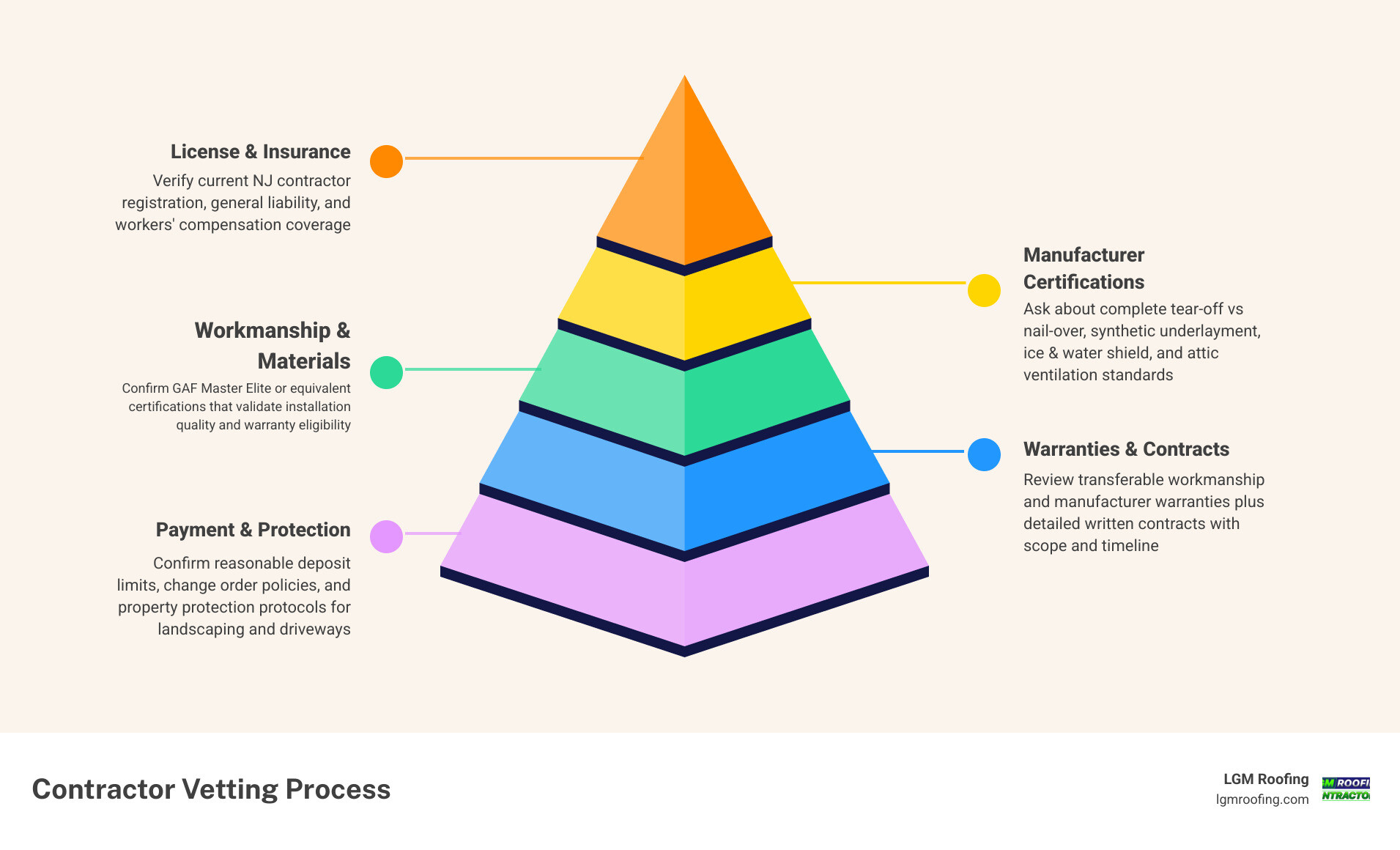
Knowing the right questions to ask before hiring a roofing company can be the difference between a roof that lasts 30 years and one that fails in five. Here is a quick reference list to use when interviewing any contractor:
- Are you licensed and insured in New Jersey, and can you provide proof?
- What manufacturer certifications do you hold?
- How many years have you been in business, and do you have local references?
- What materials and techniques will you use — complete tear-off or nail-over?
- What warranties do you offer, and are they transferable?
- What is your payment schedule, and how large is the required deposit?
- How do you handle unexpected issues like rotted decking?
- What safety protocols does your crew follow?
- Will you provide a detailed written contract covering scope, timeline, and cleanup?
- How will you protect my landscaping, driveway, and property during the project?
Your roof is the single most important protective system on your home. A failed installation does not just mean leaks — it can void your manufacturer warranty, expose hidden structural rot, and leave you with a five- or six-figure repair bill. According to industry data, a new roof represents a significant financial investment, and the quality of the contractor you choose determines whether that investment lasts 15 years or 50. Yet many homeowners sign contracts after a single conversation, without ever verifying a license number, confirming insurance coverage, or asking what happens if rotted decking is discovered mid-job.
The problem is not a lack of available contractors. In New Jersey, roofing companies range from well-established local businesses to out-of-state storm chasers who arrive after a bad weather event, collect a deposit, and disappear. Even among legitimate contractors, the gap between an average installation and a truly professional one comes down to details most homeowners would never think to ask about — underlayment quality, ventilation standards, change order policies, and the difference between a manufacturer’s material warranty and a workmanship warranty.
I’m Darwin Mizhirumbay, second-generation owner of LGM Roofing and a firm believer that the best questions to ask before hiring a roofing company are the ones that separate contractors who simply show up from those who genuinely stand behind their work. Growing up around this industry and now leading a GAF Master Elite certified company, I’ve seen what goes wrong when homeowners skip the vetting process — and what goes right when they don’t. In the sections below, I’ll walk you through every question worth asking, organized by phase, so you can evaluate any roofing contractor with confidence.
Relevant articles related to questions to ask before hiring a roofing company:
Why You Need a Vetting Script: Questions to Ask Before Hiring a Roofing Company
When you begin search-engine hunting for a contractor to work on your home in Wayne, Paterson, Bloomfield, or Piscataway, you are not just looking for someone with a truck and a nail gun. You are looking for a business partner to secure your home’s envelope. This is why having a structured vetting script is essential for risk mitigation and consumer protection.
Without a plan, it is incredibly easy to fall for high-pressure sales tactics, sleek brochures, or bids that seem too good to pass up. A structured list of questions to ask before hiring a roofing company levels the playing field. It forces the contractor to demonstrate their operational transparency, technical expertise, and financial stability.
A professional contractor will always welcome these questions. They see your detailed inquiries as a sign of a serious, educated client who values quality. Conversely, if a contractor bristles, hesitates, or brushes off your questions during an initial consultation, consider that the ultimate warning sign to walk away. To learn more about separating the true professionals from the rest, check out our guide on what makes a good roofing company and how to find one.
Phase 1: Verifying Legal Legitimacy and New Jersey Compliance
Before discussing colors, materials, or timelines, you must establish that the business is legally authorized and fully insured to operate in New Jersey. Skipping this phase exposes you to massive financial and legal liabilities.
Are you licensed and insured in New Jersey, and can you provide proof of current coverage?
In New Jersey, operating as a home improvement contractor without registration is illegal and punishable by severe fines. Any contractor you hire must hold a valid NJ Home Improvement Contractor (HIC) registration. A standard business license is not the same as an HIC registration; the former is merely for tax purposes, while the latter verifies legal compliance with state consumer protection laws.
Additionally, you must demand physical certificates of two critical types of insurance:
- General Liability Insurance: This covers accidental damage to your property during the project (for example, if a heavy bundle of shingles is dropped and damages your siding or breaks a window). We recommend looking for contractors carrying a minimum of $1 million to $2 million in general liability coverage.
- Workers’ Compensation Insurance: Roofing is ranked as one of the most dangerous jobs in the country. If a crew member slips off a ladder on your property and the contractor does not carry active workers’ compensation, you as the homeowner could be held personally liable for their medical bills.
Always ask for a Certificate of Insurance (COI) sent directly from the contractor’s insurance provider, and take ten minutes to verify their registration number online at the NJ Division of Consumer Affairs database. To understand the full scope of these risks, read our detailed article on why hiring an unlicensed NJ roofer is a recipe for disaster, and learn how to verify roofing contractor credentials fast.
Do you pull all necessary municipal building permits for New Jersey properties?
Never hire a contractor who asks you to pull the building permit, or one who claims a permit is not necessary. In New Jersey, a building permit is legally required for any roof replacement that covers more than 25% of the total roof area.
A reputable contractor will handle the entire permitting process — from filing the paperwork with municipal offices in Wayne, Paterson, Bloomfield, or Piscataway to scheduling the final inspection with the local building inspector. Operating without a permit can result in municipal fines, stop-work orders, and major headaches when you eventually try to sell your home.
For a complete breakdown of local rules, read the definitive guide to roof replacement permits in NJ and our overview of understanding the NJ building code for your next roof replacement.
Phase 2: Evaluating Workmanship, Materials, and Property Protection
Once you have verified that the company is legally compliant, it is time to dig into the technical execution of the project. How will the roof actually be built, and how will your property be protected during the chaos of construction?

What manufacturer certifications do you hold, and how do they affect my warranty?
Manufacturer certifications are a direct reflection of a contractor’s commitment to quality. The gold standard in the asphalt shingle industry is the GAF Master Elite status. Only 2% of North American roofing contractors achieve this credential from North America’s largest roofing manufacturer.
To earn this certification, a contractor must maintain proper licensing, carry robust insurance, have an excellent community reputation, and undergo ongoing professional training. Most importantly, only GAF Master Elite contractors can offer you the highest tier of warranty protection, such as the GAF Golden Pledge Limited Warranty, which covers both material defects and workmanship for extended periods.
To understand why this matters so much for your home’s future, dive into our resources on the truth about GAF certification standards and see how GAF certification ensures your roof installation actually lasts.
What materials and techniques will you use, and how will you protect my property?
A roof is a complex system of layers working together, not just shingles nailed to wood. Ask your contractor to specify the exact materials they plan to use:
- Tear-Off vs. Nail-Over: Will they perform a complete tear-off of the old roof, or a nail-over (installing new shingles over old ones)? A complete tear-off is always the best practice because it allows us to inspect the underlying wooden decking for hidden rot, mold, or structural damage. Nail-overs add excessive weight, trap heat, and hide pre-existing wood rot.
- Underlayment: Will they use traditional felt paper or modern synthetic underlayment? Synthetic underlayment is significantly stronger, highly tear-resistant, and provides a much more reliable secondary water barrier.
- Ice and Water Shield: In New Jersey, where freezing winter temperatures lead to ice dams, installing self-adhering ice and water shields in critical areas — like valleys, eaves, chimneys, and roof-to-wall connections — is mandatory under the building code.
- Attic Ventilation: Proper ventilation prevents heat and moisture buildup that can rot your roof deck from the inside out and void your shingle warranty. A properly balanced system requires one square foot of net ventilation area for every 150 square feet of attic floor space.
Shingle Comparison Guide
| Feature | 3-Tab Shingles | Architectural Shingles |
|---|---|---|
| Lifespan | 15–20 years | 30–50 years |
| Wind Resistance | Up to 60 mph | Up to 110–130 mph |
| Physical Profile | Flat, single-layer, uniform | Dimensional, multi-layer, textured |
| Durability | Thin, prone to wind blow-offs | Thick, heavy-duty, highly wind-resistant |
Property Protection and Cleanup Protocols
A 30-square roof tear-off creates approximately 8,000 lbs of heavy, sharp debris. A professional roofing contractor must have a clear property protection and cleanup protocol:
- Landscaping Safeguards: Using heavy-duty tarps and plywood structures to shield delicate garden beds, shrubs, and flowers from falling shingles.
- Driveway Protection: Placing protective wooden planks beneath heavy dumpsters to prevent cracking or scratching your concrete or asphalt driveway.
- Magnetic Sweeps: Running high-powered magnetic rollers over your lawn, driveway, and walkways multiple times daily to catch stray roofing nails before they end up in your car tires or pet paws.
Phase 3: Understanding Warranties, Payment Terms, and Project Logistics
The final phase of your interview script should focus on legal protections, financial boundaries, and communication plans.
What warranties do you offer, and are they transferable?
When evaluating warranties, you must distinguish between two separate coverages:
- Manufacturer Warranty: This covers defects in the roofing materials themselves. Standard material warranties can last between 20 to 50 years, but they are often prorated over time.
- Workmanship Warranty: This covers installation errors made by the roofing crew. A standard workmanship warranty from an average contractor might only last 1 to 2 years, which is a major warning sign.
Through GAF Master Elite credentials, premium warranties can cover both workmanship and materials for up to several decades. Additionally, you should ask if the warranty is transferable to the next homeowner if you decide to sell your house, which adds incredible resale value to your property.
To avoid getting caught by loop-holes, read our guide on how to avoid being nailed by the fine print in warranties, and learn everything you need to know about the GAF Golden Pledge warranty.
What are the financial and logistical questions to ask before hiring a roofing company?
To protect your wallet and ensure a smooth project timeline, ask these financial and logistical questions:
- What is the payment schedule? Never work with a contractor who demands full payment upfront. New Jersey consumer protection guidelines strongly suggest keeping initial deposits within reasonable limits, typically capped at one-third (33.3%) of the total contract price. The final payment should only be released after the project is fully completed, has passed municipal inspection, and you have completed a final walkthrough.
- How do you handle unexpected issues like rotted decking? Wood rot can only be fully diagnosed once the old shingles are torn off. A professional contractor should outline a clear change order process: they must stop work, take photos of the damaged decking, and provide a written price-per-sheet of plywood replacement for your approval before proceeding.
- What is the realistic timeline? Most standard residential roof replacements in New Jersey take between one to three days to complete, depending on size, complexity, and weather conditions. Ask about their plan for unexpected rain during the project — they should have heavy-duty, commercial-grade tarps ready to secure your home’s interior instantly.
What reputation-based questions to ask before hiring a roofing company should I prioritize?
Do not rely solely on online star ratings, which can sometimes be manipulated. Instead, prioritize these reputation-based questions:
- Can you provide three local references from projects completed in the last six months? Call these references directly and ask: Was the project completed on time? Did the crew clean up thoroughly? Were there any surprise charges?
- How long have you been in business under your current name? Longevity in the local community is a massive trust indicator. Fly-by-night operations often change names every few years to escape bad reviews or legal liabilities. Look for established local companies with decades of experience in the region.
- Do you use your own crew or subcontractors? Companies that employ their own trained, supervised crews generally maintain much tighter quality control and safety standards than those that outsource their projects to the lowest-bidding subcontractors.
Frequently Asked Questions About Hiring a Roofer
How do I know if my roof needs a repair or a full replacement?
This depends on the age of your roof, the extent of the damage, and the frequency of leaks. If your asphalt shingle roof is approaching 20 years of age, is actively leaking in multiple spots, or has widespread shingle curling and bald patches (loss of protective granules), a full replacement is usually the safest and most cost-effective long-term path. For minor, localized damage on a relatively young roof, a targeted professional repair may be all you need. To help you evaluate your options, read our diagnostic guide on roof repair vs. replacement in NJ: how to decide.
What is the standard deposit limit for a New Jersey roofing project?
Under New Jersey consumer protection guidelines, you should never pay more than one-third (33.3%) of the total project cost as an upfront deposit. Be highly suspicious of any contractor who demands a large upfront payment before materials are delivered or work begins.
How long does a typical residential roof replacement take?
For a standard single-family home, a highly skilled and properly sized professional crew can complete a full tear-off and replacement in one to three days. Extreme roof complexity, steep pitches, or severe weather delays (such as heavy rain or freezing temperatures) can extend this timeline slightly.
Conclusion
Hiring a roofing company is one of the most significant home improvement decisions you will make as a New Jersey homeowner. By arming yourself with these essential questions to ask before hiring a roofing company, you protect your family, your property, and your financial investment from low-quality installations and deceptive business practices.
At LGM Roofing, we have spent more than 25 years building a reputation of absolute transparency, superior craftsmanship, and exceptional customer service across New Jersey, including Wayne, Paterson, Bloomfield, and Piscataway. As a certified GAF Master Elite contractor, we do not just install roofs — we deliver peace of mind backed by the strongest warranties in the industry.
If you are ready to experience the difference that true professional expertise and honest communication make, we invite you to ask us every single question on this list. Explore our professional home exterior services today, and contact us to schedule your comprehensive, no-obligation roof evaluation.
Ready for a roof you can trust?
Get a free, no-pressure estimate. Family-owned since 2006, GAF Master Elite, and rated 4.9 by 130 homeowners on Google.