
The Ultimate Guide to Architectural Shingles vs Three Tab Shingles
Compare the architectural shingles vs three tab shingles difference in durability, looks, and performance to pick the best roof for your home.

The Ultimate Guide to Architectural Shingles vs Three Tab Shingles
What Is the Architectural Shingles vs Three Tab Shingles Difference?
Understanding the architectural shingles vs three tab shingles difference comes down to four things: how they’re built, how long they last, how well they handle bad weather, and what they look like on your roof. Here’s a quick breakdown before we dive deeper:
| Feature | Architectural Shingles | 3-Tab Shingles |
|---|---|---|
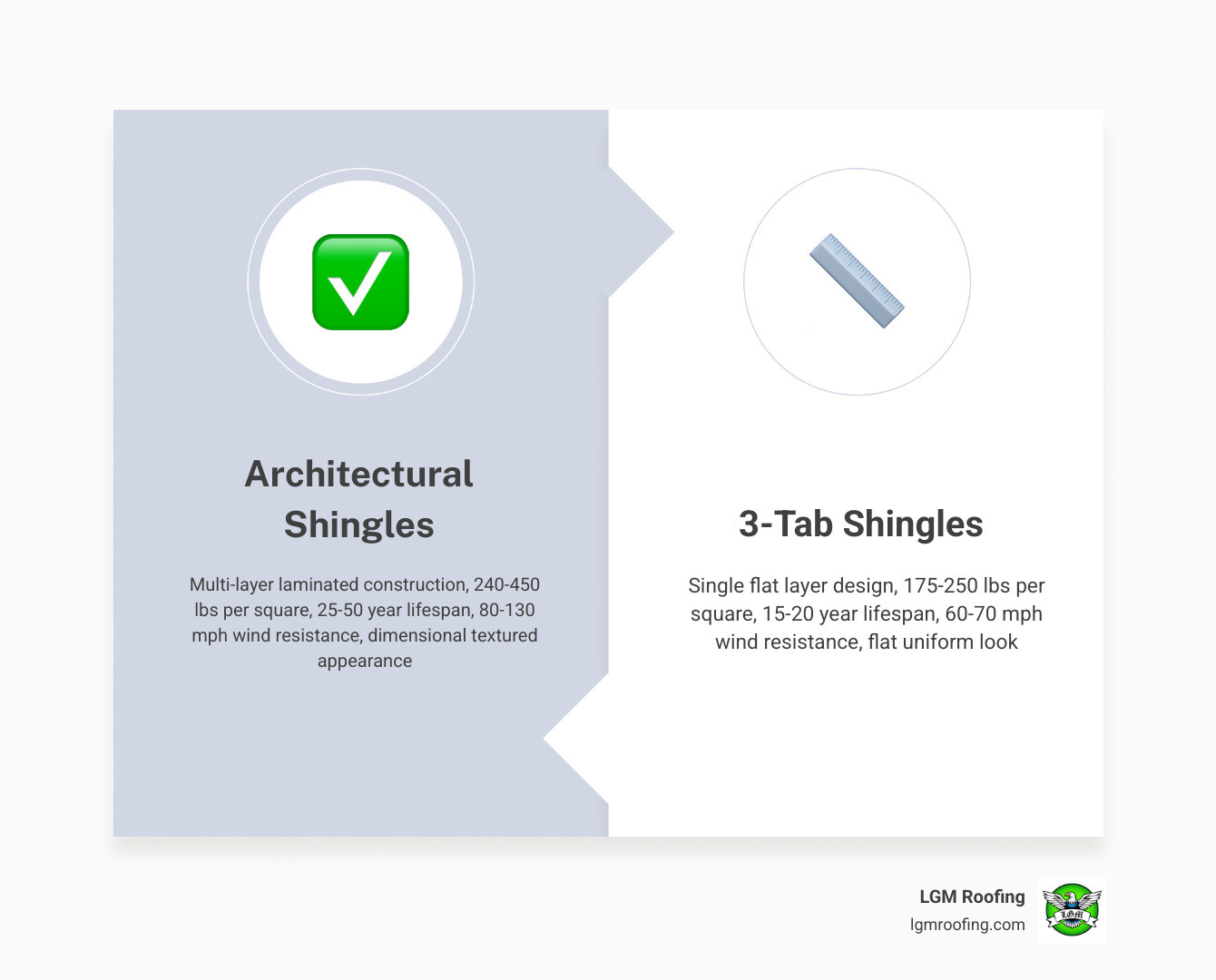
| Construction | Multi-layer laminated | Single flat layer |
| Weight | 240–450 lbs per square | 175–250 lbs per square |
| Lifespan | 25–50 years | 15–20 years |
| Wind Resistance | 80–130 mph | 60–70 mph |
| Appearance | Dimensional, textured | Flat, uniform |
| Warranty | 30–50 years (some lifetime) | 20–30 years |
Most homeowners don’t realize they’re even making this choice until the job is done — and by then, it’s too late to change course. Your shingle type affects how your roof looks from the street, how it holds up in a storm, and how soon you’ll need to replace it again. Whether you’re replacing an aging roof on your New Jersey home or making a decision for a rental property, getting this right matters more than most people think.
Architectural shingles now account for more than 90% of new asphalt shingle installations across North America — and there are good reasons for that shift. But 3-tab shingles still have a place in the right situation. This guide breaks down exactly what separates these two options so you can make a confident, informed decision.
I’m Darwin Mizhirumbay, founder of LGM Roofing and a second-generation roofing professional who has helped countless New Jersey homeowners navigate the architectural shingles vs three tab shingles difference firsthand. Growing up around the trade and now leading a GAF Master Elite certified company, I’ve seen how the right shingle choice protects a home for decades — and how the wrong one leads to premature replacements and costly regret.
Understanding the Architectural Shingles vs Three Tab Shingles Difference
To truly understand how these two options stack up, we have to look past the surface. At first glance, both are asphalt shingles designed to shed water and protect your home. However, their structural DNA is completely different.

When you look at a traditional 3-tab shingle, you are looking at a single, flat layer of material. It is manufactured as a continuous strip with two vertical cutouts stamped into the lower half. This design creates the illusion of three individual, uniform pieces (hence the name “3-tab”). When installed, they lay completely flat against your roof deck, forming a repeating, brick-like grid pattern.
Architectural shingles—also widely known as dimensional or laminated shingles—are engineered using a completely different philosophy. Instead of a single flat layer, architectural shingles are constructed by laminating two or more layers of asphalt together. The top layer is cut with varied, staggered shapes, leaving some areas thicker than others. This multi-layered construction gives the shingle physical depth, creating a rich, textured, three-dimensional profile on your roof.
Choosing the right profile is one of the most critical steps in planning your roof replacement. For a deeper look at your overall material choices, you can read our guide on how to Pick Your Shingle and Mingle with the Best Roofing Options.
Material Composition and the Architectural Shingles vs Three Tab Shingles Difference
The physical weight and composition of these materials directly impact their performance on your home. Because architectural shingles feature multiple fused layers, they are about 50% heavier than 3-tab shingles.
Specifically, architectural shingles weigh anywhere from 240 to 450 pounds per square (a “square” is a standard roofing term for 100 square feet of roof area). By comparison, lightweight 3-tab shingles weigh in at a modest 175 to 250 pounds per square.
This weight difference is a direct result of the materials used:
- Fiberglass Backing: Both shingles utilize a fiberglass mat as their core, but architectural shingles feature a significantly thicker, tougher fiberglass base mat.
- Refined Asphalt: Architectural shingles are coated with a higher grade of weather-resistant, polymer-modified asphalt. This premium asphalt retains its flexibility longer and resists cracking under intense thermal stress.
- Ceramic Granules: The colored mineral granules on the surface protect the asphalt from damaging ultraviolet (UV) rays. Architectural shingles feature a much denser application of these granules, providing superior protection against fading and physical wear.
- Adhesive Strength: Because they are heavier and thicker, architectural shingles require incredibly powerful, advanced laminating adhesives to bond the layers together. This extra-strength sealant also helps the shingles stick down firmly to the roof deck, preventing wind uplift.
Aesthetic Variations and the Architectural Shingles vs Three Tab Shingles Difference
Your roof can make up as much as 40% of your home’s visible exterior. That means the shingles you choose will have a massive impact on your property’s curb appeal and overall market value.
Because 3-tab shingles are thin and lay completely flat, they offer a very traditional, uniform look. While this clean, simple grid pattern works well on older, historic homes or minimalist structures, it lacks visual depth. Over time, as the shingles age and experience normal wear, this flat profile can look somewhat dated.
Architectural shingles, on the other hand, are designed to mimic the luxurious, high-end look of natural materials like hand-split cedar shakes or heavy slate tiles. The staggered tabs and varied thickness create natural shadow lines that give your roof a stunning, dimensional appearance.
This added depth does more than just look good—it actually hides minor imperfections in your roof deck. Furthermore, investing in this enhanced curb appeal can elevate your home’s exterior aesthetic so much that it can raise your overall property value by up to 7%. If you are preparing to sell your home in New Jersey towns like Wayne, Paterson, Bloomfield, or Piscataway, this visual upgrade can be a major selling point.
Durability, Lifespan, and Weather Resistance
Living in New Jersey means our roofs have to handle a bit of everything: heavy lake-effect snow loads, freezing winter ice dams, humid summer heat waves, and severe coastal windstorms. The physical differences between these shingles translate directly into how they perform when the weather turns ugly.
Because 3-tab shingles are lightweight and lay flat, they are highly susceptible to wind damage. Strong gusts can easily get underneath the thin edges of a 3-tab shingle, breaking the adhesive seal and folding the tab backward or tearing it off completely. Once a single tab tears away, water can seep into the exposed nail heads below, leading to quiet, hidden leaks that rot your roof deck.
Architectural shingles are far more robust. Their heavy, multi-layered design and superior wind-resistant adhesives make it incredibly difficult for high winds to catch the edges. In fact, premium architectural lines, such as GAF Timberline HDZ, feature specialized strike zones and advanced sealants that allow them to withstand hurricane-force wind gusts without budging.
To help protect your home’s long-term value, it is essential to understand the factors that impact your roof’s physical lifespan. You can explore this further in our article on Shingle Longevity 101 What Really Affects Your Roofs Life.
| Performance Metric | Architectural Shingles | 3-Tab Shingles |
|---|---|---|
| Average Lifespan (Mild Weather) | 25 to 35+ Years | 15 to 20 Years |
| Average Lifespan (Harsh NJ Weather) | 18 to 25 Years | 7 to 12 Years |
| Wind Resistance Rating | 110 to 130 mph (Some up to 150 mph) | 60 to 70 mph |
| Impact Resistance | Typically Class 4 (Excellent against hail) | Typically Class 3 (Moderate) |
| Algae/Fading Resistance | High (Denser granule distribution) | Moderate to Low |
Installation Considerations and Building Codes
When it comes to installing these materials, the process requires precision and an experienced hand. While both types of shingles are installed using nails and underlayment, the actual physical application differs.
Because 3-tab shingles must be perfectly aligned horizontally, vertically, and diagonally to keep the uniform grid pattern straight, there is very little room for error. If a installer is off by even a fraction of an inch early on, the entire roof will look crooked from the street.
Architectural shingles are much more forgiving during installation because their pattern is intentionally random and staggered. However, because they are 50% heavier, they require a sturdy, code-compliant roof deck to support the extra weight.
Additionally, New Jersey building codes dictate exactly how many layers of shingles can exist on a home. Homeowners often ask us if they can simply install a new layer of shingles over their old, worn-out roof to save on labor.
While code technically allows for up to two layers of asphalt shingles in many New Jersey municipalities, shingling over an existing roof is rarely a smart move. Installing heavy architectural shingles over an old, uneven layer of 3-tab shingles can cause the new shingles to lay awkwardly, preventing them from sealing properly and shortening their lifespan.
To learn more about the risks and benefits of this approach, read our detailed guide: Is Shingling Over Your Old Roof a Smart Move?.
If you are wondering about the legal limits of layering roofing materials in your local town, check out our resource on How Many Shingle Layers Are Actually Allowed by Code?.
Frequently Asked Questions About Asphalt Shingles
Choosing the right roofing system is a major investment, and we want to make sure you have all the facts. Many homeowners weigh asphalt against other premium materials during their research. If you’re curious about how asphalt stacks up against alternative materials, you can read our comprehensive breakdown: The Great Roofing Debate Metal vs Asphalt Shingles.
Below are some of the most common questions we hear from homeowners in Wayne, Paterson, Bloomfield, and Piscataway regarding the architectural shingles vs three tab shingles difference.
Which shingle type is better for severe weather?
Architectural shingles are far superior for severe weather. Thanks to their heavy weight, double-layer laminated construction, and high-quality asphalt, they easily outperform 3-tab shingles in every major weather category:
- Wind: While 3-tab shingles are only rated for winds up to 60 or 70 mph, architectural shingles can handle gusts ranging from 110 to 130 mph (and up to 150 mph with specialized installation methods).
- Hail and Impact: Architectural shingles typically carry a higher impact resistance rating, meaning they are much less likely to crack or lose protective granules when hit by hail or falling branches.
- Snow and Ice: The thick, multi-layered design of architectural shingles provides better resistance against the physical weight of heavy snow and the destructive freeze-thaw cycles that cause winter ice dams in New Jersey.
How do warranties compare between dimensional and 3-tab shingles?
Because manufacturers know that architectural shingles are built to last, they back them with significantly stronger warranties.
Traditional 3-tab shingles typically carry manufacturer warranties ranging from 20 to 30 years. However, these warranties are often heavily prorated after the first few years, meaning the manufacturer covers less and less of the replacement cost as the roof ages.
Architectural shingles usually come with minimum warranties of 30 to 50 years, with many premium lines offering lifetime coverage.
Furthermore, because LGM Roofing is a GAF Master Elite certified contractor, we can offer exclusive, top-tier GAF warranties—like the Golden Pledge Limited Warranty. This provides 50 years of non-prorated material coverage and up to 25 years of workmanship coverage backed directly by GAF, the largest roofing manufacturer in North America. This level of protection is simply unavailable on standard 3-tab shingle installations.
Can you mix architectural and 3-tab shingles on the same roof?
Technically, you can use both on the same home, but we strongly advise against it for several reasons:
- Aesthetic Clash: Mixing flat, uniform 3-tab shingles with thick, textured architectural shingles creates a highly disjointed, unappealing look that will hurt your home’s curb appeal.
- Unequal Lifespans: If you patch an architectural shingle roof with 3-tab shingles during a repair, those repaired areas will fail and wear out much faster than the rest of the roof.
- Slope and Structural Differences: While 3-tab shingles are sometimes used as starter strips along the eaves or cut up to use as ridge caps, modern roofing systems utilize specialized, pre-cut starter strips and heavy-duty ridge cap shingles specifically engineered to match the wind rating of your architectural shingles.
Conclusion
When deciding on the right material for your home, the architectural shingles vs three tab shingles difference comes down to balancing your immediate budget against your long-term goals.
If you own a rental property, a detached garage, or plan to sell your home within the next few years and need a quick, cost-effective replacement, 3-tab shingles can be a practical choice. But if you are investing in your primary residence and want a roof that will protect your family, enhance your curb appeal, and last for the next three decades, architectural shingles are undoubtedly the superior choice.
At LGM Roofing, we bring over 25 years of construction and roofing experience to every single home we touch in Wayne, Paterson, Bloomfield, Piscataway, and across New Jersey. As a trusted GAF Master Elite certified contractor, our commitment to excellence, exceptional local service, and rock-solid warranties ensure your home is fully protected against whatever the New Jersey weather throws our way.
Before you make your final decision, it’s highly beneficial to understand the difference between simply installing a new layer of shingles and committing to a complete roof replacement. We break down everything you need to know in The Shingle Truth Reroofing vs Full Tear Off Comparison.
Ready to upgrade your home with a roof built to last? Explore our full range of professional services on our LGM Roofing Services page, or contact us today to schedule a comprehensive roof inspection and get a detailed, professional recommendation tailored to your home.
Ready for a roof you can trust?
Get a free, no-pressure estimate. Family-owned since 2006, GAF Master Elite, and rated 4.9 by 130 homeowners on Google.